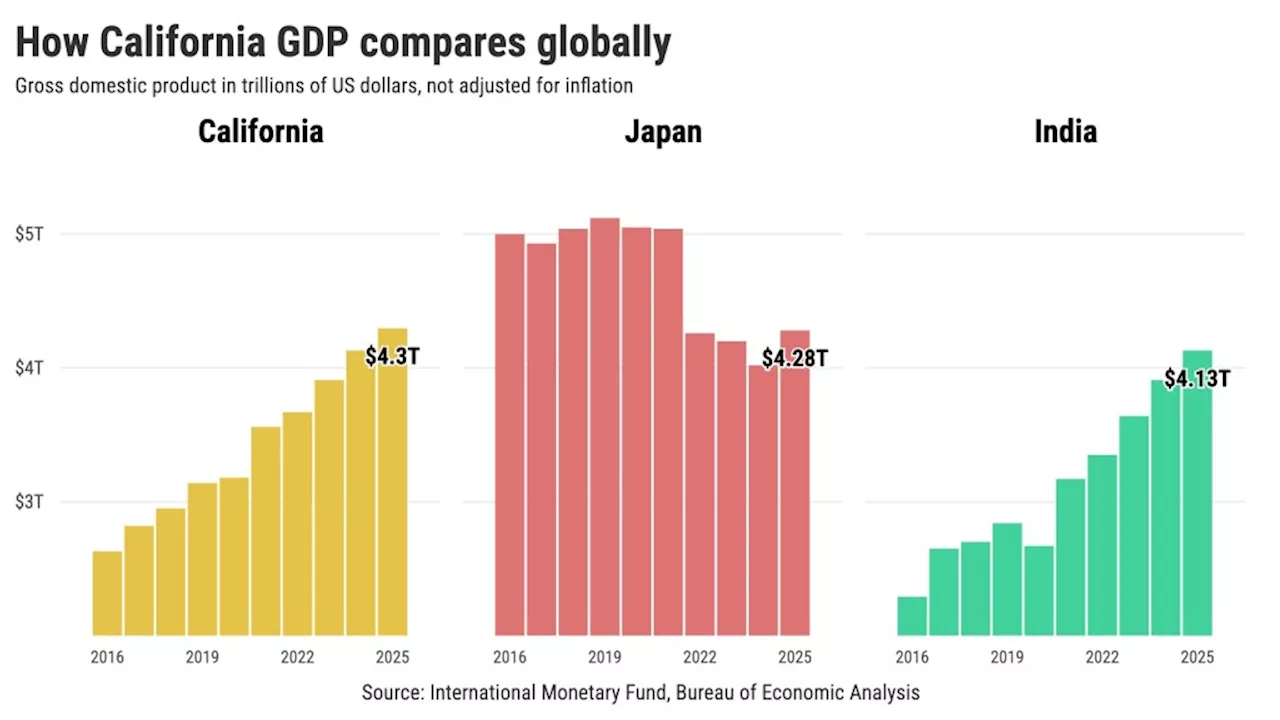
California is currently experiencing a significant economic surge, with its gross domestic product (GDP) reaching an annual rate of $4.296 trillion in the third quarter of 2025. This figure reflects a robust 4.5% increase compared to the previous year and positions the state in a competitive race for the title of the fourth-largest economy in the world. California’s economic output now surpasses Japan’s, which stands at $4.28 trillion, by a narrow margin of $16 billion. The ongoing competition for this ranking is influenced by various factors, including currency valuations and the rapid growth of other economies, particularly India.
As the International Monetary Fund (IMF) prepares to release its updated projections in April, the dynamics of this competition are becoming increasingly complex. India’s economy is valued at approximately $4.125 trillion, making it a formidable contender. With a gap of about $300 billion—roughly 7%—between California and its closest rivals, the state’s position remains precarious, especially given India’s rapid economic expansion driven by its large population.
California’s economic trajectory has been notable since it achieved the designation of the fifth-largest economy worldwide in 2017 and subsequently moved up to fourth place in 2024. Nonetheless, while the state boasts impressive aggregate economic performance, individual financial experiences vary significantly. For instance, the consumer confidence index in California reached a five-year low in January, highlighting the need for a nuanced understanding of the state’s economic health beyond mere GDP figures.
Comparative Growth and State-Level Analysis
Examining California’s economic performance in detail reveals a mixed picture. The state’s recent GDP growth of 4.5% annually marks the fastest rate in over two years, yet it ranks 25th among U.S. states. In contrast, Texas recorded a growth rate of 4.2%, placing it 32nd, while Florida saw a 3.5% increase, ranking 42nd. Notably, several Midwestern states have outperformed California, with Kansas at 6.5%, South Dakota at 6.3%, and Arkansas at 5.8%.
Over the two years leading up to the second quarter of 2025, California’s average GDP growth was 2.9%, which ranked 15th among U.S. states. When assessing changes in growth rates, California surged by 1.6 points in the third quarter of 2025 compared to its previous two-year average, placing it 32nd nationally. States such as Kansas, South Dakota, Connecticut, and New Hampshire experienced more significant improvements during the same period.
These varied economic indicators illustrate the complexities of California’s economic landscape. While the state continues to lead in total economic output, the competition for ranking among other global economies remains fierce, requiring stakeholders to consider multiple factors when evaluating economic performance.
In summary, California’s economy is currently navigating a dynamic period characterized by impressive growth figures and fierce competition for global ranking. As the state continues to expand its economic footprint, the implications for its residents and businesses will depend significantly on the interplay of various economic factors and competitors on the world stage.