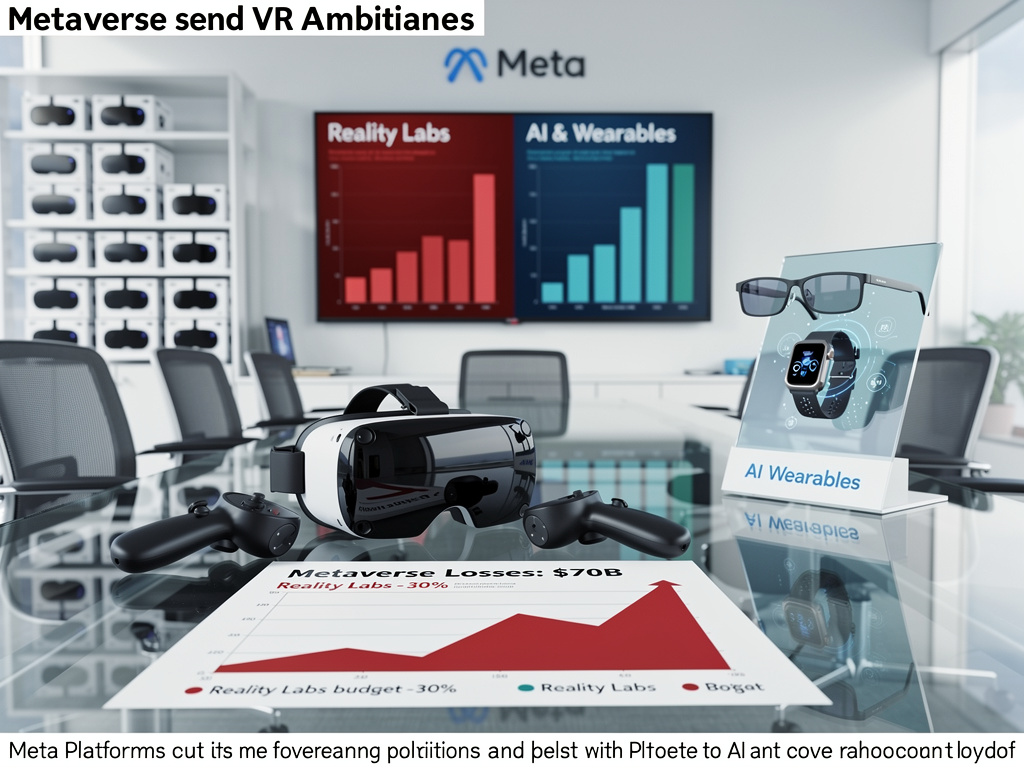
Mark Zuckerberg’s ambitious vision for the metaverse is facing a significant setback as Meta Platforms Inc. plans to reduce budgets for its Reality Labs division by as much as 30% in 2026. This decision, reported by multiple sources, marks a pivot away from expansive virtual reality projects towards more pragmatic investments in artificial intelligence and consumer wearables. The shift comes after the company has reported staggering losses exceeding $70 billion since its rebranding from Facebook in 2021.
The Reality Labs division, tasked with developing Meta’s metaverse initiatives, has struggled to gain user traction despite extensive marketing efforts. Products such as Horizon Worlds and the Quest VR headset line have seen disappointing adoption rates, prompting internal discussions about budget cuts and possible layoffs as early as January 2024, according to Bloomberg.
Financial Implications and Market Reactions
Meta’s Reality Labs reported an operating loss of $4.7 billion in the third quarter alone, contributing to cumulative losses that have exceeded $70 billion since 2021. The company’s focus on virtual and augmented reality, marked by Zuckerberg’s bold announcement of a $10 billion annual spend on Reality Labs, has raised concerns among investors, particularly as consumer interest in VR headsets has waned.
Despite modest growth in Quest headset sales, the market demand has not reached expected levels. Horizon Worlds, Meta’s flagship virtual social platform, has seen engagement drop significantly, with monthly active users remaining below 1 million. This decline has caught the attention of Wall Street, where Meta’s stock, initially buoyed by metaverse excitement, has rallied on the strength of artificial intelligence developments.
The impending budget cuts have caused Meta’s shares to rise by 3%, reaching approximately $620 on December 4, 2023, signaling investor relief from the ongoing financial drain associated with the metaverse.
Shifts in Strategy and Leadership Changes
Internal discussions about budget reductions intensified following reports that Zuckerberg privately acknowledged that the metaverse initiative “is not working.” This shift in perspective has led to a reallocation of resources towards more promising ventures, including AI-driven projects such as the Llama models and partnerships with companies like Apple for wearable technology.
Meta is also undergoing a broader efficiency drive, having already laid off 21,000 employees since 2022. With Reality Labs employing over 10,000 staff, further layoffs are expected as part of the ongoing cost-cutting measures. The focus has now shifted towards developing wearables, with plans for products like Orion AR glasses taking precedence.
Meta’s commitment to artificial intelligence represents a strategic pivot, as the company aims to compete in the rapidly evolving AI landscape against companies like OpenAI and Google. As Reality Labs adjusts its focus, the division’s annual spending, estimated at $20 billion, will come under scrutiny during future budget assessments.
While Zuckerberg has made it clear that Meta is not entirely abandoning the metaverse, the company is emphasizing a more disciplined approach. Executives are now looking to integrate augmented reality experiences rather than focusing solely on standalone metaverse worlds.
The broader implications of Meta’s realignment are being felt across the extended reality (XR) industry, where competitors such as Apple and Microsoft are also facing challenges in consumer adoption of their respective products. Observers note that Zuckerberg’s pivot towards AI validates its emerging dominance, particularly as the company’s advertising business continues to generate significant revenue, exceeding $150 billion annually.
Looking ahead, Meta remains committed to research and development within the metaverse space, targeting lightweight AR devices for everyday use. Partnerships with companies like EssilorLuxottica on smart glasses illustrate this evolution, combining AI assistants with user-friendly designs.
As the company prepares for further announcements, including updates during Zuckerberg’s upcoming earnings call, the future trajectory of Reality Labs remains a critical focus for investors and industry observers alike. The outcome of these strategic shifts may ultimately determine Meta’s position in the competitive landscape of technology and innovation.