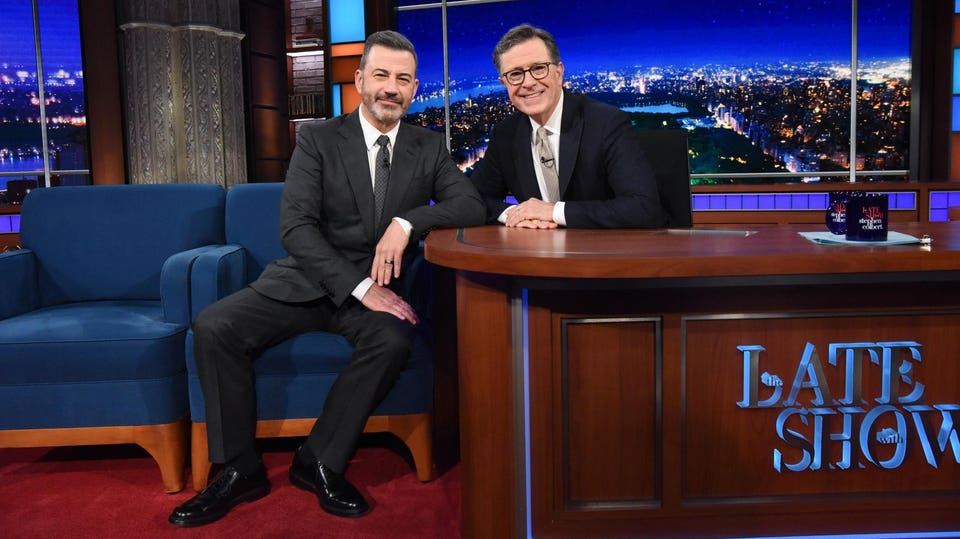
Late-night television hosts Jimmy Kimmel and Stephen Colbert have publicly criticized the Federal Communications Commission (FCC) for its recent enforcement of the “equal time” rule, which mandates that media networks provide equal opportunities for political candidates to appear on their platforms. During their respective shows on Thursday, both Kimmel and Colbert described this move as a restrictive measure aimed at limiting their freedom of expression.
Kimmel first addressed the FCC’s notice during his Wednesday monologue, claiming that President Donald Trump was waging a “war on talk shows.” He referred to the FCC’s chair, Brendan Carr, as “Brendan Cartel” and accused the agency of “reinterpreting long-agreed-upon rules to stifle us.” Kimmel explained that the “equal time” rule was originally established during a period when radio was the dominant broadcast medium, and later applied to television. He highlighted that late-night shows have operated under an exemption from this rule since 2006, following the appearance of former California Governor Arnold Schwarzenegger on “The Tonight Show.”
Kimmel expressed concern that Carr’s actions were an effort to silence opposing viewpoints, stating, “He is doing everything he can to shut us up the easy way or the hard way.” The late-night host emphasized the declining viewership of broadcast television, noting that it has fallen from accounting for 100% of viewing to approximately 20%. He pointed out that networks like Fox News, Newsmax, and One America News Network continue to deliver extensive coverage favoring Trump, underscoring the uneven playing field in political discourse.
In a subsequent segment, Colbert reacted to the FCC’s announcement and its implications for his show. He acknowledged the potential risks of discussing the new enforcement, humorously stating, “I got to watch what I say about Trump, because Johnny Law is once again coming after yours truly here.” Colbert referenced a New York Times headline that described the FCC’s actions as a “new crackdown on late-night TV,” joking about the timing of this development as CBS has chosen not to renew his show for another season.
Colbert’s remarks included a direct address to the FCC, where he sarcastically expressed gratitude for the perceived influence of his show on political matters. “I’ve been doing this job for 21 years,” he said, “and let me tell you something, buddy, if our government had turned out the way I had chosen, you would not have the power to make this announcement.”
The FCC’s enforcement of the “equal time” rule has sparked a broader conversation about media freedom and the role of late-night shows in political commentary. As Kimmel and Colbert continue to challenge these regulations, they raise important questions regarding the balance between fair political representation and the freedom of expression in the media landscape.