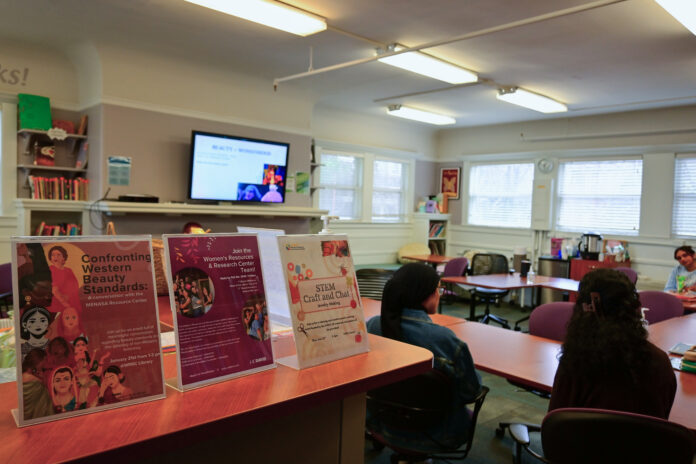
On January 21, 2024, students gathered at the Joy Fergoda Library for “Confronting Western Beauty Standards: A Conversation with The MENASA Resource Center.” Co-hosted by the Women’s Resources and Research Center (WRRC) and the Middle Eastern North African and South Asian (MENASA) Resource Center, the event aimed to explore the impact of Western beauty ideals on femininity and identity.
The discussion featured insights from scholars associated with both centers, who emphasized how Western beauty standards shape societal expectations and contribute to the “othering” of non-Western femininity. The MENASA Resource Center, located on the second floor of the Student Community Center, provides resources for academic and interpersonal support, leadership opportunities, and community engagement.
“The MENASA Resource Center provides holistic support for communities by fostering belonging, support, and empowerment,” stated an anonymous scholar staff member. The WRRC similarly serves as a vital resource for students challenging systems of oppression and promoting gender equity. Open from 10 a.m. to 5 p.m. on weekdays, the WRRC encourages dialogue on gender and social justice through various workshops and events.
During the event, attendees engaged in a reflective conversation about how Western beauty standards influence not only self-image but also access and opportunities in various social contexts. According to research published in the *International Journal of Gender and Women’s Studies*, these standards often promote unattainable ideals, which can erode cultural and individual differences.
Ashley Hanks, a second-year sociology major and community organizer at the WRRC, articulated the connection between beauty and assimilation to whiteness. “Western beauty defines beauty as an assimilation to whiteness,” she explained. “These standards are reinforced through social interactions and media representations, impacting how we internalize and project our identities.”
The discussion also highlighted the power dynamics associated with beauty. Journalist Leah Donnella noted in an NPR article that beauty can serve as a form of power, influencing one’s access to opportunities and spaces. “Being considered beautiful can help you gain access to certain spaces or increase your power in certain settings,” Donnella wrote.
Participants reflected on how Western cultural definitions of beauty disproportionately affect women of color and ethnic communities. “In Western culture, beauty is the paramount value of womanhood,” Hanks remarked. “The opposite is portrayed in Disney villains, where ‘ugliness’ is synonymous with evilness and worthlessness. This narrative often emphasizes features associated with MENASA identities.”
The event also examined how women of color, particularly within the MENASA community, navigate these societal pressures. Sabrina Sandhu, a second-year psychology major and WRRC community organizer, shared her perspective on cultural resilience. “Resilience exists in the small moments,” she said. “Wearing my jhumkas helps me represent my culture. I encourage others to embrace their cultural identity, as these small actions can significantly enhance self-expression.”
Organizers Hanks and Sandhu aimed for attendees to leave with a nuanced understanding of the intersection between beauty and power structures. Hanks emphasized the importance of conversation in challenging internalized beauty standards. “These discussions create a safe space for exploration and curiosity,” she said. “They help us address the consciousness of self-hatred that often develops from a young age.”
As the conversation unfolded, attendees shared personal experiences and connected with each other beyond the formal discussion, forming plans to attend future events together. “These conversations create community,” Sandhu noted. “It’s heartening to see friendships form over shared experiences and cultural adaptations.”
The MENASA Resource Center and the WRRC plan to host additional events in the coming weeks. Students can participate in MENASA’s “Connection Hour: Matcha & Muffins” social on February 6, a “Palentine’s Mug Making” workshop on February 10, and a Career Panel on February 24. The WRRC will also hold a workshop titled “Invisible Labor: Strategies to Protect Your Emotional Energy” on February 5 at the Cross Cultural Center Community Lounge, along with their fourth annual “We Rise Retreat” scheduled from February 27 to March 1.