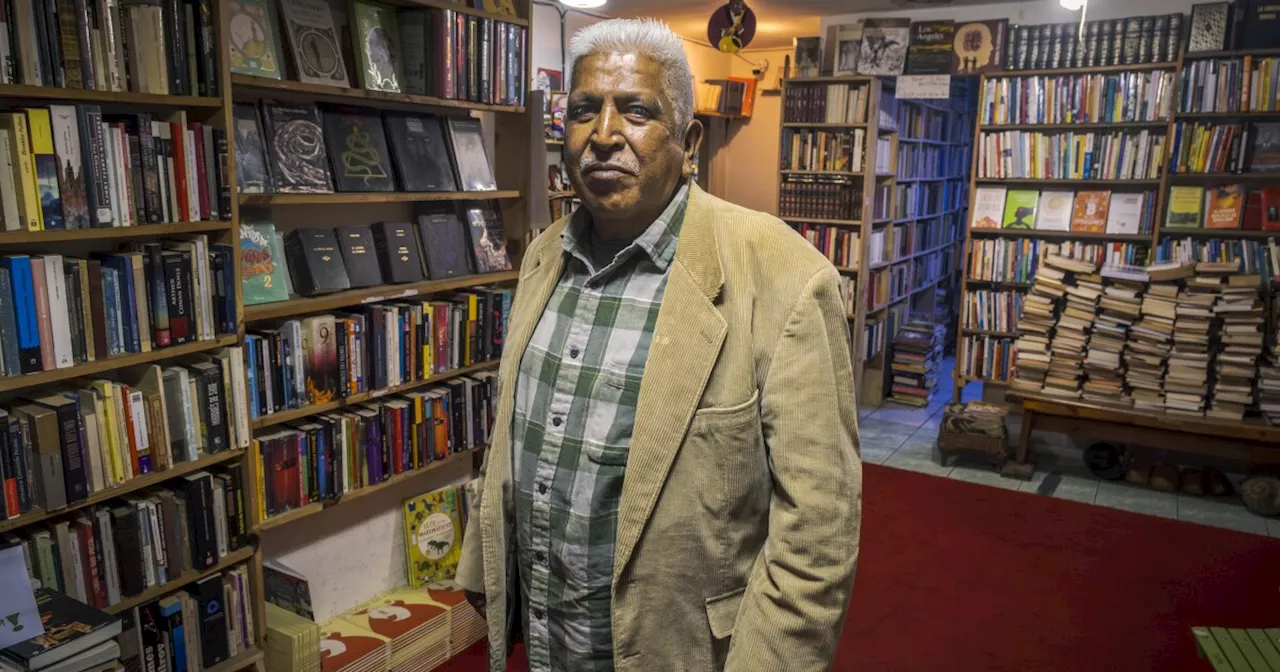
Miguel Márquez San Juan, the founder of Libros, Café y Jazz, is being honored for his significant contributions to the cultural landscape of Tijuana. For over 16 years, he created a vibrant community hub that seamlessly combined literature, music, and social interaction. On October 18, 2024, friends and patrons gathered to celebrate his legacy and the bookstore’s lasting impact.
Márquez, who moved to Tijuana in 1984, has transformed a modest space into a cherished venue located just two blocks off Avenida Revolución. As he navigates a narrow alleyway, the lively sounds of Tijuana fade, replaced by the soothing melodies of jazz. A small yellow sign hangs above the entrance to Libros, Café y Jazz, inviting passersby into a world where books and music coexist harmoniously.
Inside, the atmosphere reflects Márquez’s passion for the arts. Surrounded by shelves filled with books, he often plays “Kind of Blue” by Miles Davis while reading from the celebrated Mexican novel “Pedro Páramo.” The film adaptation of this classic, featuring actor Manuel García-Rulfo, is scheduled to premiere on November 6, 2024.
“Vine a Comala porque me dijeron que acá vivía mi padre, un tal Pedro Páramo. Mi madre me lo dijo y yo le prometí que vendría a verlo como es en cuanto ella muriera,” Márquez recited, drawing connections between the book’s themes and the community he has nurtured.
The bookstore, co-managed with his daughter, Citlali Márquez Solórzano, has become a beacon for literature enthusiasts in Tijuana. It offers a diverse selection of used books, from secondhand music CDs to unique titles like “Bedtime Stories for Rebellious Girls.” The store also features a poetry vending machine, allowing visitors to purchase poems for just five pesos, further enriching the literary experience.
While Tijuana has several libraries, few provide the opportunity for readers to take books home. The Central Cultural Tijuana (CECUT) offers a space for reading but does not allow checkouts. Daniel Togliatti, CECUT’s press coordinator, emphasized the importance of both institutions in fostering a creative environment. “Part of the mission of the Central Cultural Tijuana is to share this space for writers from the region,” Togliatti explained.
He added, “They feel inspiration and the possibility of new, different worlds in this communication between the writer and the reader.” Togliatti compared the relationship between CECUT and Libros, Café y Jazz to two vehicles traveling along the same road, sometimes at the same speed, both supporting Tijuana’s artistic community.
Márquez continues to engage the public with events such as jazz performances. “For example, this coming Sunday or Saturday—we’ll have a group of jazz musicians here, and 20 to 30 people typically attend,” he shared, highlighting the ongoing commitment to community engagement.
The story of Libros, Café y Jazz is one of resilience and creativity, reflecting the spirit of Tijuana. As Miguel Márquez San Juan’s influence endures, the bookstore remains a vital part of the city’s cultural narrative, ensuring that literature and music will continue to thrive in this vibrant community.