In an unexpected twist during the lead-up to the **2026 Winter Olympics** in **Cortina d’Ampezzo**, Italy, social media has exploded with videos of people using household items as makeshift curling stones. From pots and mop buckets to even babies in car seats, creativity knows no bounds as amateur curlers attempt to mimic the sport’s professional techniques.
American curler Tara Peterson noted the phenomenon, stating, “Every four years, it blows up. Everyone’s like, ‘We want to do it,’ and then, yes, they get creative with things, so it’s awesome.” This creativity is evident in various videos circulating online, including one featuring a couple joyfully pushing a baby in a car seat across the ice, and another showing Swedish comedian Mans Moller hilariously impersonating champion Isabella Wrana while sliding pans and shouting “CUUUURL!”
In the southern **Puglia** region of Italy, local grandmothers, or nonnas, have joined the fun, pushing silver pots along stony courtyards while sweeping with broomsticks. Meanwhile, in **Sundsvall**, Sweden, a stylist playfully hurls hair products at a colleague, only to be met with a curling iron, humorously blurring the lines between hairstyling and curling.
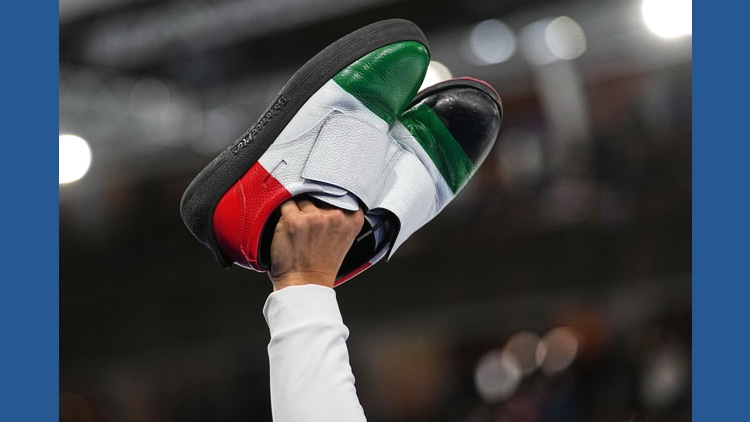
While these efforts are spirited, seasoned curlers emphasize the importance of specialized equipment for serious play. Standard sneakers, for instance, are not suitable for curling, as they offer little grip on ice. Instead, curlers must invest in specialized shoes, which can cost up to **$700**. The shoes often feature unique designs, as seen with Taylor Anderson-Heide of the United States, who opted for a casual white sneaker style during the Games.
Understanding Curling Equipment
Another critical component of curling is the broom. Unlike conventional cleaning brooms, curling brooms use lightweight materials such as carbon fiber and nylon pads to enhance performance. Peterson explained that high-quality brooms can cost between **$200 and $250**. The weight of the broom directly influences a curler’s ability to control the stone’s speed and trajectory.
This technology has advanced significantly over the years, leading to controversies such as the “Broomgate” scandal that began in **2015**. Some high-tech brooms offered an unfair advantage by allowing sweepers to manipulate stones with precision, prompting **World Curling** to impose strict regulations on broom specifications.
The Origins of Curling Stones
Despite the lighthearted attempts to redefine curling stones, nothing compares to the traditional stones used in professional matches. The official stones at the **Cortina** Games are crafted from **Ailsa Craig**, an uninhabited isle **10 miles (16 kilometers)** off the coast of **Scotland**. The granite from this island is renowned for its density and quality, making it ideal for curling stones.
The production of these stones comes from **Kays Curling**, a company with a rich history in the sport that dates back to the first Winter Olympics in **1924**. Originally considered an exhibition event, curling has since been recognized as an official medal sport since it was reinstated in **Nagano 1998**.
As the excitement builds for the upcoming Winter Olympics, the blend of traditional curling and creative adaptations showcases the sport’s accessibility and appeal. While anyone can grab a pot or a mop and join in the fun, the essence of curling remains rooted in its specialized equipment and the skill of its players. Whether on the ice in **Cortina** or a backyard in **Sundsvall**, curling continues to unite people through creativity and competition.