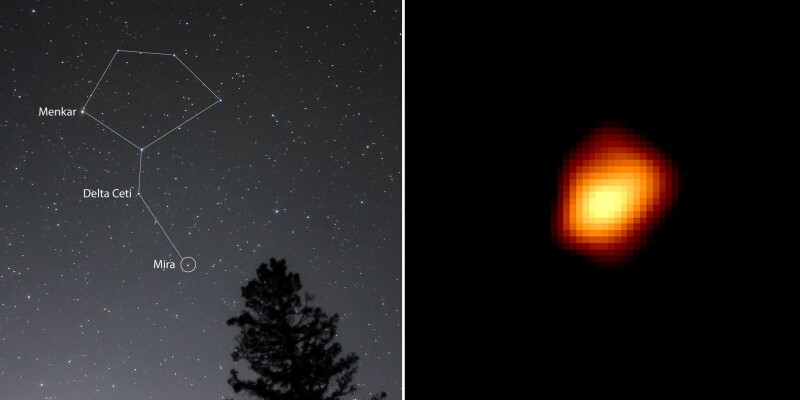
Last week, astronomers and stargazers alike were delighted to observe the star Mira, also known as “the Wonderful,” as it began to brighten in the night sky. Located in the constellation Cetus, Mira is known for its dramatic variations in brightness, which are due to its physical changes in size and temperature. This pulsating star, first documented by Polish astronomer Johannes Hevelius in 1662, has become a focal point for celestial observation as it approaches its peak brightness.
Mira has an 11-month cycle during which it fluctuates from a dim magnitude of approximately 10.0, below the visible limit for the naked eye, to as bright as magnitude 3.0, comparable to the stars of the Big Dipper. Currently, as of January 4, 2024, it shines at magnitude 3.5, making it about two and a half times fainter than the brightest stars in that constellation. Astronomers anticipate that Mira will reach its maximum brightness in early February 2024.
Understanding Mira’s Unique Behavior
Mira is notable for being the first pulsating variable star ever discovered. Its brightness changes as it physically expands and contracts, akin to the process of human breathing. At its smallest, Mira measures around 300 times the size of our Sun but can swell to more than 700 times its size when fully expanded.
This unique behavior results from an imbalance in the core of the star, which has aged and exhausted its primary hydrogen fuel. As a consequence, Mira undergoes cycles of contraction and expansion. During the contraction phase, the star becomes hotter and brighter before it expands again, shedding billions of tons of gas and dust into space.
As the full moon wanes and clears the evening sky, observers in darker areas away from city lights should find it easier to spot Mira. With a detailed star map, amateur astronomers can locate this celestial wonder with relative ease. The star’s brightening offers a rare opportunity to witness its dynamic nature over the coming weeks.
Reflecting on Celestial Futures
The changes in Mira may provide insight into the eventual fate of our own Sun. As stars like Mira age, they transition from stable hydrogen burning to utilizing heavier elements for energy production, leading to a similar pattern of expansion and instability. Observing Mira’s brightness fluctuations serves as a reminder of the natural cycles that govern stellar evolution.
As Mira continues to brighten, both seasoned astronomers and casual observers are encouraged to take note of this remarkable star. Each glimpse into its changing luminosity not only captivates the imagination but also deepens our understanding of the cosmos and our own place within it.