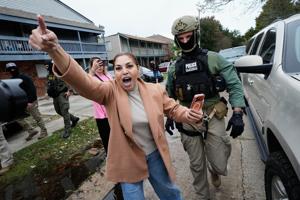
State and federal authorities are actively monitoring online discussions related to the immigration crackdown in New Orleans, known as “Catahoula Crunch.” Law enforcement records reviewed by The Associated Press reveal that officials are tracking social media for threats against agents while assessing public sentiment regarding the recent arrests.
The operation commenced last week, yet details about the initial arrests have been limited. This has led to demands for increased transparency from local officials who feel excluded from the process. “Online opinions remain mixed,” stated a briefing circulated to law enforcement. “Some support the operations, while others are opposed.”
The law enforcement records indicate that less than one-third of the 38 individuals arrested during the first two days had criminal histories that extended beyond minor offenses. Local leaders, including New Orleans City Council President J.P. Morrell, expressed concern that the arrests do not align with the stated goal of targeting violent offenders. Morrell noted, “There’s literally no information being given to the city of New Orleans whatsoever,” raising questions about the intentions behind the crackdown.
Authorities have framed the operation as a measure to remove “criminal illegal aliens.” However, as of now, the U.S. Department of Homeland Security (DHS) has publicly confirmed only six arrests, all of whom reportedly have criminal records. Among these individuals is one who was convicted of homicide and another convicted of sexual assault. The agency aims to make at least 5,000 arrests in the region over the course of this operation, expected to last up to two months.
Local officials, including State Senator Royce Duplessis, criticized the crackdown as more focused on instilling fear rather than ensuring public safety. Duplessis stated, “It confirms what we already knew — this was not about public safety; it’s about stoking chaos and terrorizing communities.”
Concerns have also been raised about the potential chilling effect of online surveillance on free speech. Law enforcement agencies are monitoring social media for posts that could interfere with immigration enforcement, warning that anyone who obstructs these operations could face charges.
In a statement, DHS spokesperson Tricia McLaughlin emphasized the need for a safe environment, asserting that “Americans should be able to live without fear of violent criminal illegal aliens harming them.” Despite this, records reviewed indicate that only nine of the arrested individuals had criminal histories that warranted serious concern.
The intelligence gathering involves collaboration between various law enforcement agencies, including the FBI and Customs and Border Protection, stationed at the Louisiana State Analytical and Fusion Exchange. This center has been monitoring discussions on platforms like Reddit, where local residents share information about the raids. Briefings noted that some community members have accused agents of targeting specific racial groups, particularly in areas with significant Hispanic populations.
Local activists, including those associated with groups like Union Migrante and Indivisible NOLA, have condemned the surveillance efforts. Activist Rachel Taber stated, “We are not doing anything illegal,” while Beth Davis, a spokesperson for Indivisible NOLA, expressed disbelief that authorities feel threatened by community organizers.
As this operation unfolds, the tension between law enforcement and local communities continues to grow. The surveillance of public sentiment and online activism highlights the complexities surrounding immigration enforcement and community relations in New Orleans.