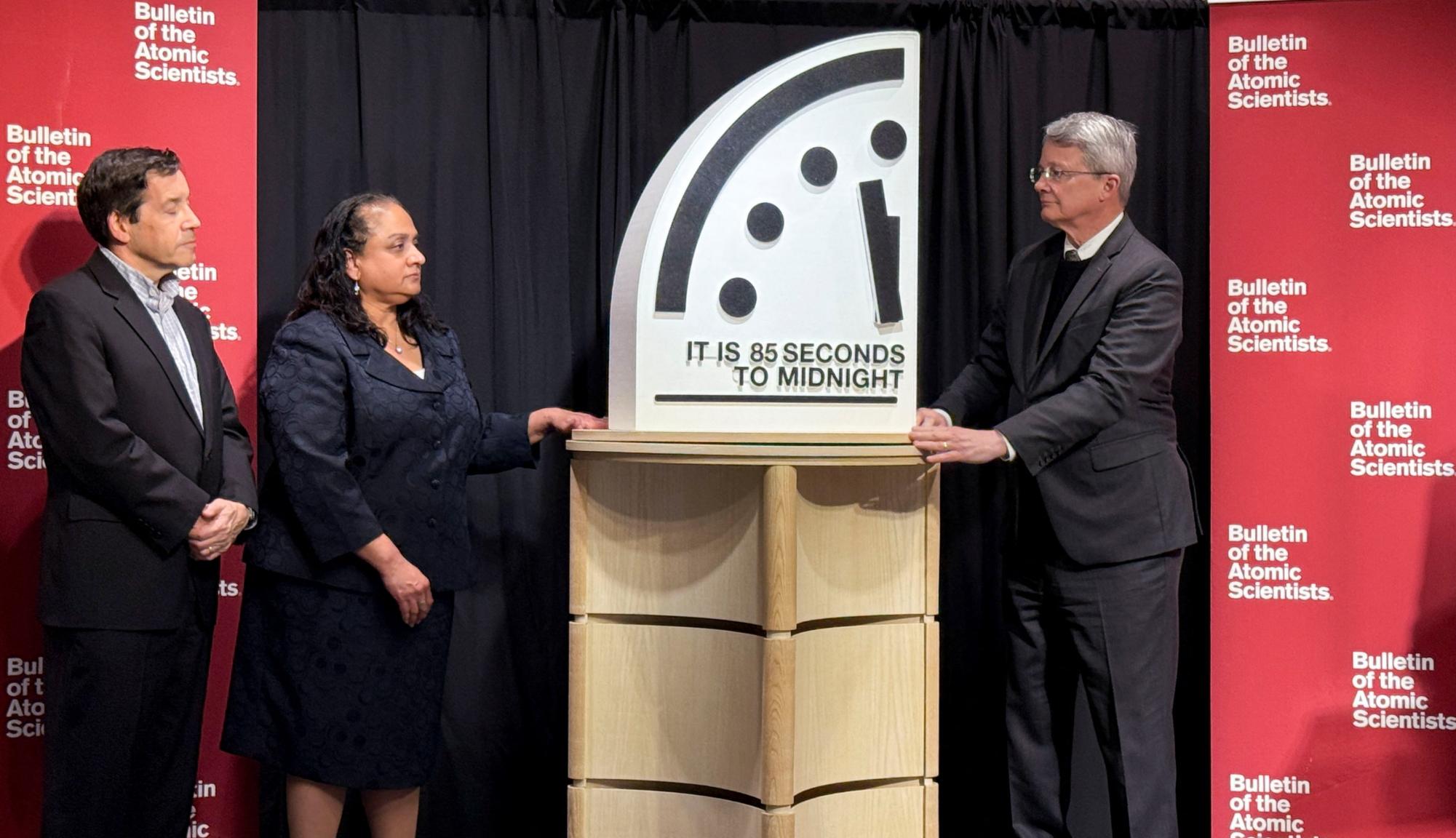
The Doomsday Clock has been set to **85 seconds to midnight**, signaling that humanity is closer to catastrophic destruction than ever before. This alarming announcement was made during a town hall meeting in Washington, D.C. on **January 27, 2026**, by experts including **Jon Wolfsthal**, director of global risk at the Federation of American Scientists, and **Asha George**, executive director of the Bipartisan Commission on Biodefense.
The **Bulletin of the Atomic Scientists**, which manages the clock, emphasizes that this time setting reflects the growing threats posed by nuclear weapons, geopolitical tensions, and the rapid advancement of artificial intelligence. The clock serves as a symbolic representation of the impact of human actions on global safety, illustrating the urgent need for international cooperation.
Experts are urging world leaders to take immediate action. According to **Alexandra Bell**, President and CEO of the Bulletin of the Atomic Scientists, there has been a significant decline in global cooperation regarding nuclear risks. She noted, “In terms of nuclear risks, nothing in 2025 trended in the right direction… Cooperation is on the decline, and we are running out of time.”
The origins of the Doomsday Clock date back to **1947**, when it was created by renowned physicists including **Albert Einstein** and **Robert J. Oppenheimer**. It was designed to reflect the dangers posed by nuclear weapons after World War II. Since then, the clock has undergone numerous adjustments based on global events and risks.
Historical Context and Significant Events
The clock has moved back and forth over the decades, with its history marked by notable crises and moments of cooperation. Here are some pivotal events that have influenced its time setting:
– **1949**: The Soviet Union conducts its first nuclear test, prompting the onset of the arms race, and the clock is set to **3 minutes** to midnight.
– **1963**: Following the Cuban Missile Crisis, the Partial Test Ban Treaty is signed, allowing the clock to move back to **12 minutes**.
– **1987**: The Intermediate-Range Nuclear Forces Treaty is established, resulting in a significant reduction of nuclear weapons and setting the clock at **6 minutes**.
– **1991**: The end of the Cold War leads to substantial nuclear disarmament, with the clock set at **17 minutes** to midnight, the furthest from catastrophe.
Recently, the clock has ticked closer to midnight than ever. In **2020**, it was adjusted to **100 seconds** as humanity grappled with the dual threats of climate change and nuclear conflict. This was followed by further escalations, with the clock advancing to **90 seconds** in **2023** due to the war in Ukraine and other global instabilities. In **2025**, it was set to **89 seconds** as global leaders failed to address the growing risks effectively.
The Current Landscape of Global Threats
The latest adjustment to **85 seconds** highlights several pressing issues: the proliferation of nuclear weapons, the challenges posed by climate change, and the unchecked development of artificial intelligence in military contexts. The Bulletin of the Atomic Scientists stresses that these factors have intensified the risks of global annihilation.
Joseph Davila, a student attending the Washington town hall, expressed his fears, stating, “To me, Doomsday is the metaphorical end of the Earth being livable.” His sentiment reflects a growing anxiety among younger generations regarding the future of the planet.
The Doomsday Clock serves not as a prediction of a specific disaster but as a stark warning of the potential for destruction. As **Alexandra Bell** articulated, it is a call to action for global leaders to prioritize cooperation and take decisive steps toward reducing nuclear arsenals and addressing environmental threats.
As the clock continues to tick forward, the urgency for collaborative solutions becomes increasingly critical. The symbolic nature of the Doomsday Clock reminds humanity that change is possible, but only through collective efforts to secure a safer future.
In light of these developments, the world watches closely as nations navigate the complex landscape of international relations, technological advancements, and environmental challenges. The hope remains that through cooperation and dialogue, the trajectory toward catastrophe can be reversed.