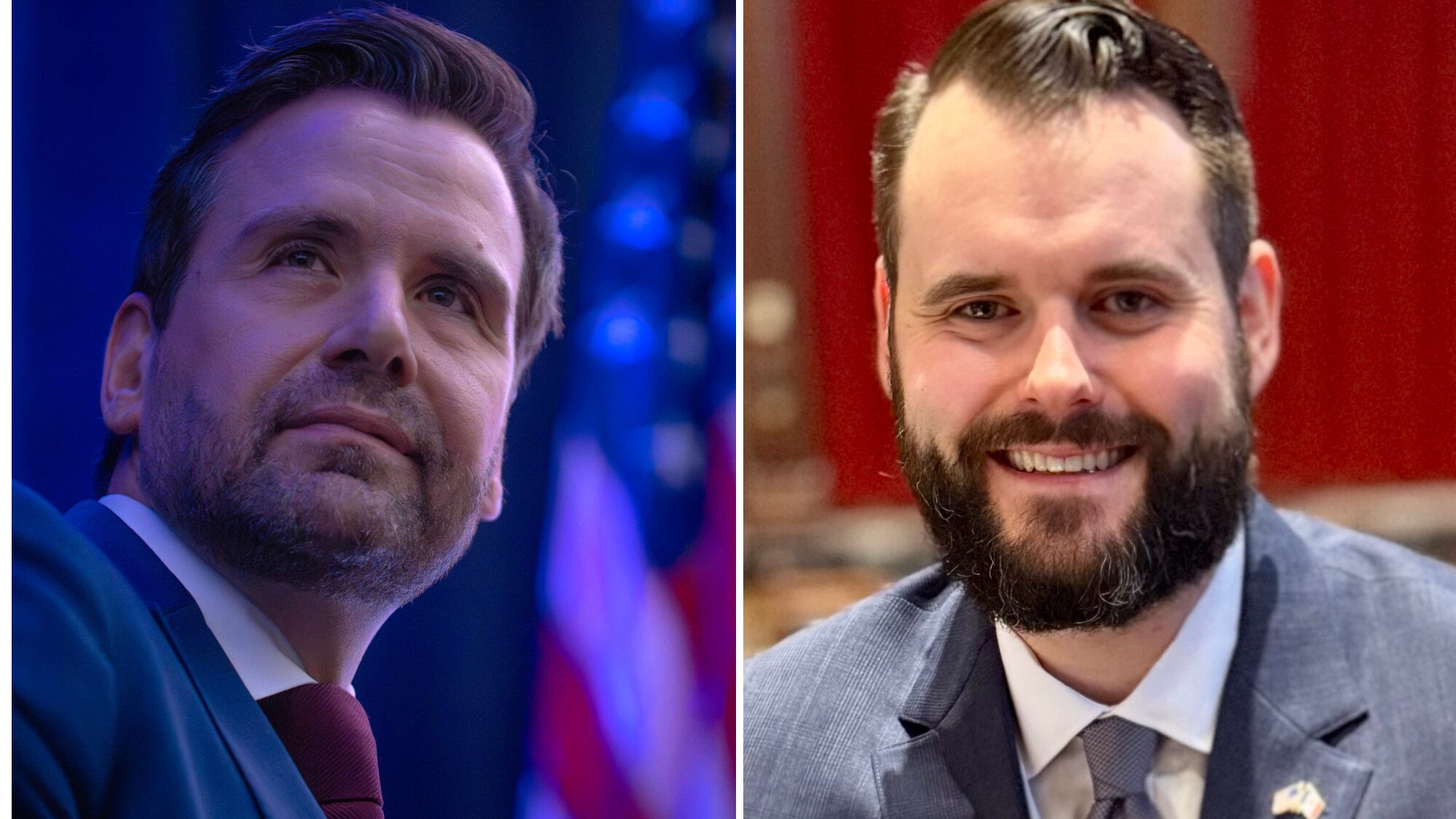
The Democratic primary for the U.S. Senate seat in Iowa is shaping up as a competitive race between state Senator Zach Wahls and state Representative Josh Turek. With the field narrowing, voters must decide between two distinct candidates ahead of the primary scheduled for June. Wahls, known for his advocacy on LGBTQ+ issues, positions himself as the liberal choice, while Turek, a former Paralympian, embodies a more moderate approach that he believes will appeal to independents and disenchanted Republicans.
Wahls gained national attention in 2011 when he spoke on behalf of his two mothers during a legislative debate on same-sex marriage. He emphasizes a progressive agenda anchored in working-class values, stating that he can inspire the Democratic base to turn out in numbers during the midterm elections. Meanwhile, Turek’s appeal lies in his past successes in a district that also supported former President Donald Trump, suggesting he can attract a broader audience beyond core Democratic voters.
Jessica Taylor, Senate and Governors Editor for the Cook Political Report, notes the central question for Democrats: “Do you need to energize your base more to get them to turn out, or do you need to win over the middle?” This dilemma is evident in Iowa, where neither candidate has yet established a definitive lead as the primary approaches.
Turek appears to be gaining the unofficial support of national Democratic figures who believe he might have a better chance in the general election against the Republican candidate, U.S. Representative Ashley Hinson. Wahls has seized upon this perception, criticizing Turek for his connections to the political establishment. In response, Turek has highlighted a recent poll from the National Republican Senatorial Committee showing Wahls as the Democratic frontrunner, arguing that the Republicans are attempting to elevate a candidate they see as more beatable in November.
The open Senate seat follows the announcement from Republican Joni Ernst that she will not seek reelection. Polls indicate a challenging environment for Iowa Democrats, as registered Republicans significantly outnumber Democrats. The Cook Political Report currently rates the Iowa Senate race as “likely Republican,” complicating the pathway for the eventual Democratic nominee.
As both candidates ramp up their campaigns, they accuse each other of being influenced by outside interests. While the Democratic Senatorial Campaign Committee (DSCC) has not formally endorsed Turek, there are claims from Wahls’ camp that the DSCC has discouraged companies from supporting him. This dynamic reflects a broader concern among Democrats about the influence of national party politics on local races.
Turek’s campaign manager, Brendan Koch, stated that national Republicans are rallying behind Wahls, while Hinson has targeted Wahls in her campaign messaging. During her launch event, Hinson characterized Wahls as a “far-left Democrat” and suggested he lacks the fortitude to stand up for average Americans. Wahls has welcomed the attention, asserting that Republicans view him as a significant threat.
On the other hand, Turek has pointed to his electoral successes in a challenging district, arguing that his experience makes him the candidate best suited to win over moderates and independents. He emphasizes his bipartisanship and commitment to addressing the needs of Iowans, particularly those with disabilities, drawing from his personal story of living with spina bifida.
Both candidates are also focusing on their fundraising capabilities. Wahls reported raising $742,000 compared to Turek’s $678,000, with Wahls holding a significant cash advantage of $733,000 to Turek’s $398,000. This financial backing is seen as an indicator of enthusiasm among the Democratic base, although Taylor cautions that in a conservative state like Iowa, appealing to centrist voters may be crucial.
Wahls recently released an internal poll suggesting he leads Turek 42% to 24% in the primary, reflecting his name recognition and support within the party. He has also garnered endorsements from numerous labor unions, further asserting his image as a champion of working-class issues. Wahls’ connection to organized labor is a focal point of his campaign; he has actively participated in union events and emphasizes his background in a union family.
The race is still evolving, and both candidates are aware of the challenges ahead. With increasing national attention, the outcome of the Iowa Senate primary could have broader implications for the Democratic Party’s strategy in the midterms. As the candidates prepare for the upcoming months, the dynamics of this closely watched race continue to unfold.
Stephen Gruber-Miller and Brianne Pfannenstiel, political reporters for the Des Moines Register, have contributed to this coverage, providing insights into the unfolding election landscape in Iowa.