Demonstrations across Iran have escalated this week, as citizens express deep-rooted frustrations against the government, transcending mere economic grievances. While reports suggest that unrest was sparked by the rial‘s record lows, the situation reflects a profound desire for change within a regime perceived as morally bankrupt.
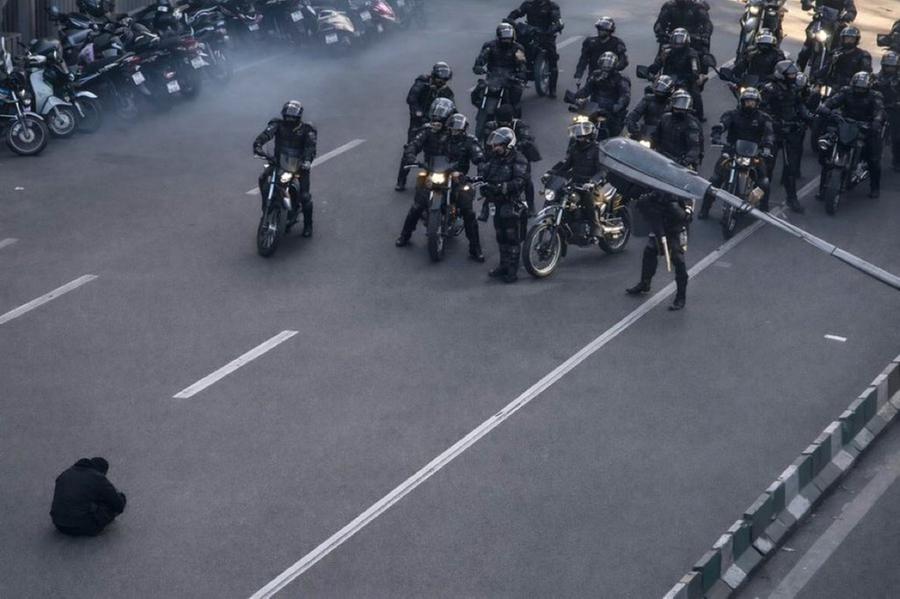
A striking image emerged from Tehran, where a solitary figure sat cross-legged in the street, defying the advancing security forces. This act of quiet resistance encapsulates the spirit of a movement that has grown beyond immediate economic concerns into a broader struggle for dignity and freedom.
The Iranian economy is indeed facing severe challenges, with inflation rising above 42 percent and the rial collapsing to historic lows. Storeowners in Tehran’s Grand Bazaar, a traditional center of commerce and political sentiment, have taken the dramatic step of closing their businesses in protest, signifying both desperation and defiance. Yet, to view the protests solely through an economic lens is to overlook the larger narrative of discontent that has built up over decades.
Iranians are taking to the streets not just for financial relief but to challenge a system that has consistently failed them. The demonstrations highlight widespread grievances, including the frequent use of violence against dissenters, arbitrary detentions, and systemic discrimination against ethnic and religious minorities such as the Kurds, Baluchis, and Baha’is. Women, in particular, are protesting against oppressive regulations governing their bodies and choices, which reflect a broader societal struggle for respect and autonomy.
Corruption within the government has reached levels that render official resignations, such as that of the central bank governor earlier this week, as mere theater rather than true accountability. Environmental mismanagement has exacerbated the crisis, leading to a water shortage affecting major reservoirs in Tehran, which currently operate at about 12 percent capacity. This misallocation of resources is starkly contrasted by the regime’s continued financial support for foreign militant groups, such as Hezbollah, which reportedly received around $1 billion this year alone.
Chants of “azadi” (freedom) and “death to the dictator” reverberate through the streets, signaling a collective demand for change that is as much about human rights as it is about economic stability. This is not an isolated incident; Iran has witnessed multiple waves of protests in recent years, including the student protests in 1999, the Green Revolution in 2009, and significant national protests in 2017 and 2019 triggered by fuel price hikes. The outrage surged again in 2022 following the death of Mahsa Jina Amini, which ignited a women-led uprising against compulsory hijab laws.
As tensions rise, recent conflicts, such as the 12-day war with Israel, have further fueled public anger, revealing the regime’s vulnerabilities and contributing to a significant decline in the rial’s value. The Iranian leadership now faces a critical challenge: maintaining control over a population of 92 million that increasingly refuses to be governed through fear.
The global community must grapple with the implications of these protests. Simplifying the unrest to economic factors allows for a comfortable detachment from the moral crisis unfolding in Iran. Yet, the actions of the Iranian people—locking their doors, chanting for freedom, and standing resolute in the face of oppression—underscore a more urgent narrative.
The people of Iran are not merely seeking rescue; they are demanding recognition. Their voices reflect a collective yearning for justice and dignity that cannot be ignored.