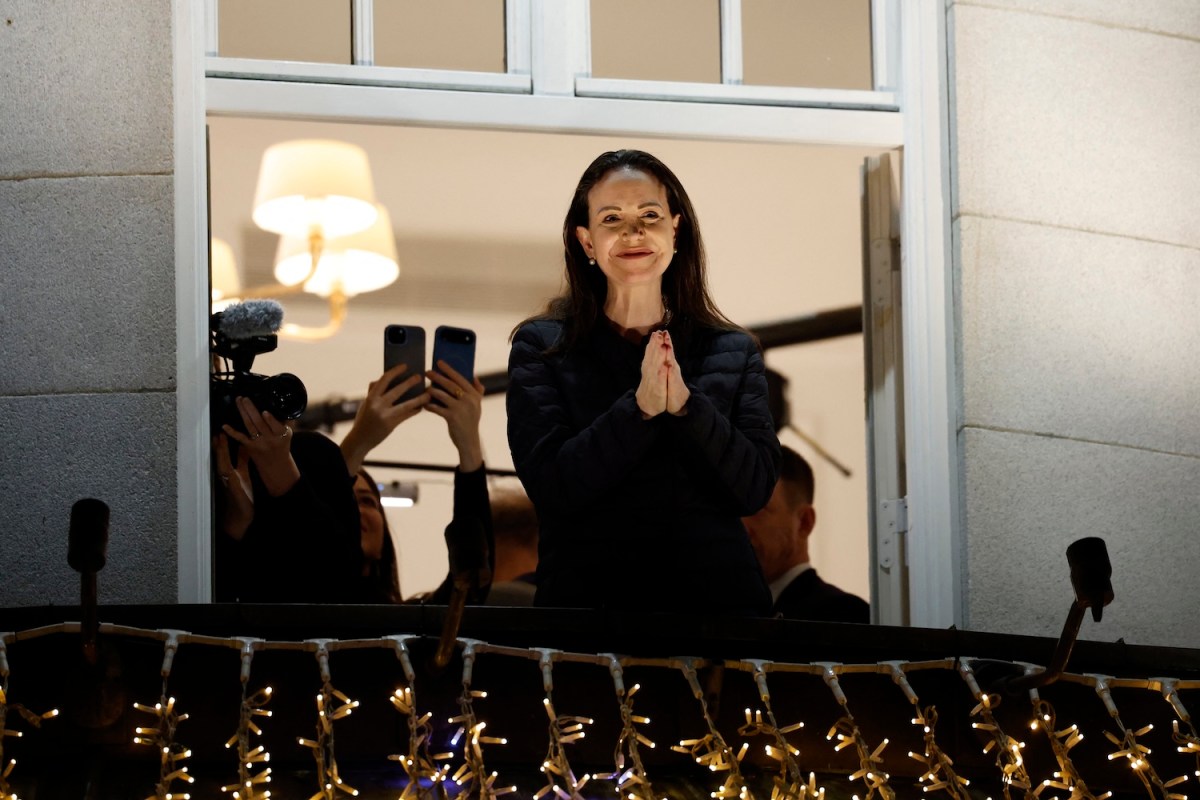
Venezuelan opposition leader and Nobel Peace Prize laureate María Corina Machado arrived in Oslo early Thursday morning after a dramatic escape from her home country. The escape involved disguises, a fishing boat, and a private jet, as detailed by The Wall Street Journal. Machado, 58, appeared on the balcony of Oslo’s Grand Hotel around 02:30 local time, greeting supporters just hours after her daughter accepted the Nobel Peace Prize on her behalf.
The Nobel Committee recognized Machado for her “tireless work promoting democratic rights” against the authoritarian regime of President Nicolás Maduro. She has emerged as a key figure in Venezuela’s fractured opposition and is the leader of the party that claimed victory in the disputed 2024 presidential election, securing 67 percent of the vote according to international allies. Despite this, Maduro’s government declared victory, leading to widespread arrests and repression that forced Machado into hiding.
This unexpected arrival in Norway adds tension to the standoff between Maduro and U.S. President Donald Trump. The Trump administration has increased its naval presence in the Caribbean, citing concerns over drug trafficking and accusing Maduro of overseeing powerful cartels. Machado’s Nobel win has intensified political divisions in Venezuela, with Maduro labeling her a “demonic witch” and denouncing the prize as foreign interference, even as international support for Machado’s democratic aspirations grows.
Details of the Escape
Machado’s escape began on Monday afternoon from a suburb of Caracas, where she had been in hiding for nearly a year. Disguised with a wig and accompanied by two aides, she navigated roughly 10 military checkpoints on a 10-hour road trip to a coastal fishing village without being detained. After a brief rest, Machado and her companions boarded a small fishing skiff around 05:00 for a perilous crossing of the Caribbean Sea to Curacao. The journey faced challenges from strong winds and rough seas, delaying their progress.
The escape network, which has assisted others in fleeing Venezuela, contacted the U.S. military prior to the boat’s departure to prevent any misidentification during recent American airstrikes on vessels in the region. People familiar with the operation indicated that the Trump administration was aware of Machado’s escape plans, although U.S. officials denied that the military was directly coordinating with the group. Around the time of the crossing, U.S. Navy F-18 fighter jets were reportedly active near the route from Venezuela’s coast to Curacao.
Machado reached Curacao around 15:00 on Tuesday and was met by a private security contractor, allegedly supplied by the Trump administration. After checking into a hotel to rest, she boarded an executive jet provided by an associate in Miami, which flew to Oslo, stopping for refueling in Bangor, Maine. Before departing, Machado recorded a brief audio message thanking those who “risked their lives” to assist her escape. In a separate message released by the Nobel Peace Prize committee, she confirmed her travel to Oslo for the festivities, although the Nobel Institute indicated it was unaware of her whereabouts as the award ceremony commenced.
Response and Political Implications
At the Nobel ceremony, Jørgen Watne Frydnes, chair of the Nobel Committee, described Machado’s journey as occurring “in a situation of extreme danger.” As she could not attend the ceremony in person, her daughter, Ana Corina Sosa, accepted the Peace Prize on her behalf, assuring the audience, “She will be back in Venezuela very soon.”
Outside the Grand Hotel, supporters celebrated Machado’s arrival, chanting “¡Valiente!” (“brave”) and singing the Venezuelan national anthem. Machado, a former industrial engineer and National Assembly deputy, has become a symbol of resistance against Maduro’s regime. She was awarded the 2025 Nobel Peace Prize for her leadership in uniting the opposition and mounting a “successful electoral challenge,” despite facing disqualification from running and threats that forced her chosen candidate, Edmundo González, into exile.
In her Nobel acceptance message, posted on X in October, Machado dedicated the prize to “the suffering people of Venezuela and to President Trump for his decisive support of our cause.” Former Venezuelan lawmaker Julio Borges echoed this sentiment, stating that the Nobel Peace Prize for Machado recognizes her moral leadership and the struggles of the Venezuelan people. He emphasized that history shows that the strength of moral leadership ultimately prevails over totalitarian regimes.