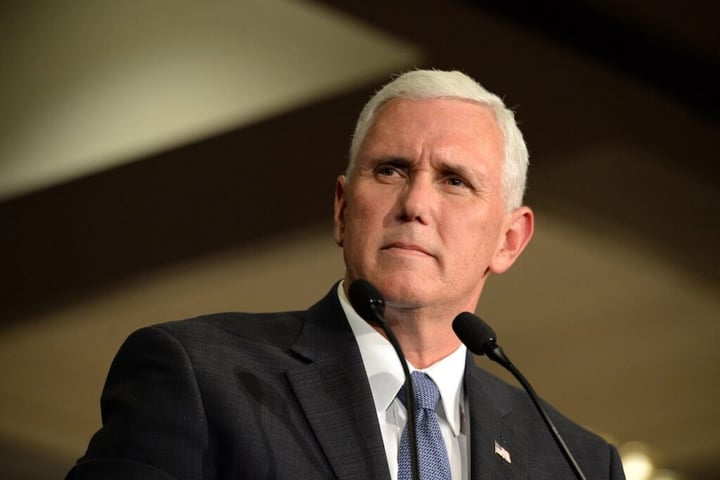
Former Vice President Mike Pence has sharply criticized President Donald Trump’s recently released national security strategy, characterizing it as a “doctrine of contradictions.” Pence argues that the new strategy, which was unveiled on March 15, 2025, could alienate U.S. allies while simultaneously appeasing adversaries such as China and Russia.
This 33-page document represents a notable departure from Trump’s initial approach, which focused on “great power competition” with these global powers. In a post on the social media platform X, Pence shared a Wall Street Journal analysis, stating, “A Trump Doctrine of Contradictions: New Security Document is notably Soft on Russia and China…It will please China and Russia but discomfit America’s allies.”
Strategic Focus Shift Raises Concerns
The new strategy shifts emphasis toward the Western Hemisphere, concentrating on issues such as migration and drug trafficking while largely minimizing the threats posed by China and Russia. According to the Wall Street Journal, “By any measure the largest threat to the U.S. is the hostile power across the Pacific,” referring specifically to China. The report highlights that the strategy treats trade imbalances as a more pressing concern than China’s military expansion.
Furthermore, the strategy advocates for “strategic stability” with Russia, suggesting a reduced global leadership role for the United States. Critics warn that this approach could embolden adversaries while leaving allies uncertain about U.S. commitments abroad.
Political Reactions Highlight Bipartisan Concerns
The release of Trump’s national security strategy has sparked significant backlash from both Democratic and independent lawmakers. Senate Majority Leader Chuck Schumer, along with Senators Mark Kelly and Bernie Sanders, expressed their discontent, arguing that the strategy favors authoritarian regimes over democratic allies. Schumer specifically accused Trump of “selling out our allies in Europe and putting Russia first.”
Senator Sanders remarked that he preferred Saudi Arabia under Mohammed bin Salman, labeling the strategy as “a betrayal of American values.” Senator Kelly criticized the strategy for creating “winners and losers,” claiming it prioritizes autocrats and personal allies over U.S. security interests.
European officials have also voiced strong objections. Alice Rufo, France’s junior army minister, described the strategy as a “harsh wake-up call,” urging the need for Europe to bolster its military capabilities. German Chancellor Friedrich Merz echoed similar sentiments, stating that the strategy underscores the necessity for Europe to pursue greater military independence while maintaining transatlantic alliances.
The widespread criticism reflects a growing concern that Trump’s national security strategy could undermine U.S. diplomatic efforts and empower authoritarian regimes such as Russia and Saudi Arabia.
On a related note, President Trump announced on March 14, 2025, that NVIDIA Corp. will be allowed to ship its H200 chips to approved customers in China and other countries, further complicating the landscape of U.S.-China relations.
The ongoing debate surrounding Trump’s approach to national security highlights the complexities of U.S. foreign policy and its implications for international alliances and adversarial relationships.