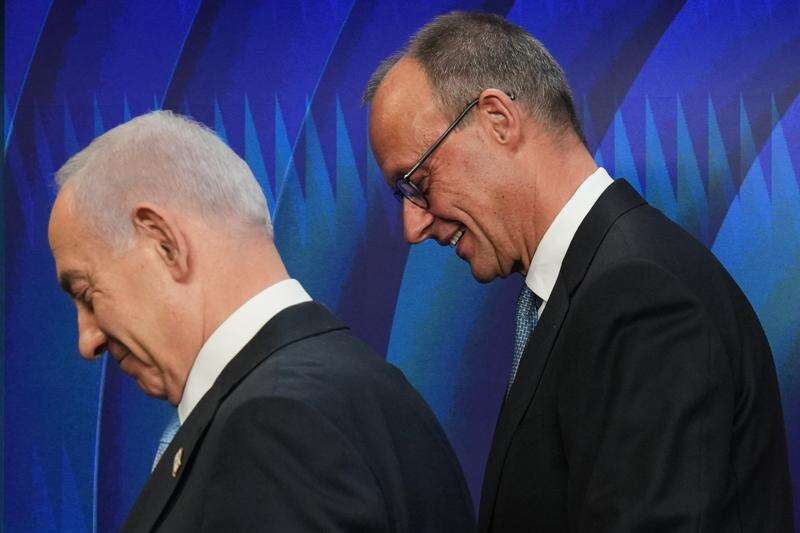
Israeli Prime Minister Benjamin Netanyahu announced on Sunday that Israel and Hamas are expected to enter the second phase of the ceasefire shortly. This development will take place after Hamas returns the remains of the last hostage held in Gaza. The announcement was made during a news conference with visiting German Chancellor Friedrich Merz.
Netanyahu emphasized that the second phase, which involves the disarming of Hamas and the demilitarization of Gaza, could begin as soon as the end of the month. The remains of Ran Gvili, a 24-year-old police officer killed during the Hamas-led attack on October 7, 2023, have yet to be returned. His body was taken to Gaza during the assault that ignited the ongoing conflict.
Ceasefire Phases and International Involvement
The second phase of the ceasefire plan also includes deploying an international force aimed at securing Gaza and establishing a temporary Palestinian government. This government would operate under the supervision of an international board led by U.S. President Donald Trump. The completion of the first phase hinges on Hamas returning Gvili’s remains, alongside Israel’s commitment to return 15 bodies of Palestinians in exchange.
Hamas has stated that it struggles to retrieve all remains due to rubble from Israel’s offensive, which has been ongoing for two years. In response, Israel has accused Hamas of deliberately delaying the process, warning that military operations might resume or humanitarian aid could be withheld if all remains are not returned.
Chancellor Merz affirmed Germany’s commitment to assisting with the second phase, indicating that German officers and diplomats would be sent to a U.S.-led civilian and military coordination center in southern Israel. Furthermore, Germany is providing humanitarian aid to Gaza.
Future Challenges and International Relations
Netanyahu acknowledged the difficulties of the second phase, recalling that few believed the first stage could be accomplished. He remarked, “As I mentioned to the chancellor, there’s a third phase, and that is to deradicalize Gaza, something that people believed was impossible. But it was done in Germany, it was done in Japan, it was done in the Gulf States. It can be done in Gaza too, but of course, Hamas has to be dismantled.”
Merz reiterated Germany’s unwavering support for Israel, stating, “We will always stand up for Israel’s existence and security.” He highlighted that this commitment is rooted in the historical context of the Holocaust. While he expressed support for a two-state solution, he emphasized that recognition of a Palestinian state should only occur after a comprehensive peace process.
Concerns about Netanyahu’s potential travel to Germany were raised, particularly regarding an arrest warrant issued by the International Criminal Court last year related to the Gaza conflict. Merz mentioned that there are currently no plans for a visit but indicated he might extend an invitation in the future.
Current Situation in Gaza
Additionally, the Israeli military reported the killing of a militant who approached its troops near the Yellow Line, which separates the Israeli-controlled area of Gaza from the rest. According to Gaza’s Health Ministry, more than 370 Palestinians have been killed since the ceasefire began, with six bodies from recent attacks brought to local hospitals in the past 24 hours.
The original Hamas-led attack on October 7 resulted in approximately 1,200 fatalities and over 250 hostages taken. Most hostages or their remains have been returned through ceasefires or other agreements. Since the onset of Israel’s military operations in Gaza, the Health Ministry reports that at least 70,360 Palestinians have died, although it does not differentiate between civilians and combatants. Nearly half of those reported dead are said to be women and children. The ministry operates under the Hamas-led government and its figures are considered reliable by the United Nations and other international organizations.
The situation remains complex as both sides navigate the challenges of negotiation and humanitarian concerns in a deeply divided region.