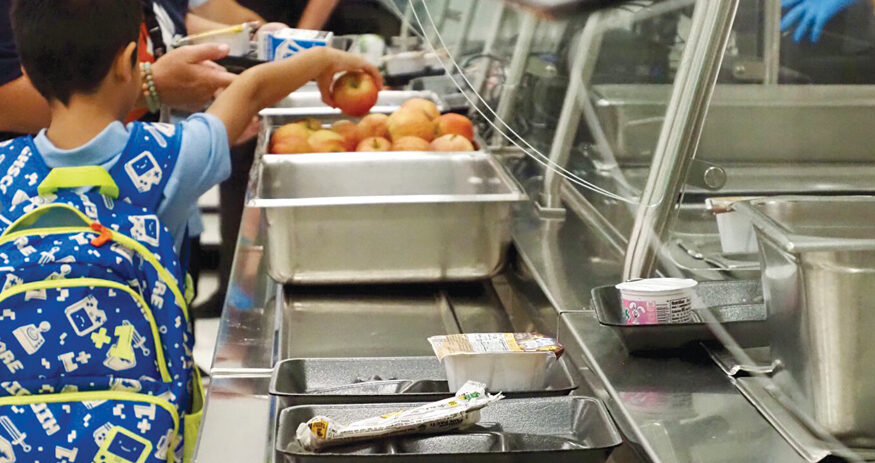
Oklahoma’s GOP-controlled Legislature has largely turned its back on a mandate to provide free meals to all public school students, initiated by former state Superintendent Ryan Walters. This initiative, announced in July 2023, aimed to eliminate cafeteria fees across all school districts in the state. However, the response from lawmakers and school officials has been tepid at best, with many districts choosing not to comply.
Walters, who resigned from his position shortly after issuing the order to lead a nonprofit organization, argued that public schools had sufficient funds to support the initiative. Despite his assertions, lawmakers have expressed a lack of interest in the mandate. Representative Dick Lowe, R-Amber, who chairs the House Common Education Committee, stated, “They’ve turned the page and quit worrying about what he said.” Lowe mentioned that with a projected shortfall in state income next year, implementing universal free meals would impose a significant financial burden.
According to the Office of Management and Enterprise Services, the General Revenue Fund collections in Oklahoma have been lower during the first five months of the 2026 fiscal year compared to the previous year. Advocates from Hunger Free Oklahoma estimate that providing free meals to all public school students would cost the state between $80 million and $100 million. Lawmakers are prioritizing other issues, notably improving childhood literacy, as highlighted by Senator David Bullard, R-Durant. He commented, “I think right now, you have kids that can pay for it, and if they can, then let the parents pay for the meal.”
While some lawmakers are dismissing the idea, House Democrats are continuing to push for the free meal policy. House Minority Leader Cyndi Munson, D-Oklahoma City, expressed concern over the state’s public education challenges, attributing some issues to Walters’ unfulfilled promises. She referenced House Bill 2092, introduced by Representative Annie Menz, D-Norman, and Senator Carri Hicks, D-Oklahoma City, which aims to expand universal free meals to more districts. This bill will carry over into the 2026 legislative session after failing to receive a committee hearing in 2025.
In 2024, nearly 280,000 Oklahoma students were enrolled in public schools that provided free meals to all students, according to a June report from Hunger Free Oklahoma. Currently, 267 districts and 849 schools across the state participate in the Community Eligibility Provision, a federal program that offers reimbursements to schools based on student poverty levels. However, districts that do not qualify for this program have indicated that Walters’ order would prove financially unfeasible, even if they were to make substantial cuts in other areas.
Multiple district leaders have voiced their unwillingness to follow the mandate, despite Walters’ threats of sanctions. His order also included provisions to ban certain “ultra-processed” foods and artificial ingredients from school meals, something that the School Nutrition Association of Oklahoma noted would be difficult to implement without significant funding and resources.
Walters issued his directive just as the deadline to apply for Community Eligibility Provision funding had passed, adding to frustrations regarding its feasibility. Experts in educational policy have stated that Walters lacked the authority to impose such a requirement without legislative support. His successor, newly appointed state Superintendent Lindel Fields, has not pursued the mandate or attempted to enforce it. Fields remarked, “I believe we can all agree that students learn best when their basic needs are met, including having a full stomach.” He added that it would be beneficial to explore solutions that cater to all students’ needs.
The ongoing debate over free school meals in Oklahoma highlights the challenges the state faces in addressing hunger and educational equity. As the legislative session progresses, the issue is likely to remain a focal point in discussions surrounding public education funding and support for low-income families.