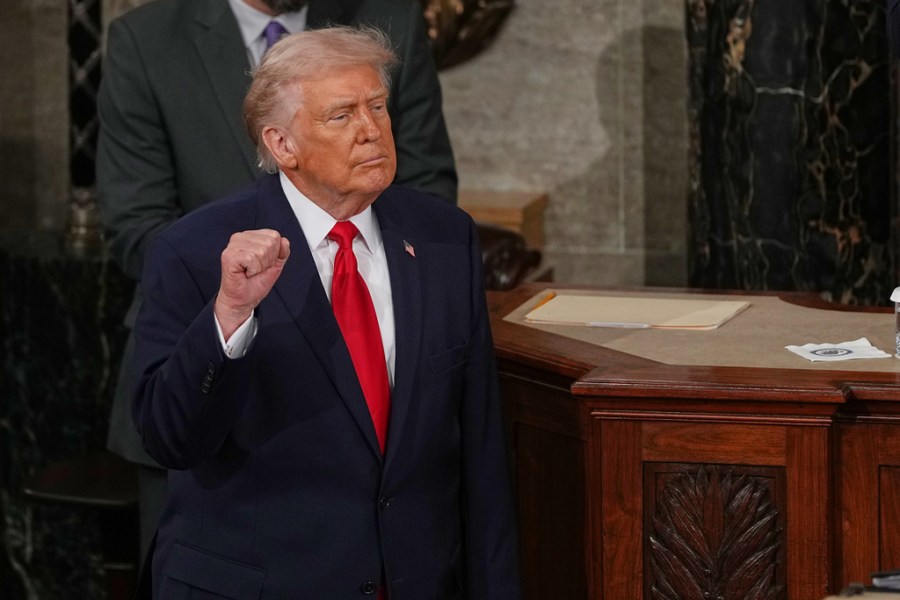
President Donald Trump delivered a charged State of the Union address on January 8, 2024, in which he criticized opponents while deflecting attention from his administration’s controversies. The speech, presented to a joint session of the United States Congress, included numerous claims about alleged misconduct by political rivals, alongside a lack of acknowledgment regarding his own administration’s challenges.
During the address, Trump accused key figures in the opposition of engaging in unethical behavior. He pointed fingers at both the Senate and the House of Representatives, suggesting that they were responsible for the nation’s current issues. His rhetoric painted a picture of a political landscape marred by dishonesty, positioning himself as a victim of alleged conspiracies.
The president’s address lacked substantive data to support his assertions. Critics quickly noted the absence of responsibility taken for his own administration’s actions, which have come under scrutiny over the past year. Instead of addressing these concerns directly, Trump focused on disparaging remarks aimed at his political adversaries.
As the address progressed, he reiterated themes familiar to his supporters, framing his presidency as a battle against corruption. Trump’s remarks were punctuated with applause from his allies present in the chamber, while opposition members reacted with visible disapproval. The stark divide illustrated the ongoing partisan tensions that have characterized American politics in recent years.
The speech was met with criticism from various political analysts and public commentators. Many highlighted the need for transparency and accountability, noting that the president’s approach may resonate with his base but fails to address the broader concerns of the American public. Political commentator Jane Smith remarked, “We need leadership that acknowledges its shortcomings, not one that shifts blame.”
Trump’s address comes at a pivotal moment as he prepares for the upcoming election cycle. With the political landscape evolving rapidly, the implications of his rhetoric may influence voter sentiment significantly. His ability to connect with the electorate while navigating ongoing controversies will be crucial in the months ahead.
As the nation reflects on the content of the address, it remains essential to monitor how these assertions play out in the political arena. The next steps from both the administration and its opponents will shape the discourse leading into the elections, with potential ramifications for the future of governance in the United States.