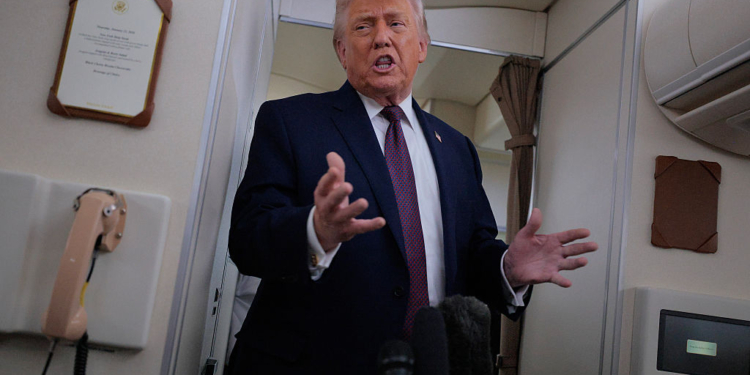
President Donald Trump recently referred to himself as the “president of peace,” but his statement took a controversial turn during a press conference on January 22, 2026. While aboard Air Force One returning from the World Economic Forum in Davos, Switzerland, Trump stated that “peace is so destructive for everyone,” raising eyebrows among reporters and social media users alike.
The president made this remark while discussing the newly established Board of Peace, which aims to oversee the reconstruction efforts in Gaza following ongoing conflicts. During the press briefing, Trump addressed the financial contributions required from nations to join the board, stating, “Some of the countries have already put up a billion. Some of the countries have already put up much more than that. And that’s a lot of money, but it’s nothing compared to the value of peace.”
Although Trump quickly attempted to clarify his statement, the damage was done. He explained, “I mean, it’s so destructive for everybody when you have wars.” Despite his clarification, the unusual phrasing caught the attention of various commentators, who seized the opportunity to critique the president’s choice of words.
Social media reactions were swift, with users highlighting the irony of a leader who has sought a Nobel Peace Prize describing peace in such a negative light. One account, Patriot Takes, tweeted, “Man who begged for peace prize: ‘Peace is so destructive.’” Others chimed in with humorous takes, suggesting a disconnect between Trump’s intentions and his statements.
Critics pointed out the apparent contradiction in Trump’s self-proclaimed title as a champion of peace, juxtaposed with his comment about the destructiveness of peace. With a growing number of individuals taking to social media to express their views, the incident has sparked discussions about the administration’s messaging on international relations and peace initiatives.
As the president continues to push forward with his plans for Gaza’s reconstruction, the fallout from this gaffe may linger, potentially impacting public perception of his commitment to peace and stability in conflict zones. The reactions to his comments underscore the complexities of political communication and the challenges leaders face in conveying their policies effectively.
Trump’s comments serve as a reminder of the delicate balance required in diplomatic discourse, especially when addressing sensitive issues such as war and peace. As discussions about the Board of Peace and its financial implications proceed, the administration will likely need to clarify its objectives and messaging to avoid further misinterpretations.