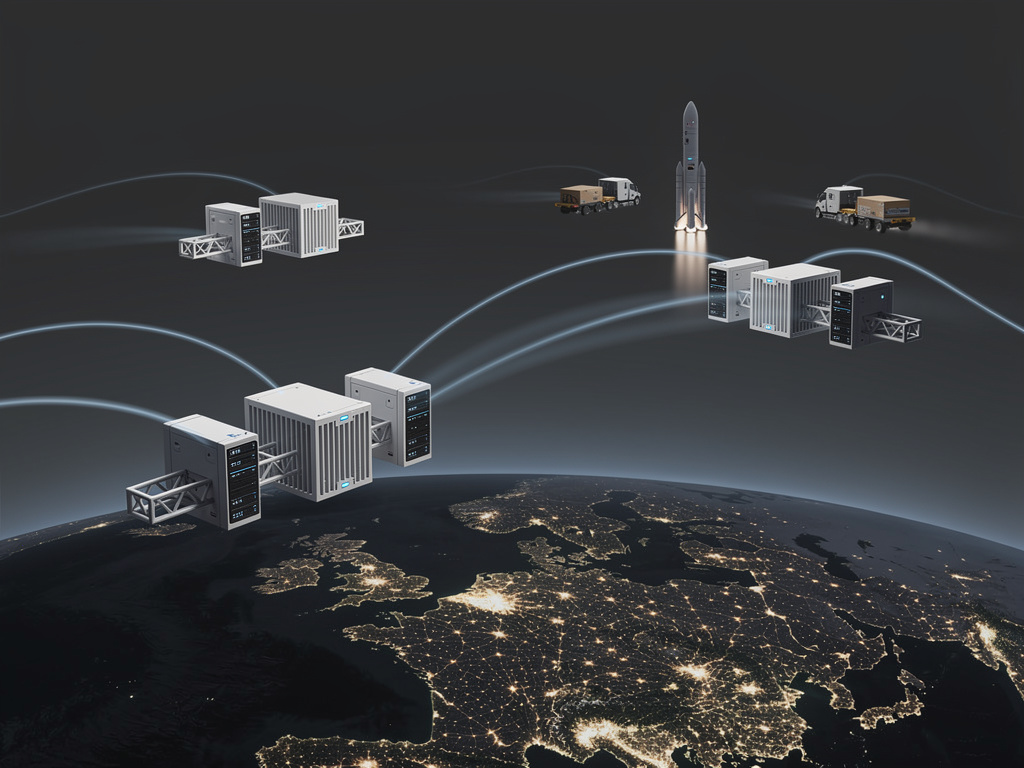
The artificial intelligence industry is facing a significant challenge as its energy consumption skyrockets, prompting leading figures like Sam Altman and Elon Musk to explore innovative solutions. Both technology pioneers are proposing that the answer to AI’s growing energy demands may lie in space, specifically through the establishment of data centers in orbit. This once-theoretical concept is gaining traction, with timelines suggesting it could become a reality by the late 2020s.
During a recent discussion, Altman indicated that space-based data centers could be operational within a few years, driven by advancements in launch technologies. Elon Musk, founder of SpaceX, echoed this optimism, highlighting the reduced costs associated with launching payloads into space via the Starship rocket. As both leaders align their visions, the prospect of deploying computational capacity beyond Earth is moving towards serious feasibility.
AI’s Growing Energy Needs Drive Innovation
The accelerating demand for electricity in AI is alarming. According to Goldman Sachs, power consumption by data centers in the United States could more than double by 2030, primarily due to AI workloads. The International Energy Agency has predicted that global data center electricity use may reach 1,000 terawatt-hours annually by 2026, equivalent to Japan’s total electricity consumption.
This surge in demand has already led to power shortages in regions like Northern Virginia, Texas, and even internationally in Ireland and the Netherlands. Major tech companies, including Microsoft, Google, and Amazon, are responding by securing long-term power purchase agreements and exploring alternative energy sources. However, these measures take years to implement, leaving the industry in urgent need of a faster solution.
Altman’s proposition for space-based data centers relies on a significant advantage: solar panels in orbit can receive uninterrupted sunlight, providing five to ten times more energy per square meter than those on Earth. He emphasized that this could create a sustainable, carbon-free power source for the burgeoning AI sector, with potential operations starting around 2026 or 2027.
The Challenges and Opportunities Ahead
Musk’s dual role as both a supplier through SpaceX and a customer via xAI positions him uniquely in this discussion. His Colossus supercomputer in Memphis is reportedly one of the largest AI training facilities globally, already straining local power resources. Musk has publicly discussed the feasibility of orbital computing, pointing to SpaceX’s Starlink satellite constellation as a successful example of deploying advanced technology in low Earth orbit.
Yet, the transition from communication satellites to data centers presents formidable engineering challenges. Cooling systems in space differ significantly from those on Earth, relying on radiative methods that are less efficient. Additional concerns include the degradation of electronics due to radiation exposure, increased latency for data transmission, and the complexities of maintenance.
Despite these obstacles, startups are beginning to explore the possibilities of space-based computing. Companies like Lumen Orbit, backed by Y Combinator, are developing satellites specifically for AI workloads. Another contender, Axiom Space, is working on commercial space station modules that could eventually house computing hardware.
The critical question remains whether the economics of space-based data centers can compete with traditional ground-based facilities. Currently, the costs of launching and maintaining equipment in orbit are prohibitive. For instance, a rack of high-performance AI servers can cost tens of thousands of dollars, while launching that same rack to orbit could exceed hundreds of thousands of dollars.
However, if SpaceX‘s Starship can achieve its target economic goals, the cost of launching payloads may drop significantly, potentially transforming the financial calculus. As terrestrial energy prices continue to climb, the balance might shift in favor of space-based solutions sooner than expected.
Regulatory and geopolitical considerations also complicate the landscape. Questions arise regarding jurisdiction for data processed in orbit and the allocation of orbital slots for computing versus communication satellites. The implications for national security are significant, as control over substantial computing capacity in space could become a strategic asset.
As industry leaders like Altman and Musk discuss actionable timelines, the prospect of space-based data centers feels more tangible than ever. The discussions are not about 2040 or 2050; instead, they focus on the late 2020s. If the AI sector cannot solve its electricity challenges on Earth swiftly, looking to the stars may become a necessity in addressing its energy crisis.