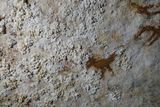
A recent study published in *Nature* has identified the oldest known rock art, dating back over 67,800 years, discovered in a cave on the island of Sulawesi in Indonesia. This discovery provides significant insights into the movements of early human populations, potentially linking them to the first migrations into Australia. The art, a stencil resembling a human hand, is approximately 16,600 years older than previously documented cave paintings in the region.
The research team included Maxime Aubert from the Griffith Centre for Social and Cultural Research at Griffith University in Australia. He noted, “It is now evident from our new phase of research that Sulawesi was home to one of the world’s richest and most longstanding artistic cultures,” highlighting the island’s importance in human history since its earliest occupation.
Significance of Sulawesi in Human History
The Indonesian island of Sulawesi has long been recognized as a critical site for archaeological research. It has preserved some of the oldest known cave art, featuring human and animal figures that may depict early hunting scenes. The current study builds on previous findings, further establishing Sulawesi as a pivotal location for understanding human artistic expression and migration patterns.
The Liang Metanduno cave, where the stencil was found, serves as a crucial focal point. The research team utilized various techniques, including uranium-series dating and mineral deposit analysis, to confirm the age of the stencil. This has led to the conclusion that it was created by an artist belonging to the species Homo sapiens, who were likely ancestors of the Aboriginal Australians.
Study author Adhi Agus Oktaviana from Indonesia’s National Research and Innovation Agency remarked, “It is very likely that the people who made these paintings in Sulawesi were part of the broader population that would later spread through the region and ultimately reach Australia.” This strengthens the hypothesis that the ancestors of the First Australians were present in the Sahul region by 65,000 years ago.
Exploring Migration Routes
Previous research has suggested that Homo sapiens arrived in Sahul through two distinct timelines: the “long chronology,” around 65,000 years ago, and the “short chronology,” roughly 50,000 years ago. These studies proposed two island-hopping routes for early human migration, with the northern route passing through Sulawesi and the southern route via Timor, leading to the New Guinean and Australian landmasses.
The findings from the Liang Metanduno cave suggest a prolonged period of human occupation, with evidence of art dating back approximately 35,000 years beyond the initial creation of the stencil. Renaud Joannes-Boyau, a researcher from Southern Cross University, stated, “With the dating of this extremely ancient rock art in Sulawesi, we now have the oldest direct evidence for the presence of modern humans along this northern migration corridor into Sahul.”
As research continues, the team aims to investigate additional sites along the northern path into Sahul. “These discoveries underscore the archaeological importance of the many other Indonesian islands between Sulawesi and New Guinea,” Aubert added, indicating the potential for further significant findings in the region.
This groundbreaking study not only illuminates the artistic capabilities of early humans but also provides a clearer picture of their migratory patterns, fundamentally reshaping our understanding of human history in the region. As new evidence emerges, it promises to enhance our knowledge of how early populations adapted and thrived in diverse environments.