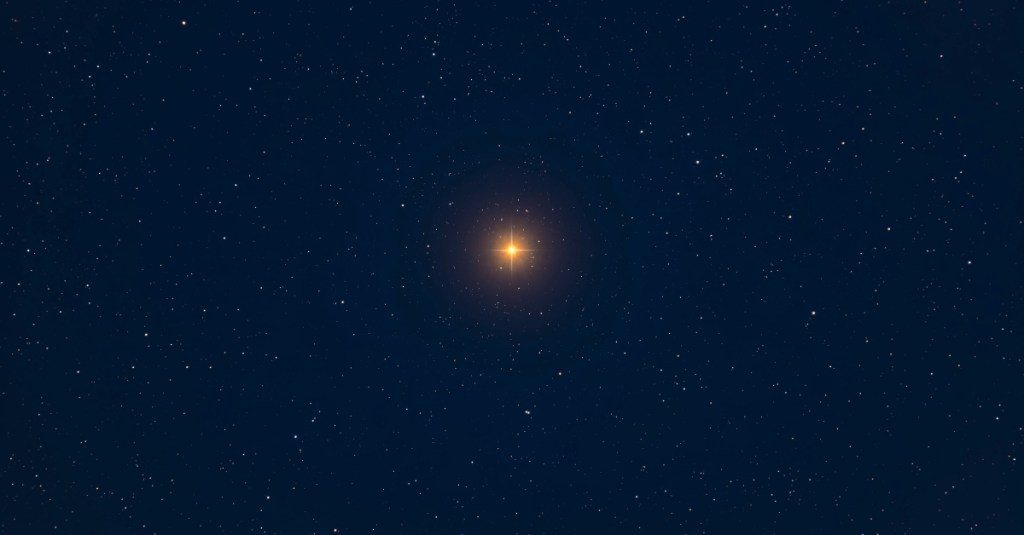
Astronomers have made a groundbreaking discovery involving the red supergiant star Betelgeuse, revealing that it has a hidden celestial companion named Siwarha. This finding helps explain the star’s unusual brightness fluctuations, which have puzzled scientists for years. The discovery came after nearly eight years of observation using the Hubble Space Telescope and ground-based observatories in Arizona and the Canary Islands.
Understanding Betelgeuse’s Behavior
Betelgeuse, located approximately 642.5 light-years from Earth, is known for its variability, pulsing roughly every 400 days due to internal processes typical of aging stars. However, a secondary cycle repeating approximately every 2,100 days had remained a mystery. This longer cycle, occurring too slowly to be attributed to known stellar phenomena, led to the hypothesis of an unseen companion star affecting Betelgeuse’s light emissions.
The research team, led by Andrea K. Dupree from the Harvard-Smithsonian Center for Astrophysics, has now confirmed this theory. The companion star, Siwarha, creates a significant effect on Betelgeuse’s atmosphere, which researchers were able to observe for the first time. Dupree described the process as a “ripple effect,” akin to a boat moving through water, causing detectable changes in the star’s brightness.
Mechanics of the Discovery
The team detected a dense trail of gas moving through Betelgeuse’s outer layers, created by Siwarha’s movement. As this companion star passes in front of Betelgeuse, it subtly alters the star’s ultraviolet light, particularly emissions from ionized iron. The result is a sharp increase in light when Siwarha is in view, followed by a gradual dimming as the gas trail absorbs radiation.
“For the first time, we’re seeing direct signs of this wake, or trail of gas, confirming that Betelgeuse really does have a hidden companion shaping its appearance and behavior,” said Dupree.
Siwarha will not be visible again until August 2027, as it has now returned behind Betelgeuse. Until its reappearance, astronomers will continue to study the ripples and patterns caused by this intriguing celestial relationship, deepening our understanding of stars and their complex behaviors.
The confirmation of Siwarha as Betelgeuse’s companion highlights the ongoing advancements in astronomical research, showcasing how new technologies can unveil secrets that have long eluded scientists. As observations continue, the cosmic relationship between these two stars offers exciting prospects for future studies in stellar dynamics.