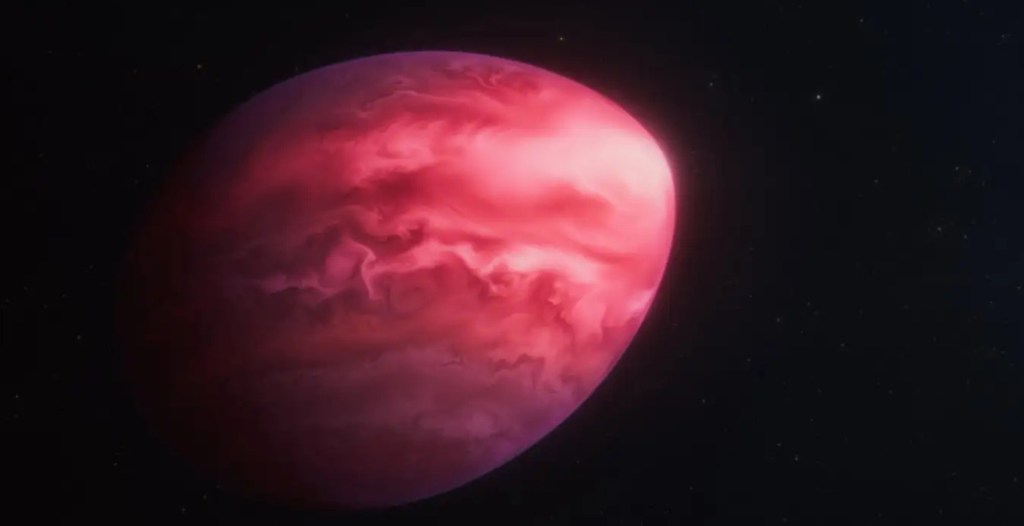
Astronomers have confirmed the existence of a rare rogue planet located nearly 10,000 light-years from Earth. This discovery marks a significant milestone in the study of free-floating worlds, which are planets that drift through space without orbiting a star. The planet, roughly the size of Saturn, was identified through precise measurements of its distance and mass, shedding new light on these elusive celestial bodies.
Rogue planets have long remained a mystery in the field of astronomy. The first signs of such a planet were detected in 2000, but it wasn’t until recent observations that scientists could provide concrete evidence of their existence. In 2024, researchers identified an object that distorted the light from a distant star using multiple ground-based observatories and the now-retired European Space Agency’s Gaia space telescope. This collaboration allowed astronomers to estimate the object’s distance at approximately 9,950 light-years towards the center of the Milky Way, with a mass about 70 times that of Earth.
According to Andrzej Udalski, an astrophysicist at the University of Warsaw in Poland and co-author of the study, these free-floating planets are likely more numerous in our galaxy than previously thought. “Theoretical studies of formation of planetary systems suggest that they should be very numerous in the Milky Way, even a few times more numerous than the number of stars in the galaxy,” he stated.
The process that leads to the formation of rogue planets is complex. Previous research indicates that chaotic interactions among planets during the early stages of planetary systems can propel some worlds outward. Additionally, passing stars may disrupt these systems, causing planets to be ejected into space. Some rogue planets could also form independently from the same clouds of gas and dust that give rise to stars.
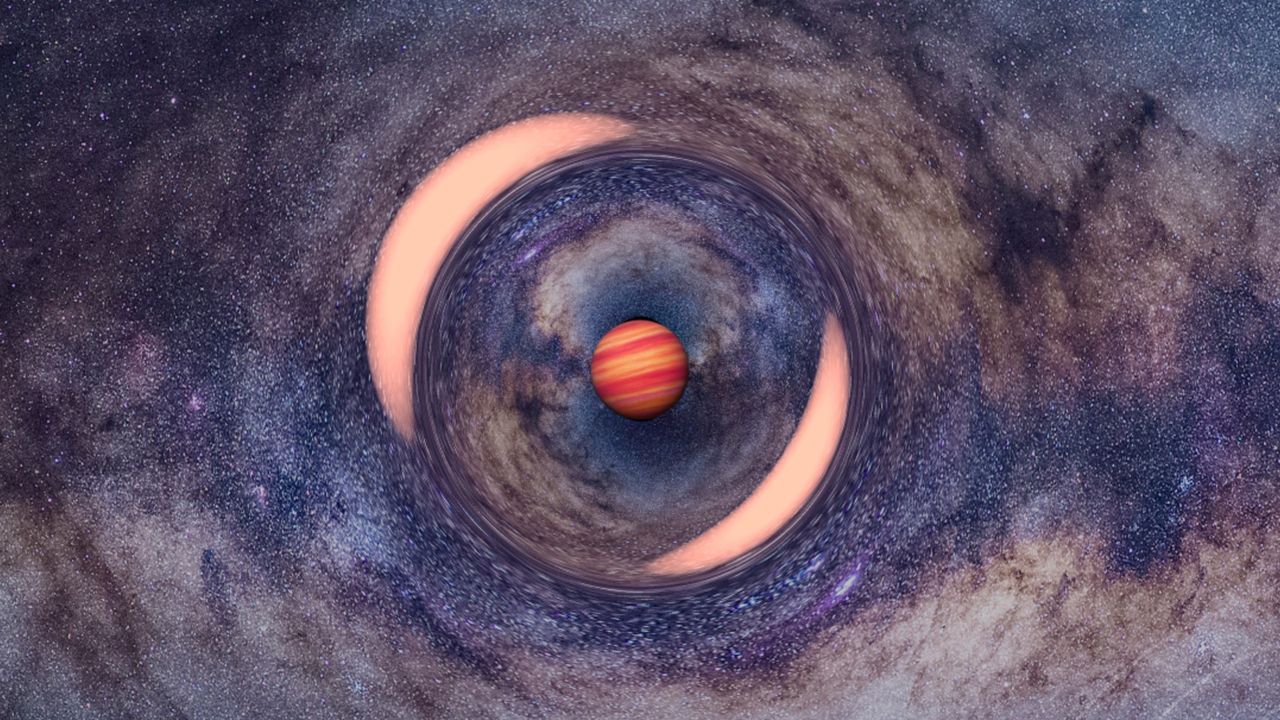
Detecting rogue planets poses significant challenges due to their lack of light emission. Currently, astronomers rely on a technique known as gravitational microlensing to uncover these wandering worlds. When a rogue planet passes in front of a star, its gravitational field can amplify the star’s brightness, allowing scientists to infer the presence of the planet. Approximately a dozen potential rogue planets have been discovered using this method.
One limitation of gravitational microlensing is that it does not provide information about the distance of the rogue planets. This complicates efforts to ascertain other characteristics, such as their mass. Until now, much about these planets remained speculative, and astronomers could not definitively confirm their identities as planets rather than more massive objects like brown dwarfs.
The recent discovery, identified as both KMT-2024-BLG-0792 and OGLE-2024-BLG-0516, represents a breakthrough. By observing this event from two different locations, the researchers were able to triangulate its distance from Earth accurately. This advance enabled them to estimate the planet’s mass based on the duration for which its gravitational field distorted the light observed.
Subo Dong, a professor of astronomy at Peking University and co-author of the study, commented, “Our discovery offers further evidence that the galaxy may be teeming with rogue planets.” The potential for future explorations is promising; next-generation space telescopes are expected to enhance the search for rogue planets. For instance, NASA’s Nancy Grace Roman Space Telescope, scheduled for launch in 2026, aims to scan vast areas of the sky in infrared light with a speed 1,000 times greater than that of the Hubble Space Telescope. Additionally, China’s Earth 2.0 satellite, set for launch in 2028, will also focus on identifying free-floating planets.
As the field of rogue planet research advances, Udalski expressed optimism about future discoveries, stating, “The future of free-floating planet science looks very bright.” The findings were detailed in the journal Science on January 1, 2024, marking a significant step forward in understanding the dynamics of our galaxy.