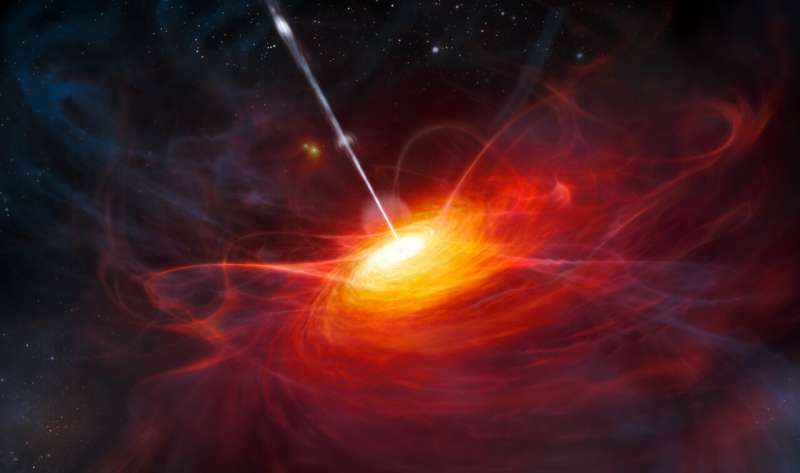
An international team of astronomers has identified ID830 as the most X-ray luminous radio-loud quasar known to date. Utilizing the Spektr-RG spacecraft along with various ground-based telescopes, the researchers published their findings on November 7, 2025, on the pre-print server arXiv. This discovery has significant implications for understanding the nature of quasars and the supermassive black holes that power them.
Quasars, or quasi-stellar objects (QSOs), are active galactic nuclei found at the centers of galaxies, driven by supermassive black holes (SMBHs). They exhibit extremely high bolometric luminosities, exceeding one quattuordecillion erg/s, and emit electromagnetic radiation across a broad spectrum, including radio, infrared, visible, ultraviolet, and X-ray wavelengths.
Unveiling the Mysteries of ID830
ID830, also known as eFEDS J084222.9+0010000, is located at a redshift of 3.43. The quasar reaches a remarkable bolometric luminosity of approximately one quindecillion erg/s. This level of brightness suggests it may harbor either an exceptionally massive SMBH close to the maximum mass limit of 10 billion solar masses or be undergoing a super-Eddington accretion phase.
A team led by Sakiko Obuchi from Waseda University in Tokyo undertook a multiwavelength study of ID830 to explore these possibilities. The researchers combined data from eROSITA X-ray spectroscopy, the Sloan Digital Sky Survey (SDSS), and radio observations from LOFAR, GMRT, FIRST, ASKAP, and VLASS. Their analysis revealed that ID830 is a rare example of a super-Eddington, radio-loud quasar exhibiting an extreme X-ray excess.
The study found that ID830 has an X-ray luminosity level of 0.01 quindecillion erg/s, ranking it among the most X-ray luminous radio-loud quasars detected. Its bolometric luminosity was measured at around 0.076 quindecillion erg/s, yielding an Eddington ratio of 1.4, thus confirming the presence of super-Eddington accretion. The researchers noted a moderate reddening of approximately 0.39 mag, and estimated the mass of the SMBH to be around 440 million solar masses.
Significance of Findings
The analysis further indicated that ID830 exhibits a high ratio of ultraviolet-to-X-ray luminosities, calculated to be -1.2. This ratio is notably higher compared to other quasars and “little red dots” (LRDs) in the super-Eddington phase that possess similar ultraviolet luminosities. LRDs are believed to be a type of early AGN with SMBHs.
The estimated jet kinetic power of ID830 is between 1–10 quattuordecillion erg/s, comparable to its radiative luminosity. This finding suggests that mechanical energy from the quasar’s jet can effectively interact with the host’s interstellar medium.
The authors of the study propose that ID830 is in a transitional phase where both the corona and the jet are energized following an accretion burst. They conclude that “ID830 may represent a post-burst super-Eddington quasar bridging the gap between sub-Eddington quasars and the X-ray weak, rapidly accreting ‘little red dots’ recently identified with the James Webb Space Telescope (JWST).”
This groundbreaking research not only enhances the understanding of quasars but also sheds light on the complex processes occurring around supermassive black holes, paving the way for future investigations in this fascinating area of astrophysics.