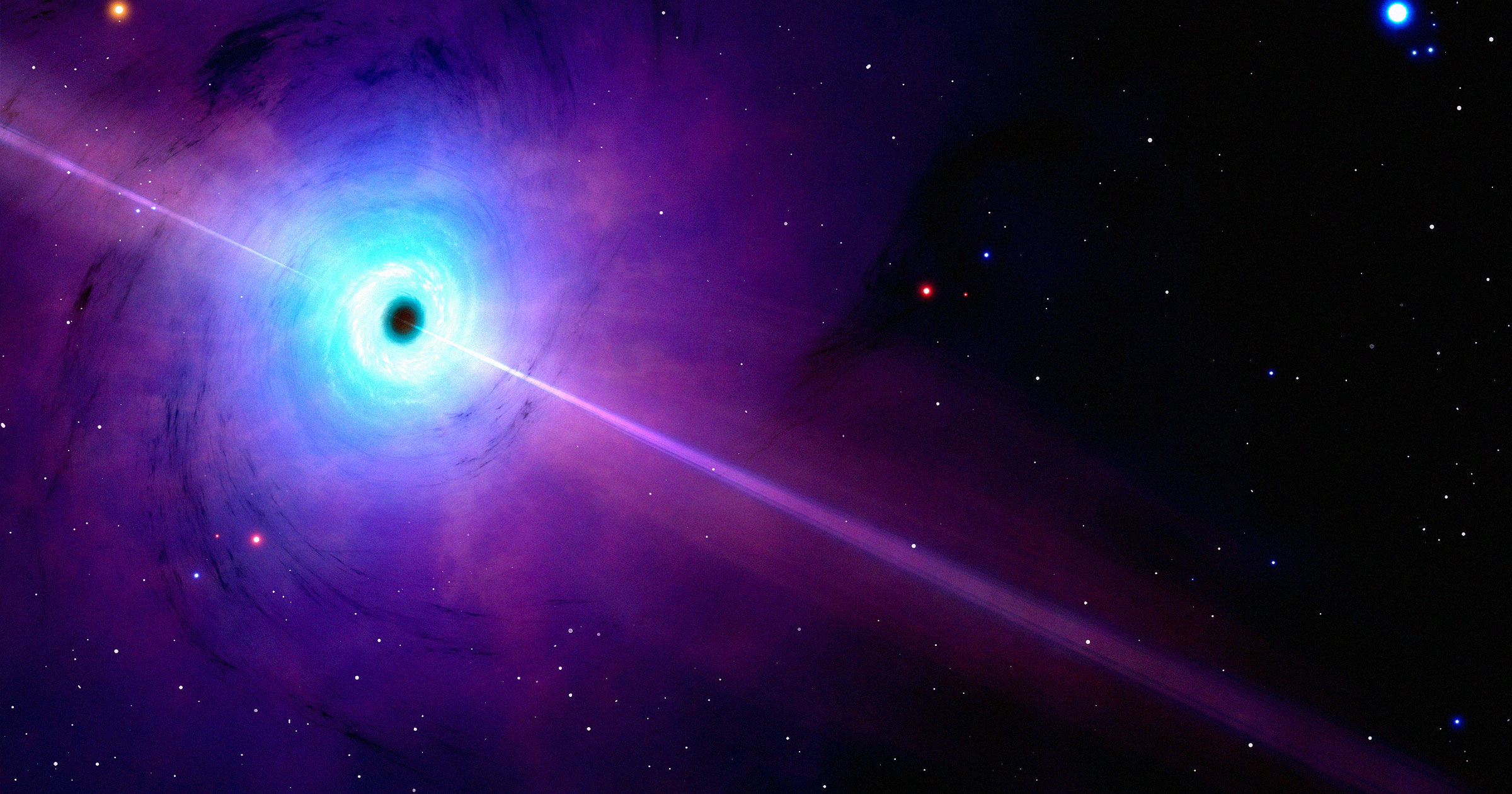
An international team of astronomers has reported a groundbreaking discovery involving a runaway supermassive black hole, identified with the help of the James Webb Space Telescope. This black hole is moving at an astonishing speed of 2.2 million miles per hour away from its home galaxy, marking it as the first known instance of its kind.
Supermassive black holes are typically located at the centers of galaxies, exerting immense gravitational forces that allow them to absorb everything in their vicinity, including light. The presence of these cosmic entities is common, with a notable example being Sagittarius A*, located at the heart of our own Milky Way galaxy. Despite their frequent detection, the formation and movement of these black holes remain largely enigmatic.
The newly discovered black hole, estimated to be 10 million times the mass of the Sun, is currently traversing the Cosmic Owl, a pair of interacting galaxies approximately eight billion light-years away. This extraordinary object is not only moving rapidly but is also pushing a vast “bow-shock” of matter ahead of it, which is comparable in size to an entire galaxy. Behind it, a 200,000 light-year-long tail of gas is forming new stars, further adding to the complexity of this cosmic phenomenon.
Astronomer Pieter van Dokkum from Yale University, who leads the research team, expressed his astonishment at the findings. “The forces that are needed to dislodge such a massive black hole from its home are enormous,” he stated. “And yet, it was predicted that such escapes should occur.” This finding signifies the first time a supermassive black hole has been confirmed to be far from its original location.
The team initially identified the intriguing black hole in 2023 using the Hubble Space Telescope. However, its event horizon, which absorbs light, presented challenges in confirming its motion through space. The capabilities of the James Webb Space Telescope allowed researchers to analyze the large volume of gases displaced by the black hole.
“It is moving at approximately 620 miles per second, faster than just about any other object in the universe,” van Dokkum explained. This high velocity is believed to have enabled the black hole to escape the gravitational pull of its original galaxy.
Researchers propose that the black hole’s high-speed trajectory may have resulted from a collision with another supermassive black hole. This interaction could have generated a powerful wave of gravitational waves, propelling it away at incredible speeds. Alternatively, if it encountered a binary black hole system, the resulting instability could have facilitated its ejection, a scenario referred to as a “three-body interaction.”
The likelihood of this supermassive black hole being ejected from its home due to a collision with a single black hole is considered more probable. Van Dokkum noted, “Mergers happen often in the life of a galaxy; each galaxy with the size and mass of the Milky Way has experienced several during its lifetime.” This frequency suggests that black hole binaries are likely to form regularly.
As the research progresses, van Dokkum remains focused on the empirical aspect of the findings. “Now that we know how to look for them, we can find other examples — and then we can answer the question directly from data, by counting the number of escapes,” he stated.
This discovery not only sheds light on the behavior of supermassive black holes but also opens up new avenues for understanding their formation and evolution in the cosmos. The implications of a runaway black hole challenge existing theories and encourage further exploration of these fascinating astronomical phenomena.