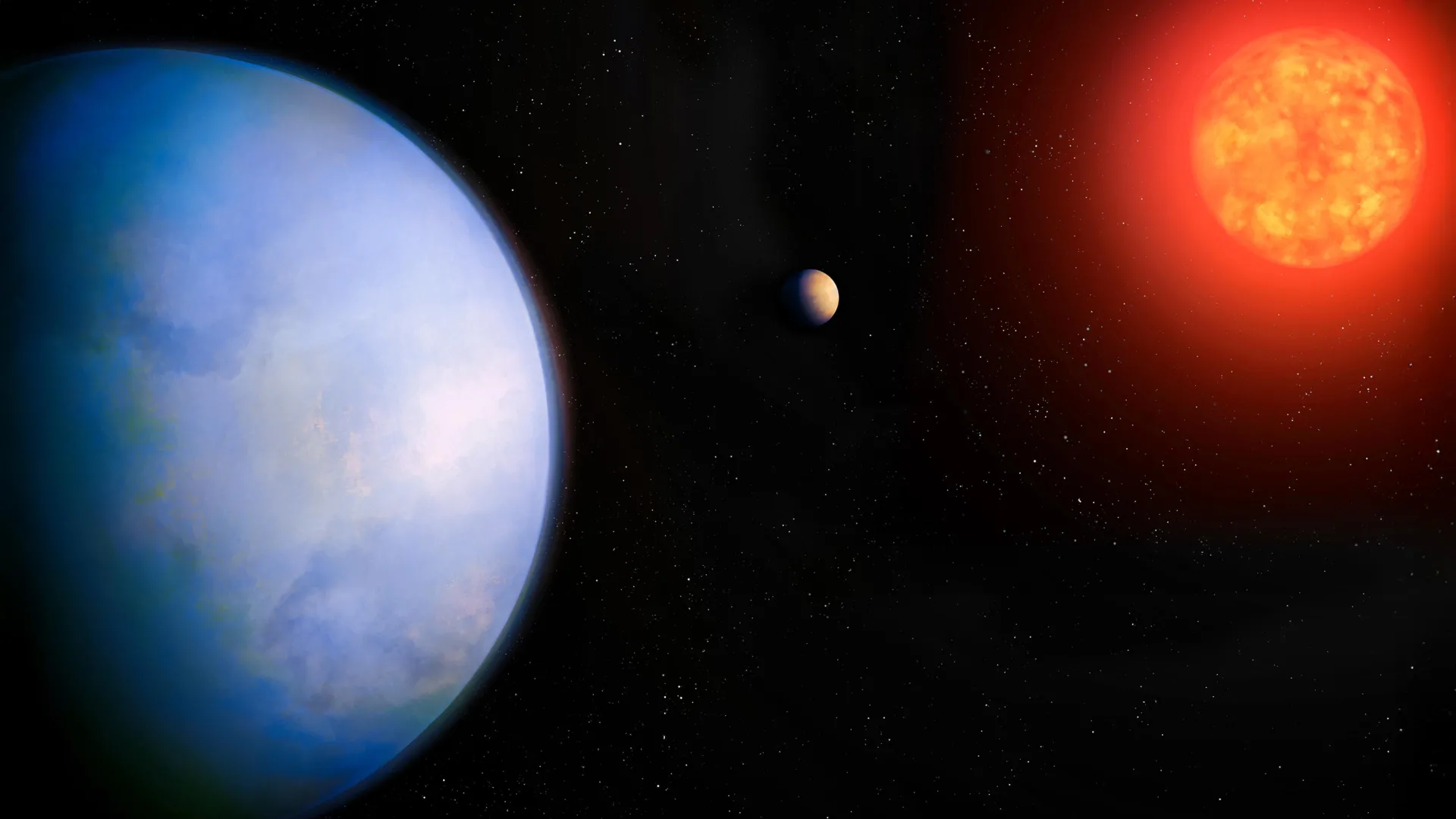
Astronomers at the University of California – Irvine have identified a super-Earth named GJ 251 c, located in the habitable zone of a nearby M-dwarf star just 18 light-years from Earth. This discovery presents a significant opportunity in the ongoing search for extraterrestrial life, as the planet’s position suggests it could potentially support liquid water, a critical element for life as we know it.
The findings, detailed in a recent publication in The Astronomical Journal, highlight the planet’s rocky composition, characteristic of super-Earths, which are typically several times more massive than Earth. Co-author Paul Robertson, an associate professor of physics and astronomy at UC Irvine, remarked, “Discovering a new exoplanet is now a common occurrence. However, GJ 251 c is particularly valuable because its host star is relatively close, making it a prime target for further study.”
Understanding GJ 251 c and its Star
GJ 251 c orbits an M-dwarf star, one of the oldest and most prevalent star types in the Milky Way. While M-dwarfs are known for significant stellar activity, which includes starspots and flares, this can complicate the detection of orbiting planets. Despite these challenges, the proximity of GJ 251 c to Earth makes it an ideal candidate for direct imaging, particularly with the upcoming Thirty Meter Telescope, currently under development. This telescope will possess the necessary resolution to observe distant, faint worlds like GJ 251 c and investigate their potential for water.
Lead author Corey Beard, a data scientist at Design West Technologies and former graduate student in Robertson’s group, emphasized the importance of the TMT, stating, “It’s the only telescope capable of imaging exoplanets of this nature. Smaller telescopes lack the required capability.”
Advanced Techniques Reveal New Planet
The detection of GJ 251 c was made possible through sophisticated instruments, including the Habitable-zone Planet Finder and NEID. These precision tools, developed in part by Robertson, measure the subtle gravitational effects that an orbiting planet exerts on its star. By examining these influences, astronomers were able to observe periodic shifts in the star’s light, confirming the presence of GJ 251 c.
The team utilized advanced computational models to classify GJ 251 c as an exoplanet candidate, reinforcing the necessity for direct imaging to ascertain its characteristics. Beard noted, “While the discovery is statistically significant, we still need to clarify the planet’s status due to uncertainties with our instruments. The next generation of telescopes will be essential for direct imaging.”
Encouragingly, the research team hopes their findings will stimulate further investigations into GJ 251 c, especially as new observatories like the Thirty Meter Telescope approach operational status. Collaboration on this project included researchers from various institutions, such as Jack Lubin from UCLA, Eric Ford and Suvrath Mahadevan from Pennsylvania State University, Gudmundur Stefansson from the University of the Netherlands, and Eric Wolf from the University of Colorado, Boulder.
This research received support from the NSF grant AST-2108493 for the HPF exoplanet survey and NASA/NSF funding for the NN-EXPLORE program, among other sources. With the potential to explore GJ 251 c further, astronomers are poised to advance our understanding of planets outside our solar system and their capacity to harbor life.