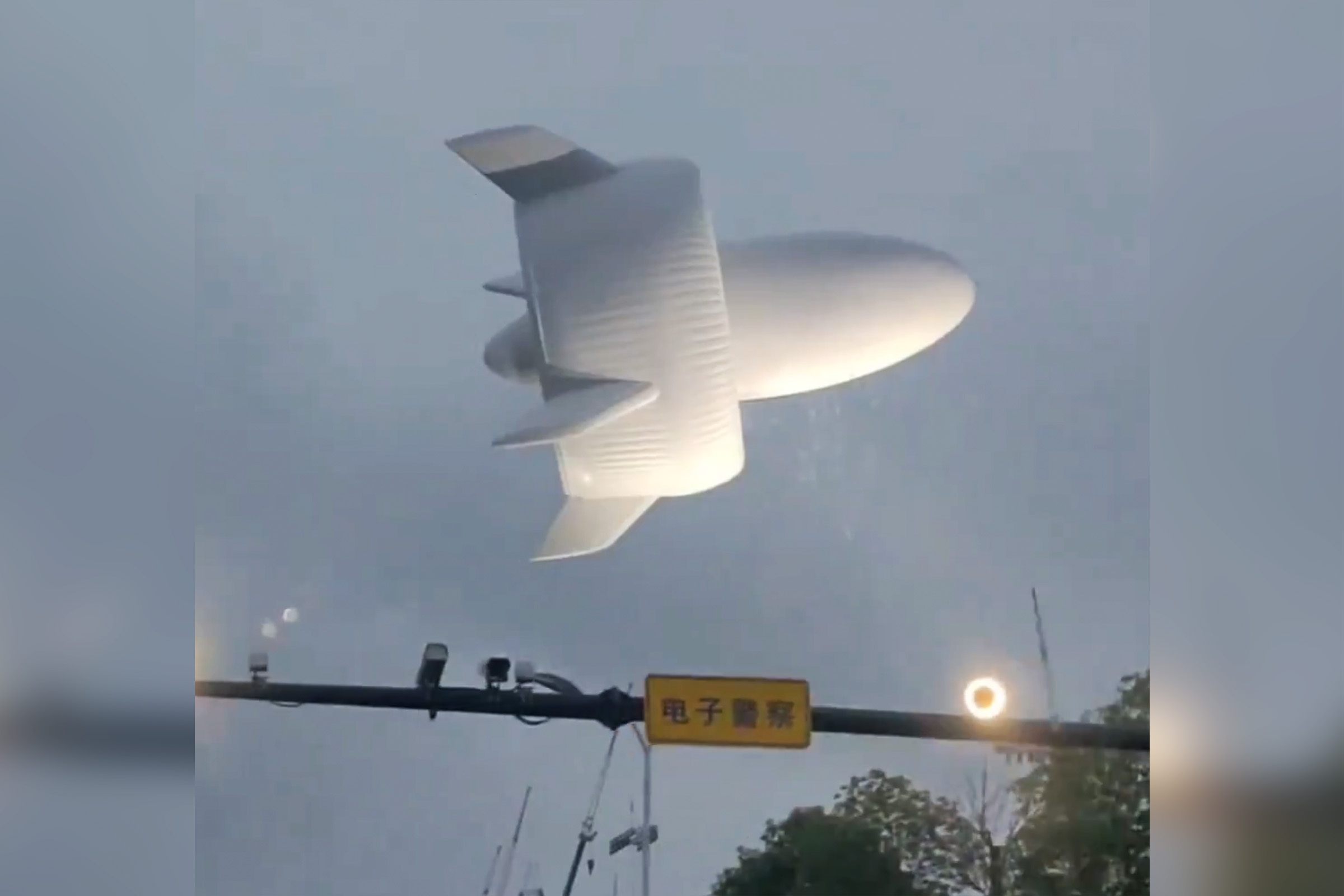
A new airborne wind turbine (AWT) prototype has made its debut over Sichuan Province, China, showcasing innovative advancements in renewable energy technology. Developed by the Chinese energy company Linyi Yunchuan in collaboration with Tsinghua University and the Chinese Academy of Sciences, the SAWES S2000 aims to harness high-altitude winds for electricity generation. A video shared by journalist Li Zexin on January 9, 2026, highlighted the turbine’s impressive design, sparking interest in China’s ongoing commitment to green energy.
The SAWES S2000 is described as the world’s first megawatt-class high-altitude wind power system intended for urban deployment, capable of producing approximately 3 megawatts of power. According to the Global Times, this cutting-edge prototype successfully completed a test flight, remaining airborne for 30 minutes and generating around 385 kilowatt-hours of electricity while reaching an altitude of approximately 6,500 feet. Notably, this turbine managed to connect to the local power grid, marking a significant milestone for AWT technology.
Dun Tianrui, the chief designer of the SAWES project, explained the turbine’s efficiency, stating, “At its current output level, one hour of operation can generate enough electricity to fully charge approximately 30 top-spec electric vehicles from zero to full.” This highlights the potential of airborne wind turbines to contribute meaningfully to urban energy needs.
Transportability and deployment efficiency are key features of the SAWES S2000. Dun noted that the unit can be easily stored in shipping containers and requires about eight hours to fully inflate. By coordinating with local gas supply chains for helium, a limited resource, the deployment time could be reduced to four or five hours.
Structurally, AWTs resemble airships, supporting multiple lightweight turbine-generators that remain relatively static in high-altitude wind streams. This allows them to effectively harness strong winds, with electricity transmitted down to the ground through a tether to feed into an electrical substation.
The recent test flights follow a successful earlier deployment of the SAWES S1500 unit in September 2025, which has a generator capacity of 1.2 megawatts. The S1500, described as being “about the size of a basketball court and as tall as a 13-story building,” was the first of its kind to generate a full megawatt of power during its maiden voyage.
These advancements come at a time when China’s carbon dioxide emissions have reportedly decreased year-over-year, driven by a surge in renewable energy sources such as wind and solar power. As the world leader in solar energy and offshore wind capacity, China continues to push the boundaries of renewable technology with projects like the SAWES S2000, reinforcing its commitment to a sustainable energy future.
The SAWES initiative not only showcases innovative engineering but also represents a pivotal step towards addressing energy demands in urban areas while reducing carbon footprints. As developments in airborne wind turbine technology continue, the global energy landscape may witness significant transformations in how renewable energy is harnessed and utilized.