The crew of the Shenzhou-20 spacecraft has safely returned to Earth on November 14, 2025, following a delay caused by damage from an impact with space debris. The three astronauts—Chen Dong, Chen Zhongrui, and Wang Jie—were originally scheduled to land on November 5 but had to postpone their return after a cracked window was discovered on their spacecraft. This prompted them to depart the Tiangong space station using the recently arrived Shenzhou-21.
The impact occurred while the crew was aboard the station, leading to a thorough inspection of the Shenzhou-20 by the six taikonauts present. The China Manned Space Agency (CMSA) provided critical support during this process. On November 11, the China Manned Space Engineering Office (CMSEO) announced that contingency plans were underway to ensure the crew’s safe return.
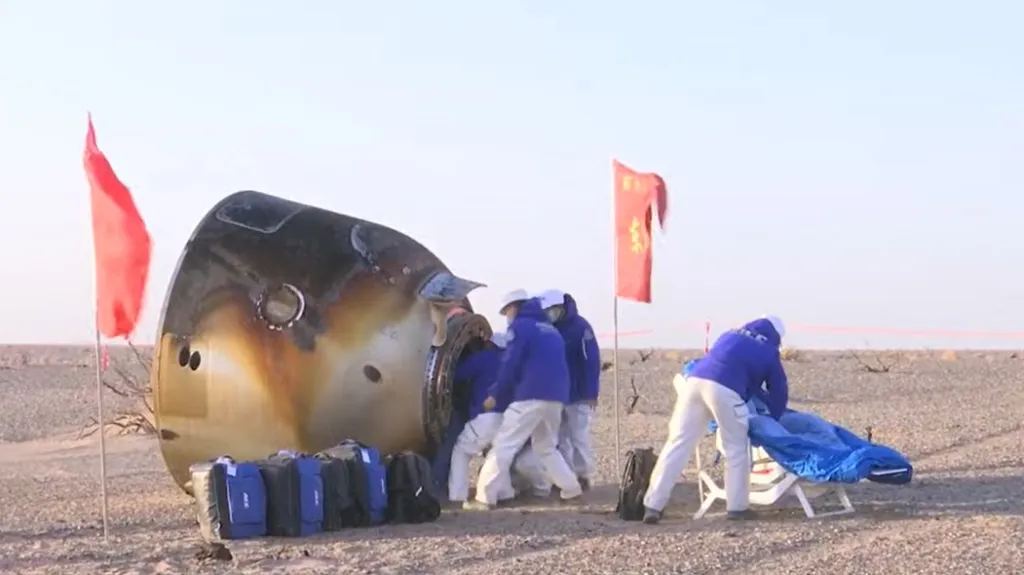
At 22:14 EST on November 13, the crew took off from the space station aboard the Shenzhou-21, indicating the Shenzhou-20 was unsafe for re-entry. They successfully landed in Inner Mongolia at 11:14 a.m. Beijing Time on November 14 (09:14 p.m. EST, November 15, 2025). Following their landing, medical teams assessed the astronauts and confirmed they were in good health, as reported by the state-owned media outlet Xinhua.
Chen Dong expressed pride in their successful mission, stating, “Space exploration has never been easy for humankind. This mission was a true test, and we are proud to have completed it successfully.” He emphasized that the safety of astronauts is a top priority for China’s space program.
The Shenzhou-21 spacecraft launched from the Jiuquan Satellite Launch Center on October 31, 2025, delivering a replacement crew of Zhang Lu, Wu Fei, and Zhang Hongzhang to the space station. However, the departure of the Shenzhou-20 crew has left the Shenzhou-21 team without a clear plan for returning to Earth. Future operations are expected to be addressed with the launch of the Shenzhou-22, which will not carry a crew.
During their extended time in space, the Shenzhou-20 crew achieved several notable milestones. Commander Chen Dong completed six extravehicular activities, making him the taikonaut with the most such tasks to date. Additionally, they became the first crew to spend more than 200 consecutive days in space. The astronauts also celebrated their arrival with a barbecued meal, marking a unique moment as they welcomed the new crew onboard the Tiangong space station.
This incident highlights significant advancements in China’s space program, showcasing its ability to handle unexpected challenges. The effective response and backup plans implemented by the CMSA ensure that operations aboard the Tiangong space station will continue smoothly.
As the International Space Station (ISS) approaches its retirement, China aims to solidify its role in future space exploration and scientific endeavors in Low Earth Orbit (LEO) through the Tiangong and other planned space stations.