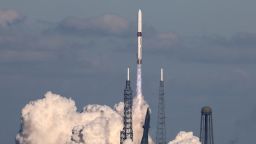
Michaela Benthaus, a 33-year-old aerospace and mechatronics engineer from Germany, made history by becoming the first wheelchair user to travel beyond the Kármán Line, a boundary often recognized for defining outer space at an altitude of 100 kilometers (62 miles) above sea level. Her groundbreaking journey took place aboard a Blue Origin New Shepard capsule on March 15, 2024, launching from the company’s facilities near Van Horn, Texas.
The mission, designated NS-37, marks the 16th suborbital space tourism flight conducted by Blue Origin, a venture founded by Jeff Bezos in 2000. The company aims to broaden access to space for individuals who may not fit the traditional astronaut profile. “I always wanted to go to space, but I never really considered it something which I could actually do,” Benthaus stated in an interview prior to her flight. Her journey serves as a significant milestone for inclusivity in space exploration.
Benthaus’s interest in space was ignited after she suffered a spinal cord injury in a mountain biking accident in 2018. Since then, she has redirected her passion toward engineering and research, demonstrating a commitment to overcoming challenges associated with her mobility. Prior to her flight, she expressed her apprehensions about whether someone with her condition could successfully navigate space travel.
The flight lasted approximately 10 minutes, during which Benthaus and her five crewmates ascended to speeds exceeding three times the speed of sound. At the peak of the flight, they experienced a brief period of weightlessness, an exhilarating aspect of space travel that Benthaus was eager to enjoy. To secure herself during this phase, she utilized a special strap designed to keep her legs in place as she exited her seat to experience microgravity and gaze out the window at Earth.
Benthaus’s previous experience with microgravity during a parabolic training flight equipped her with insights on how to maximize this unique opportunity. As she prepared for her journey, she indicated that her focus would be on appreciating the stunning views rather than engaging in acrobatics within the cabin.
In addition to her personal achievement, Benthaus aims to leverage her experience to enhance the journey for future passengers with similar disabilities. “I want to see how this leg strap works — and if not, what could maybe be improved in the future,” she noted. Concerns about her ability to return to her seat without assistance were addressed by the presence of her friend, Hans Koenigsmann, a former executive at SpaceX, who was trained to assist her if necessary.
Benthaus’s flight is not just a personal milestone; it also serves a greater purpose. She is fundraising for Wings for Life, a nonprofit organization dedicated to spinal cord injury research, highlighting the intersection of her adventure with meaningful advocacy.
This remarkable journey represents a pivotal moment in both space tourism and the broader conversation about accessibility. Michaela Benthaus’s achievement is a testament to the spirit of exploration that continues to push boundaries and inspire individuals around the world.