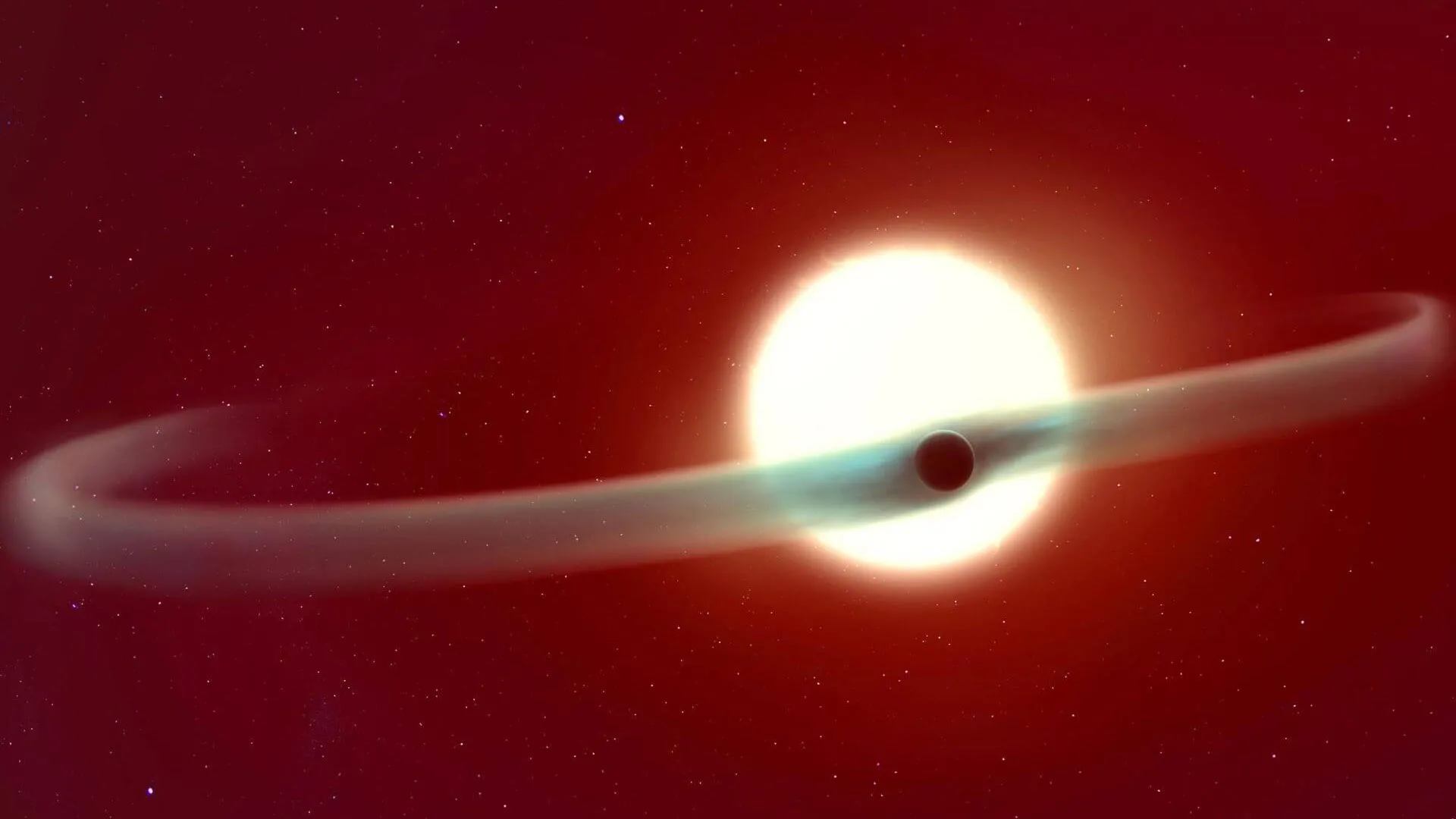
A team of astronomers has achieved a remarkable milestone in exoplanet research, capturing real-time observations of an exoplanet losing its atmosphere. Using the James Webb Space Telescope (JWST), researchers studied the gas giant WASP-121b over an entire orbit, revealing two enormous helium tails instead of just one. This unprecedented observation sheds light on the dynamic processes that shape exoplanetary atmospheres.
Continuous Monitoring Yields Unprecedented Insights
Conducted by scientists from the University of Geneva, the National Centre of Competence in Research PlanetS, and the Trottier Institute for Research on Exoplanets at the University of Montreal, this study represents a significant advancement in the understanding of atmospheric escape. Until now, astronomers could only observe such phenomena during short planetary transits, which limited their ability to gather comprehensive data. The new findings have been published in Nature Communications.
During the nearly 37-hour observation period, researchers utilized the JWST’s Near-Infrared Spectrograph (NIRISS) to monitor WASP-121b continually. This allowed them to track helium escaping from the planet’s atmosphere with great precision, marking the most extensive continuous detection of this kind ever recorded.
Two Distinct Helium Tails Identified
The study revealed that WASP-121b, classified as an ultra-hot Jupiter, is enveloped by two massive streams of helium. One tail trails behind the planet, propelled by stellar radiation and winds, while the other moves ahead, influenced by the star’s gravitational pull. These gas flows extend over a distance more than 100 times the planet’s diameter, illustrating the complex interactions between the planet and its environment.
“We were incredibly surprised to see how long the helium escape lasted,” said Romain Allart, a postdoctoral researcher at the University of Montreal and lead author of the study. “This discovery reveals the complexity of the physical processes that sculpt exoplanetary atmospheres and their interaction with their stellar environment.”
The extreme conditions surrounding WASP-121b, which completes an orbit in just 30 hours, expose its atmosphere to intense radiation. This heat causes lightweight elements like hydrogen and helium to escape into space, potentially altering the planet’s characteristics over millions of years.
Challenges for Current Theoretical Models
Despite the success of current numerical models in describing simple gas tails, the dual structure observed around WASP-121b poses challenges for existing theories. According to Yann Carteret, a doctoral student at the University of Geneva and co-author of the study, the complexity of the observed flows necessitates a new generation of 3D simulations to better understand the physics behind atmospheric escape.
The JWST’s ability to detect helium over unprecedented distances and time spans opens avenues for further exploration into the behavior of exoplanet atmospheres. Future studies will seek to determine whether the twin-tail structure observed around WASP-121b is a common phenomenon among ultra-hot Jupiters.
“Very often, new observations reveal the limitations of our numerical models and push us to explore new physical mechanisms,” concluded Vincent Bourrier, a lecturer and researcher at the University of Geneva. “Our understanding of these distant worlds is still evolving.”
This groundbreaking research not only enhances the understanding of atmospheric escape but also underscores the significance of the JWST in advancing exoplanet science. As researchers continue to refine their models, they aim to unlock further mysteries surrounding the atmospheres of distant planets.