New insights into the origins of matter have emerged from two leading international experiments examining neutrinos, the elusive particles that may hold the key to understanding why our universe contains more matter than antimatter. The recent collaborative study, published in the journal Nature, combines findings from the NOvA collaboration at Fermilab in Illinois and the T2K experiment in Japan.
According to Tricia Vahle, a professor of physics at William & Mary and co-spokesperson for the NOvA collaboration, the initial conditions of the universe predicted equal amounts of matter and antimatter at the moment of the Big Bang. If this had been the case, matter and antimatter would have annihilated each other, leaving only energy. The survival of a small excess of matter is what has allowed for the existence of the universe as we know it.
Neutrinos, often referred to as “ghost particles” due to their minimal interaction with matter, are produced in the sun through fusion reactions. Vahle recalls first learning about them in high school when scientists were attempting to measure how many neutrinos reached Earth. The results suggested a significant shortfall, raising questions about their behavior.
Collaboration Drives New Discoveries
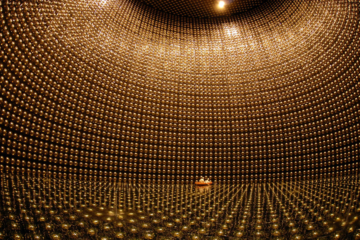
The NOvA and T2K collaborations have been investigating the behavior of neutrinos by sending intense beams of these particles over considerable distances to specialized detectors. The NOvA experiment fires neutrinos through the Earth to a large detector in Ash River, Minnesota, measuring the particles as they take less than three milliseconds to travel 810 kilometers. Meanwhile, the T2K experiment sends neutrinos from Tokai, Japan, to the Super-Kamiokande detector, located 295 kilometers away.
The current joint analysis incorporates six years of data from NOvA and eight years from T2K. Vahle states that the collaboration enhances the understanding of neutrino properties, as they employ different detection methods, distances, and energy levels. “When we combine our results, we can make a stronger statement about neutrinos than we could separately,” she explained.
This collaborative effort has yielded the most precise measurement to date regarding the differences in the masses of two types of neutrinos. The findings suggest two possible scenarios regarding neutrino mass ordering. If neutrinos exhibit an inverted mass ordering with one light and two heavier neutrinos, it may indicate a violation of charge-parity symmetry, potentially explaining the dominance of matter over antimatter. Conversely, if they follow a normal mass ordering with two light and one heavy neutrino, the implications for understanding the matter-antimatter asymmetry remain unclear.
Looking Ahead at Neutrino Research
As the NOvA and T2K collaborations continue to gather data, Vahle anticipates ongoing cooperation between the two experiments and the introduction of new neutrino research projects. “Nature is revealing that our current models of nature are lacking,” she noted. “We are learning something new, something that we got wrong, and that will lead us to think about the problem in different ways and come up with new solutions.”
The combined efforts of these international teams underscore the collaborative spirit of modern physics research, as scientists seek to unlock the mysteries surrounding the universe’s fundamental properties. The ongoing investigation into neutrinos may ultimately reshape our understanding of the cosmos and its origins.