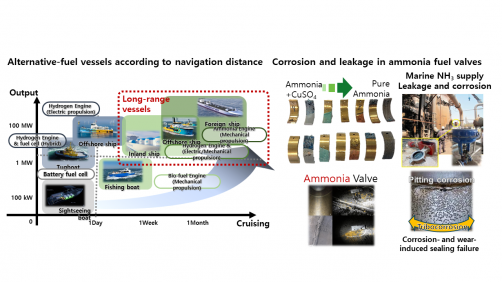
A research team from the Korea Institute of Materials Science (KIMS), led by Dr. Young-Jun Jang and Dr. Jongkuk Kim, has developed an innovative carbon coating technology aimed at addressing corrosion and wear issues in marine metals exposed to ammonia fuel. This advancement represents a significant step towards enhancing the commercial viability of eco-friendly ammonia-powered vessels, positioning South Korea at the forefront of sustainable shipping technology.
Revolutionizing Marine Materials
Conventional marine materials, such as stainless steel 440C, are known to deteriorate rapidly in ammonia environments due to the chemical reactivity and strong alkalinity of ammonia. This degradation compromises the integrity of essential components like engines, valves, pumps, and bearings. The newly developed carbon coating technology, referred to as ta-C:Hx, effectively mitigates these issues by significantly reducing corrosion rates and wear.
Experimental results indicate that traditional materials exhibit a corrosion current density of approximately 48 μA/cm² in ammonia solutions. In stark contrast, the ta-C:Hx coating reduces this density to just 4 μA/cm², achieving a remarkable 92% reduction. Furthermore, the corrosive wear rate for the coated surfaces declined dramatically from 1.4 × 10⁻⁶ mm³/N·m to 1.3 × 10⁻⁸ mm³/N·m, which is a reduction of 99.1% in tribocorrosion wear tests.
This coating technology is particularly crucial as the International Maritime Organization (IMO) pushes for a transition to zero-carbon fuels by 2030. As part of its 2023 Greenhouse Gas Reduction Strategy, the IMO has mandated that a specified proportion of fuels in international shipping must be zero-carbon alternatives, including ammonia. Additionally, the Maritime Safety Committee has established guidelines requiring verification of corrosion resistance for materials used in ammonia-powered fuel systems.
Technological Innovations and Future Prospects
The innovation stems from a tailored approach to the coating process, specifically engineered for ammonia environments. By utilizing pulsed bias control within a filtered arc deposition method, the research team minimized micropores and interfacial defects that could lead to corrosion. The introduction of hydrogen during the coating application further stabilized the carbon structure, enhancing its performance in aqueous ammonia solutions.
Despite the promising advancements, the need for reliable domestic surface coating technologies remains a significant hurdle for South Korean shipbuilders striving to meet the corrosion resistance requirements for ammonia-powered vessels. With the nation’s strategic focus on ammonia-powered shipping, as outlined in the 2050 Green Shipping National Action Plan, this newly developed technology could prove vital for the future of the industry.
Dr. Young-Jun Jang, Principal Researcher and lead investigator, emphasized the implications of this development, stating, “If this technology is commercialized, it will provide a practical solution for long-distance operation by significantly improving the efficiency and reliability of key components for eco-friendly shipbuilding and marine vessels.”
Co-researchers Dr. Jongkuk Kim and Dr. Sungmo Moon highlighted the collaborative nature of the project, noting that the technology emerged from the integration of KIMS’s internal resources rather than external technologies. This approach not only strengthens South Korea’s industrial ecosystem but also enhances its competitiveness in the global market.
The research findings were published on December 1, 2025, in the esteemed journal Carbon, which boasts an impact factor of 11.6. The team is now focused on conducting further evaluations of the coating technology’s reliability in ammonia environments, alongside demonstration studies to assess its application in actual ship components. Future plans include pursuing patent filings and exploring commercialization opportunities through industry partnerships.
As the global maritime industry shifts towards sustainable fuel sources, advancements like the ta-C:Hx coating technology could play a crucial role in facilitating the transition to greener shipping practices.