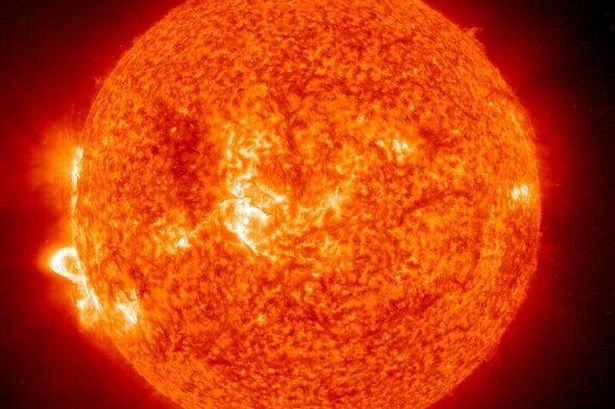
A large cluster of sunspots, designated AR 4294-4296, has rotated into view on the sun’s Earth-facing side, raising concerns about potential solar activity. This formation, which comprises two linked sunspot groups, became visible on November 28, 2023. While it bears similarities to the sunspot responsible for the historic Carrington Event of 1859, scientists emphasize that the likelihood of a similar solar storm occurring soon is low.
The two sunspot groups, AR 4294 and AR 4296, have dimensions approaching 90% of the size of the Carrington Event sunspot. The Carrington Event produced the most powerful solar storm ever recorded, with a magnitude of X45. Although AR 4294-4296 may appear larger, its actual dark regions are slightly smaller than those of the infamous Carrington sunspot.
Sunspots can generate intense solar flares and coronal mass ejections (CMEs), which pose risks to Earth’s technology. When their magnetic fields become unstable, they can release bursts of radiation that may disrupt communications and create stunning auroras in the night sky. Spaceweather.com has reported that AR 4294-4296 is one of the largest sunspot groups seen in the past decade, with the potential to emit supercharged X-class flares—the highest category on the National Oceanic and Atmospheric Administration’s (NOAA) classification system.
The Carrington Event’s X45 flare serves as a stark reminder of the potential dangers. If a similar event were to occur today, the ramifications could be severe, causing widespread damage to satellites and electrical grids. Estimates suggest that such damage could exceed $1 trillion. Recent simulations indicate that an X-class flare of this magnitude would create chaos on Earth, jeopardizing modern infrastructure.
Despite the ominous size of the current sunspot cluster, experts caution that not all large sunspots lead to significant solar storms. The configuration of magnetic fields and the frequency of explosive events are critical factors in determining whether a sunspot will produce a massive flare. Some large sunspots can be harmless, while others can release potent solar flares, as seen with AR 4294-4296, which has already shown the potential to generate X-class flares while still on the sun’s far side.
In light of this new sunspot formation, scientists are closely monitoring its magnetic field for signs of increased activity. They remain vigilant for any indications of upcoming solar activity that could affect Earth. If AR 4294-4296 rotates past without incident, it may reappear for another round in the coming weeks, possibly around Christmas.
As the sunspot cluster points directly towards Earth, specialists are urging the public to remain calm. While there may be minor disruptions in technology and the possibility of auroras in the night sky, the probability of a second Carrington Event occurring in the near future is minimal. Researchers will continue to observe AR 4294-4296 closely, assessing its potential impact on our planet.