The upcoming launch of the Nancy Grace Roman Space Telescope is poised to significantly enhance our understanding of exoplanets, particularly through its advanced gravitational microlensing surveys. With an expected increase in the number of monitored events and improved precision in light curve data, this innovative telescope will enable scientists to identify and analyze multiplanetary systems with unprecedented accuracy.
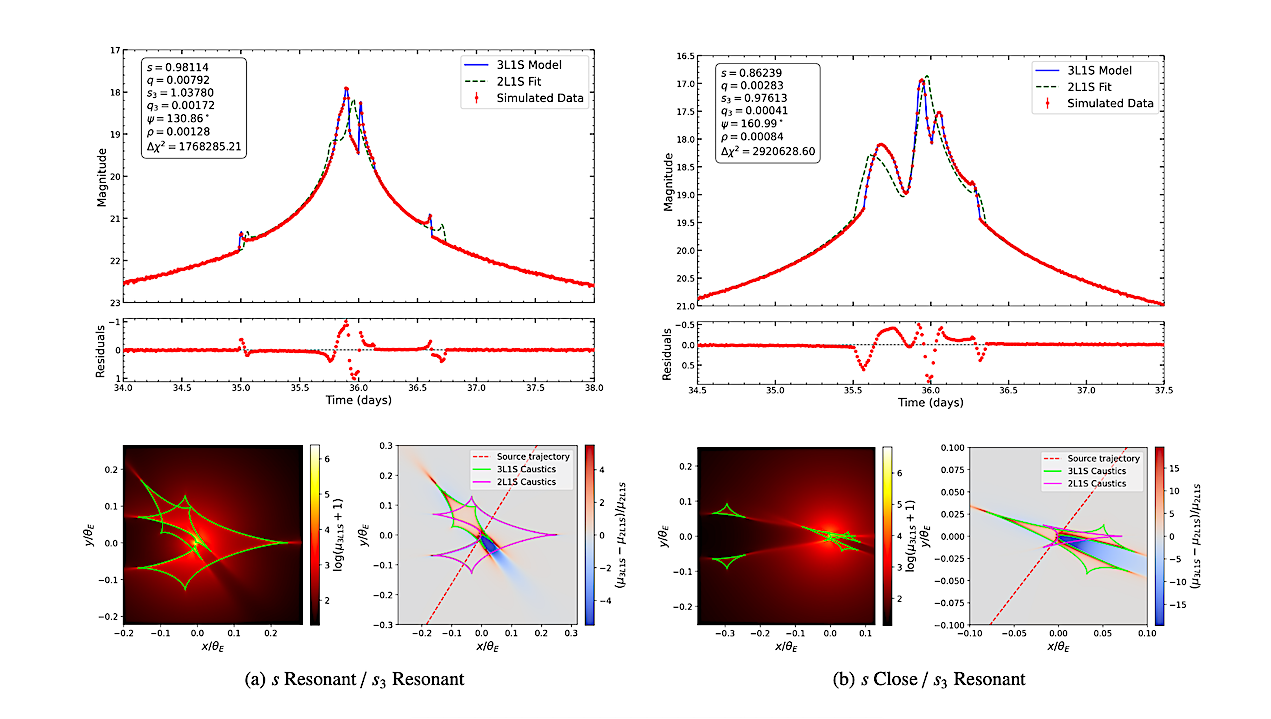
One key area of focus is the detection of triple-lens microlensing systems. These systems occur when a foreground star, hosting two bound exoplanets, creates discernible anomalies during a microlensing event. Researchers have simulated a comprehensive set of high-magnification microlensing light curves that reflect the telescope’s anticipated survey characteristics. By applying a detection criterion based on a necessary χ2 improvement for a two-planet model, they evaluated whether a second planet could be reliably identified among the data.
The findings from these simulations indicate that the majority of two-planet microlensing events will be detectable using the Roman Space Telescope. Specifically, events where both planets are relatively massive—exhibiting planet-star mass ratios around 10-3—or where the more massive planet is positioned favorably in a resonant configuration, show strong central perturbations. This results in detection efficiencies of approximately 90% for these configurations.
In contrast, systems that consist solely of low-mass planets (with ratios around 10-4) or exhibit less favorable alignments produce weaker signals, often failing to surpass detection thresholds. The planetary mass ratios and the resulting caustic geometry are critical factors influencing detectability. For instance, the size of the central caustic varies significantly between resonant orbits and those that are wide or close, further complicating detection efforts.
Researchers estimate that, considering the expected frequency of planetary systems and the share of high-magnification events, the Nancy Grace Roman Space Telescope will likely detect a high-magnification triple-lens event in about 4.5% of all multi-planet microlensing events. This projection translates to approximately 64 events identified throughout the telescope’s full survey duration.
The work of this study involved contributions from a diverse group of scientists, including Vito Saggese, Étienne Bachelet, and David P. Bennett, among others. Their collaborative effort underscores the importance of the Roman Space Telescope in advancing our understanding of exoplanetary systems.
As the launch date approaches, anticipation builds within the astrophysics community. The potential for groundbreaking discoveries regarding the formation and characteristics of multiplanet systems presents an exciting frontier in our quest to understand the universe. The advancements made by the Nancy Grace Roman Space Telescope promise not only to answer longstanding questions but also to inspire new avenues of research in exoplanetary studies.