When NASA needed a reliable transport solution for its approximately 100-ton space shuttles, it turned to the aviation industry for assistance. The agency evaluated two potential candidates: the massive Lockheed C-5 Galaxy and the Boeing 747. Ultimately, NASA selected the Boeing 747 due to its superior design and performance characteristics.
The Boeing 747’s airframe features a low-wing design, which made it an ideal platform for mounting the shuttle. In contrast, the C-5 Galaxy’s high-wing structure posed challenges for securely attaching a shuttle for transport. Additionally, the four-engine 747 offered significant power, enabling it to handle the weight and balance required for the task. When the 747 entered commercial service in 1969, it quickly became the largest commercial aircraft in operation.
With a total thrust output of 48,600 pounds from each of its four Pratt & Whitney engines, the 747 could manage a maximum gross taxi weight of 713,000 pounds. The specific 747 unit selected for NASA’s shuttle transport role was not lightweight either, weighing over 300,000 pounds when empty.
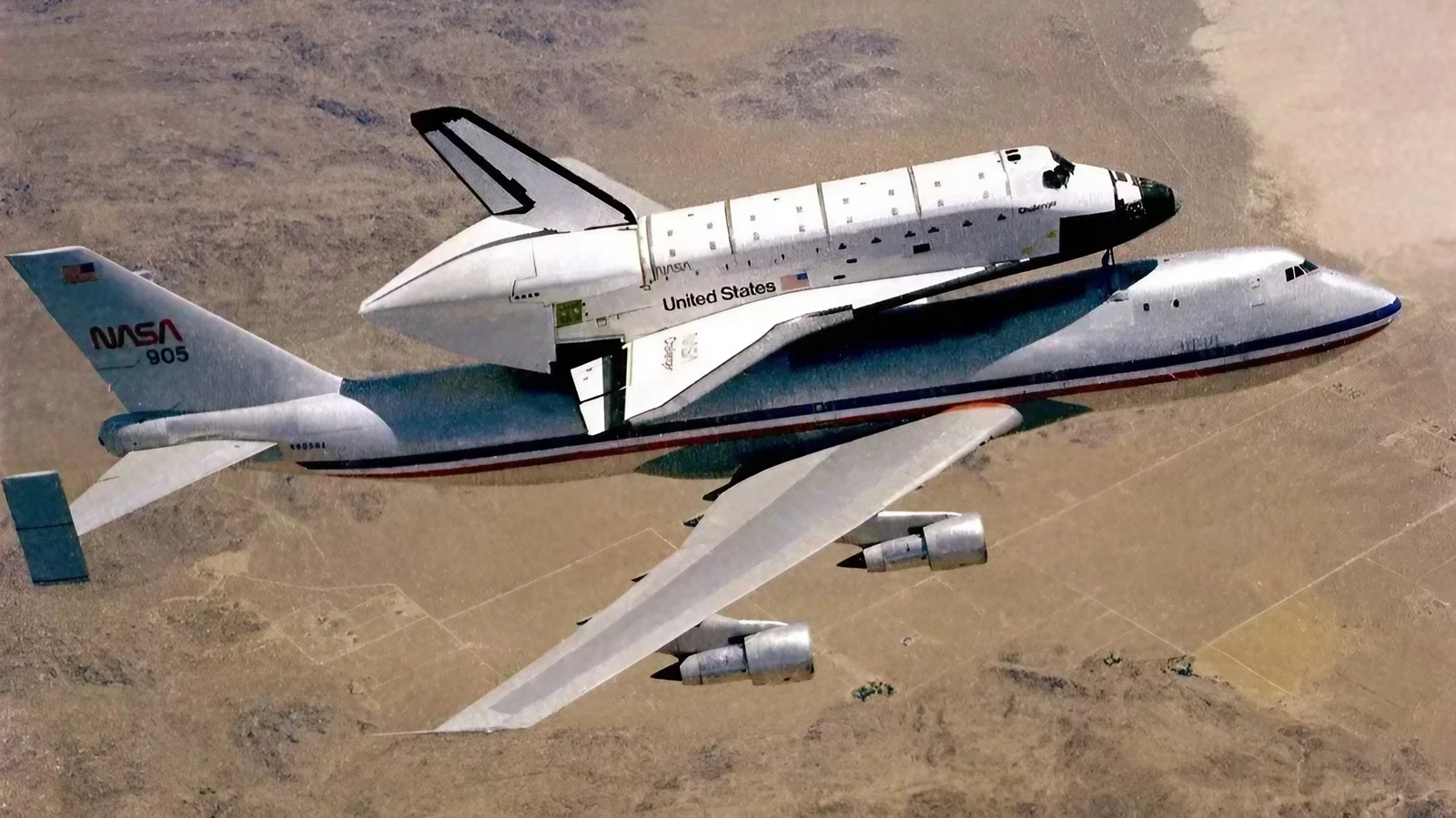
To fulfill its mission, NASA modified two Boeing 747s for the task. The first, designated NASA 905, was a 747-123 model acquired from American Airlines in 1974 for $15,601,192. A second aircraft, NASA 911, was obtained in 1989 from Japan Air Lines and was a 747-100SR-46 model. Both jets underwent extensive modifications, including the addition of three large struts to support the shuttle and significant internal structural reinforcements.
These modifications also included bolting two extra vertical stabilizers to the tail fins to enhance directional stability, as the shuttle’s unique aerodynamic profile posed challenges during flight. Engineers equipped the aircraft with instrumentation to monitor the orbiter’s electrical loads while in the air. Notably, for initial tests in 1977, NASA 905 featured an escape system that utilized pyrotechnics for crew safety.
Getting the shuttle onto the 747 was a complex operation that required specialized equipment known as Mate-Demate Devices. These structures lifted the orbiter high off the ground, allowing the 747 to be driven beneath for attachment.
During its operational years, NASA 905 carried out transport duties single-handedly for over a decade. In late 1990, NASA 911 joined the fleet, and the two jets shared the responsibility of ferrying shuttles for subsequent missions. When the shuttle program concluded, these modified 747s had one last assignment. NASA 905 completed three final ferry missions to deliver the orbiters to their new homes in museums. One of its most memorable flights involved delivering the shuttle Discovery to the Smithsonian’s National Air and Space Museum, which included a celebratory flyover of Washington D.C. at approximately 1,500 feet.
The NASA 911 was officially retired in February 2012 and is now on display at the Joe Davies Heritage Airpark. Later that same year, NASA 905 also retired and became part of an extensive exhibit at Space Center Houston.
The story of NASA’s decision to utilize the Boeing 747 for shuttle transport highlights the innovative engineering and collaboration that defined the space shuttle program, marking a significant chapter in aviation and space exploration history.