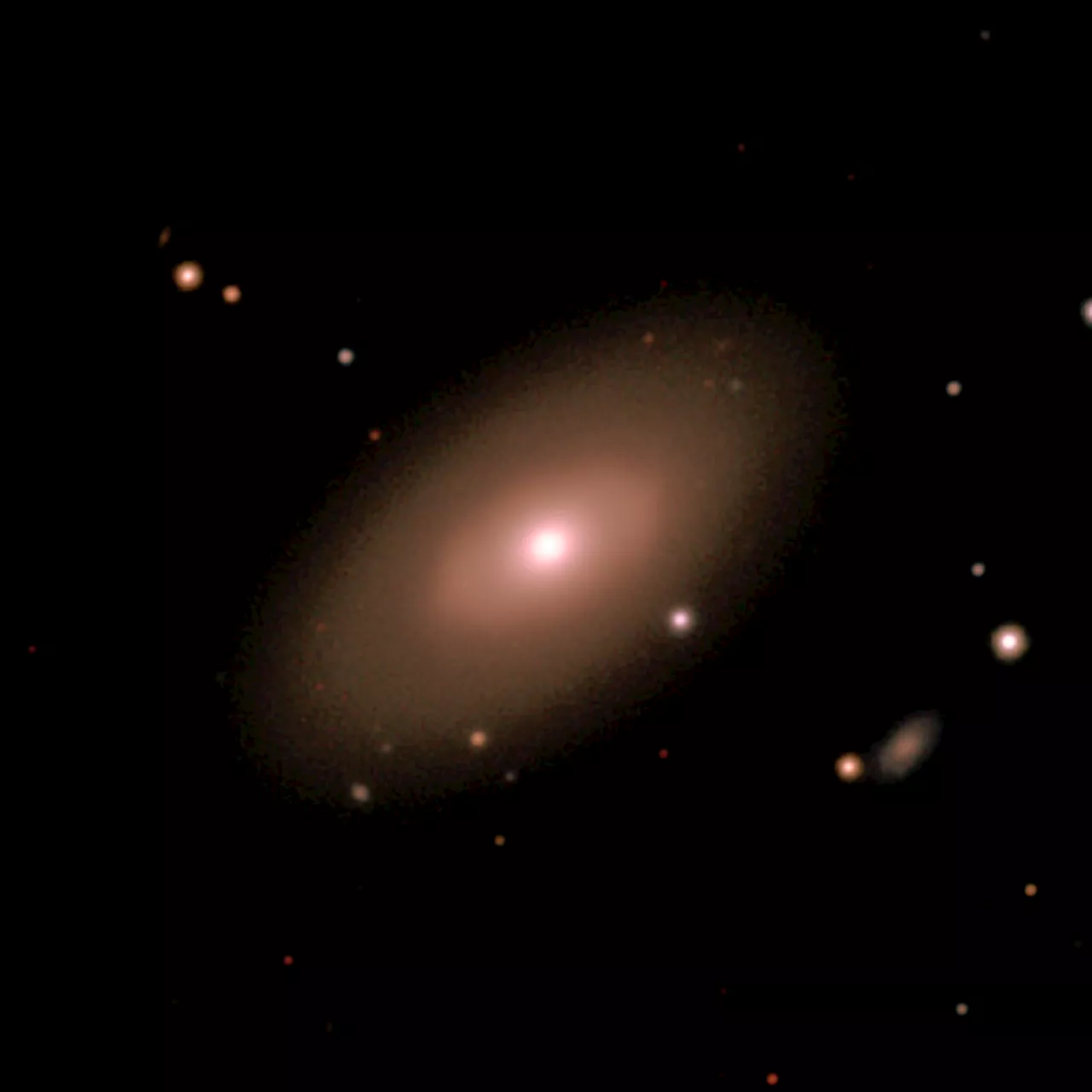
A recent study utilizing data from NASA’s Chandra X-ray Observatory has revealed that many smaller galaxies may not harbor supermassive black holes at their centers. This finding challenges the prevailing notion that nearly all galaxies contain these colossal cosmic entities. The research examined a sample of over 1,600 galaxies, including NGC 6278 and PGC 039620, to assess the presence of supermassive black holes.
Over the past twenty years, astronomers gathered data on various galaxies, ranging from those with masses exceeding ten times that of the Milky Way to dwarf galaxies with stellar masses significantly lower. The study’s results, published in The Astrophysical Journal, indicate a stark contrast in the presence of supermassive black holes between smaller and larger galaxies.
Fan Zou from the University of Michigan, who led the study, emphasized the importance of accurately counting black holes in smaller galaxies. “It’s more than just bookkeeping. Our study gives clues about how supermassive black holes are born. It also provides crucial hints about how often black hole signatures in dwarf galaxies can be found with new or future telescopes,” Zou stated.
The research team identified X-ray signatures, which indicate black hole presence, in many of the larger galaxies analyzed. Over 90% of these massive galaxies, including those comparable to the Milky Way, exhibited bright X-ray sources at their centers, a clear indication of supermassive black holes. In contrast, smaller galaxies, particularly those with masses less than three billion solar masses, typically lacked these unmistakable black hole signals.
Two potential explanations were considered for this discrepancy. The first suggests that a significantly lower proportion of smaller galaxies contain massive black holes. The second posits that the X-rays generated by matter falling into these black holes might be too faint for Chandra to detect.
Elena Gallo, another co-author from the University of Michigan, noted, “We think, based on our analysis of the Chandra data, that there really are fewer black holes in these smaller galaxies than in their larger counterparts.”
The researchers determined that the amount of gas falling onto a black hole is a crucial factor in its X-ray brightness. Since smaller black holes are expected to attract less gas than their larger counterparts, they would naturally produce fainter X-ray emissions that could go undetected. The findings confirmed this expectation, revealing an additional deficiency of X-ray sources in less massive galaxies that could not be solely explained by the reduced gas inflow.
The study concluded that the observed decline in X-ray detections among lower mass galaxies indicates a genuine decrease in the number of black holes in these galaxies. This insight could significantly enhance our understanding of how supermassive black holes form.
Two leading theories exist regarding their formation. One theory suggests that a massive gas cloud collapses directly into a black hole, starting with a mass thousands of times that of the Sun. The alternative theory posits that supermassive black holes evolve from smaller black holes formed when massive stars collapse.
Co-author Anil Seth from the University of Utah remarked, “The formation of big black holes is expected to be rarer, in the sense that it occurs preferentially in the most massive galaxies being formed, so that would explain why we don’t find black holes in all the smaller galaxies.”
This study lends support to the theory that giant black holes are born with substantial initial masses. If the alternative theory were accurate, the researchers would have anticipated a similar prevalence of black holes in smaller galaxies as in larger ones.
The implications of this research extend beyond the formation of black holes. A reduced number of black holes in dwarf galaxies may also influence the rates of black hole mergers resulting from collisions between these smaller galaxies. This could lead to fewer sources of gravitational waves detected in the future by facilities such as the Laser Interferometer Space Antenna.
NASA’s Marshall Space Flight Center in Huntsville, Alabama, oversees the Chandra program, while the Smithsonian Astrophysical Observatory manages science operations from Cambridge, Massachusetts, and flight operations from Burlington, Massachusetts.
This groundbreaking research not only reshapes our understanding of galaxy formation but also raises intriguing questions about the evolution of black holes in the cosmos.