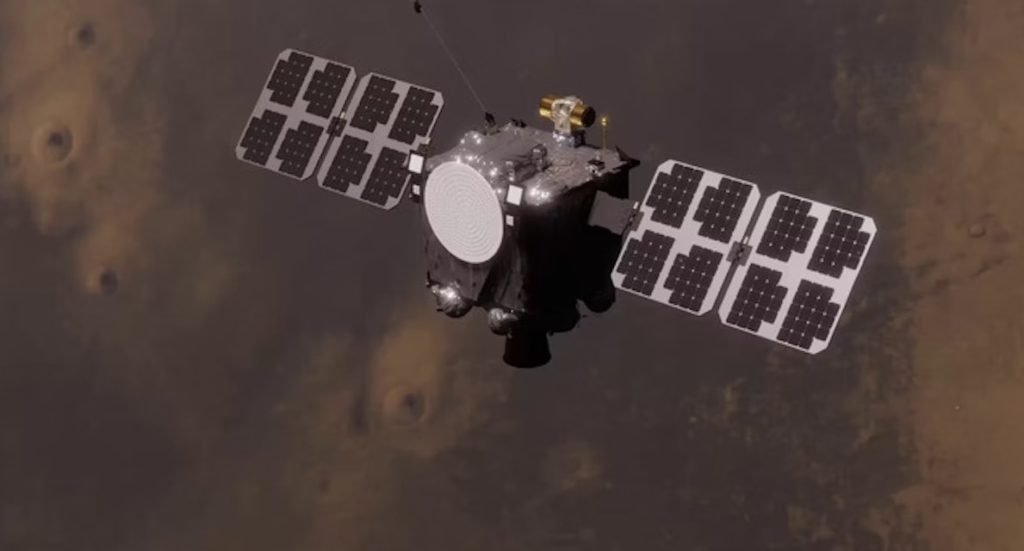
NASA has successfully launched its latest mission, ESCAPADE (Escape and Plasma Acceleration and Dynamics Explorers), sending two cost-effective orbiters to study Mars’ atmosphere. The mission, which took off on November 13, 2025, aboard a Blue Origin New Glenn rocket, represents a significant step in the agency’s efforts to enhance deep space exploration capabilities through innovative technology.
The ESCAPADE mission consists of two identical spacecraft, each comparable in size to a copy machine. This design allows for simultaneous measurements, improving the scientific results obtained from the mission. The dual spacecraft approach also serves as a safety net; if one orbiter encounters issues, the other can still collect valuable data. This redundancy enables researchers to build spacecraft more affordably, as it allows for greater acceptance of risk.
Exploring Mars’ Atmospheric History
Mars was once a vibrant planet with a much thicker atmosphere, conducive to liquid water flow, which created the channels and gullies seen today. Understanding how Mars lost its atmosphere is crucial to unraveling its past and determining its potential for supporting life. Currently, the Martian atmosphere is less than 1% of Earth’s, and the planet also lost its magnetic field, which would have protected this atmosphere.
ESCAPADE aims to measure remnants of this ancient magnetic field preserved in Martian rock, while also studying the flow and energy of the atmosphere and its interactions with solar wind—particles emitted by the sun. These findings will provide insights into how quickly Mars continues to lose its atmosphere today.
Cost-Effective Space Exploration
Space exploration is fraught with challenges, including extreme temperatures and radiation exposure. In this vacuum environment, spacecraft must endure temperatures that can swing dramatically depending on their exposure to sunlight. ESCAPADE addresses these hurdles with a modest budget of USD 80 million, a cost-effective figure for a mission targeting another planet.
Utilizing commercial technologies and lessons from previous missions, such as the GRAIL mission, which mapped the Moon’s gravity fields, ESCAPADE shows how affordable deep space missions can be. Led by Rob Lillis from UC Berkeley’s Space Sciences Laboratory, the collaboration between Rocket Lab, Advanced Space LLC, and Blue Origin signifies a new era of agile and cost-efficient space exploration.
ESCAPADE’s trajectory to Mars is also innovative. The mission will first travel to the L2 Lagrange point, a location where the gravitational forces of the Earth and Sun balance. After approximately one year of data collection on solar activity, the spacecraft will use Earth’s gravity to accelerate, arriving at Mars in about ten months. This new approach not only reduces fuel requirements but also provides greater flexibility for future missions.
With its pioneering methods and collaborative spirit, the ESCAPADE mission represents a significant leap forward in space exploration, offering a blueprint for future endeavors. For a new generation of scientists and engineers, this mission is an exciting opportunity to expand our understanding of Mars and its atmospheric history.