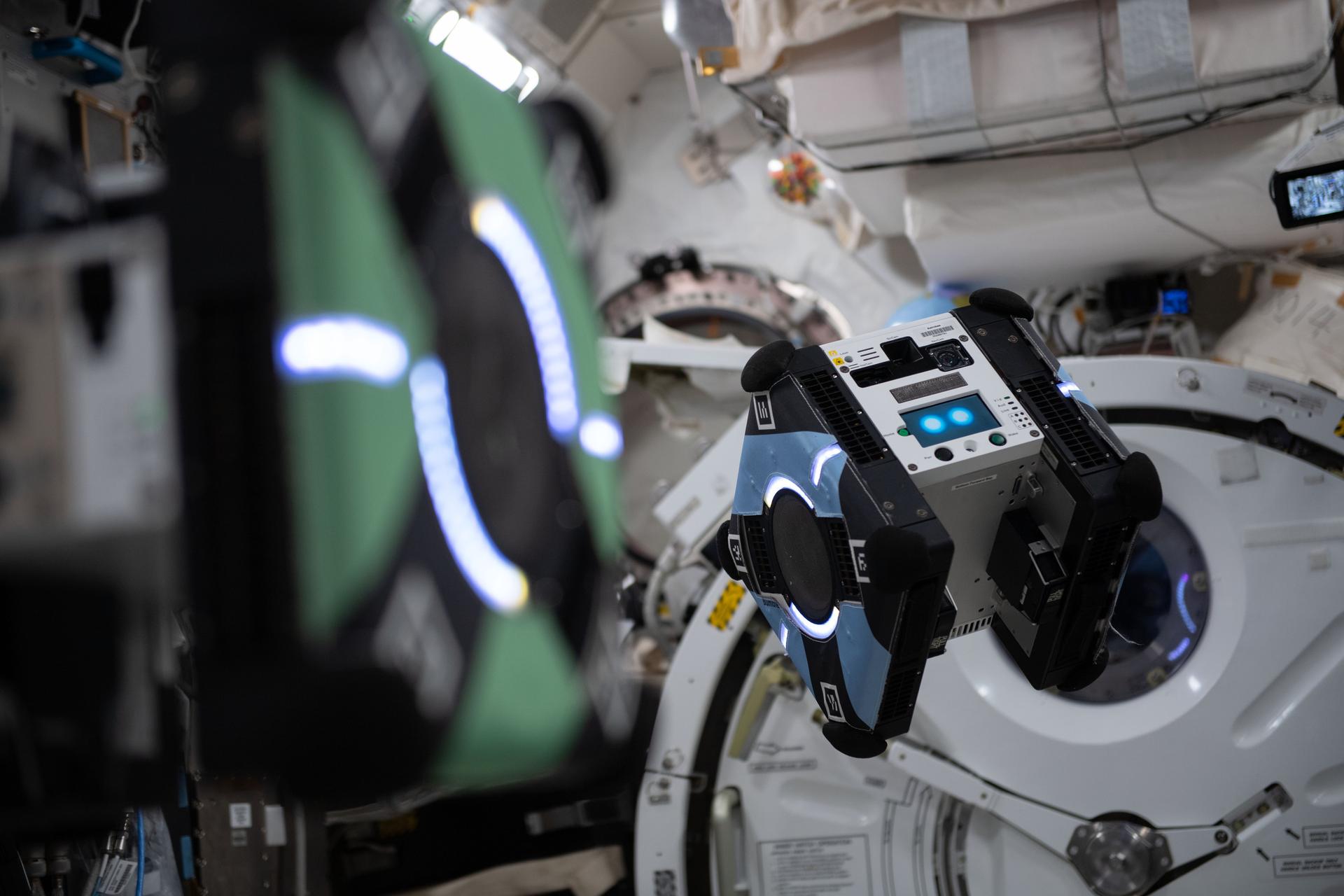
NASA has successfully addressed a critical challenge in space exploration by utilizing advanced digital twin technology to enhance the navigation capabilities of its robots. Traditional robots often struggle in microgravity environments, where tools designed for Earth can become ineffective. This issue is particularly evident aboard the International Space Station (ISS), where autonomous robots like Astrobee frequently lose their orientation. Thanks to a collaboration with Professor Pyojin Kim and his team from the Gwangju Institute of Science and Technology (GIST), NASA has developed an innovative algorithm that significantly reduces navigation errors.
The ISS, an expansive laboratory orbiting Earth, requires precise robotics to assist astronauts with routine tasks. These tasks are vital for maintaining the astronauts’ focus on critical research work. However, the Astrobee robot faced challenges in maintaining its bearings, often necessitating human intervention that disrupted tightly scheduled activities.
Professor Kim, an expert in navigation technology, explains that the absence of gravity creates unique difficulties for robots. “Terrestrial navigation algorithms are designed based on gravity, making them difficult to apply directly in space where reference points are missing,” he said. Traditional Inertial Measurement Units (IMUs) used by robots to sense tilt and orientation falter in the weightlessness of space, leading to cumulative errors and disorientation.
To combat this issue, the team employed Visual-Based Navigation (VBN), which leverages cameras to allow robots to deduce their orientation based on visual input. Initially, the team thought that existing Earth-based technologies could be easily adapted for use in the ISS. However, they quickly learned that the station’s chaotic environment—filled with cables, experimental setups, and personal items—rendered standard navigation systems ineffective.
The breakthrough came when the researchers created ‘digital twins,’ accurate 3D replicas of the ISS environment. By utilizing NASA’s blueprints, the team constructed a simplified virtual model, devoid of transient clutter. This digital twin serves as a reference point, enabling the robot to filter out visual noise from its cameras and better understand its surroundings. Professor Kim noted, “The digital twin serves as a ground truth, enabling the robot to filter out visual noise and recalibrate its position.”
With this innovative approach, the robot can interpret its environment through geometric features, creating a “visual compass” that provides a reliable directional reference. The system effectively employs the ‘Manhattan World Assumption,’ a principle that suggests man-made spaces typically consist of orthogonal surfaces. This characteristic aligns perfectly with the structure of the ISS, allowing for precise triangulation of the robot’s location.
As a result, the average rotational error of Astrobee has been reduced to just **1.43 degrees**, a significant improvement that ensures the robot can operate autonomously without human intervention. This advancement not only enhances the efficiency of space missions but also has potential applications on Earth, particularly for indoor drones and robots operating in GPS-denied environments.
Professor Kim is optimistic about the broader implications of this technology. “Orientation techniques based on these structural features are applicable not only to space stations but also to typical urban settings,” he stated, highlighting the versatility of the research.
Reflecting on the significance of space exploration, Professor Kim emphasized the economic and industrial value of ventures beyond Earth. With companies like SpaceX showcasing the potential for commercial opportunities in space, a wave of startups is emerging in fields ranging from lunar mining to satellite fabrication. NASA’s foundational technology and expertise remain crucial to support this burgeoning industry.
Professor Kim’s journey into space robotics began with an internship at NASA Ames Research Center during his doctoral studies. His work involved testing the Astrobee robot in simulated microgravity conditions. This experience solidified his understanding of the shared theoretical foundations between terrestrial drones and space robots, despite their operational differences.
The collaborative effort between Professor Kim and NASA has evolved over nearly a decade, with both parties benefiting from shared insights and expertise. He expressed gratitude for the mentorship and support he received during his early career, noting that “this research would have been impossible without the help of my mentor at the time, Dr. Brian Coltin, and my NASA colleagues.”
Professor Kim also shared his admiration for NASA’s approach to innovation. He observed that while failures in research are often hidden behind successful outcomes, the agency’s willingness to embrace setbacks fosters a culture of bold experimentation. This philosophy has enabled NASA to achieve groundbreaking advancements in technology and exploration.
In conclusion, the integration of digital twin technology into NASA’s robotic navigation systems exemplifies the agency’s commitment to pushing the boundaries of exploration. By improving the autonomy and reliability of robots like Astrobee, NASA not only enhances its operations in space but also lays the groundwork for future innovations that could benefit a variety of industries on Earth.