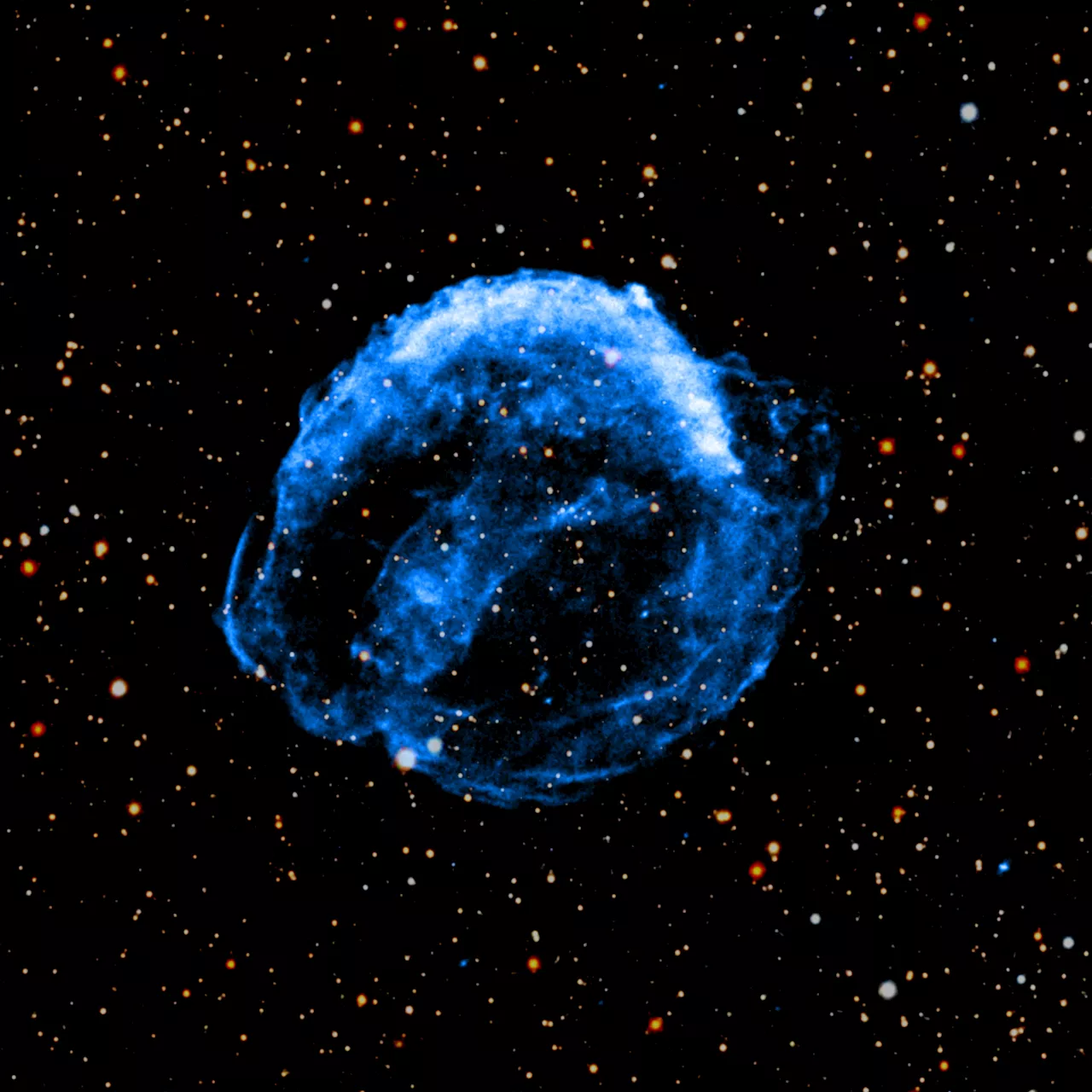
A captivating new video released by NASA’s Chandra X-ray Observatory showcases the evolution of Kepler’s Supernova Remnant over a span of more than two and a half decades. The video, which is the longest ever produced by Chandra, combines X-ray data collected in 2000, 2004, 2006, 2014, and projected observations from 2025 with optical imagery from Pan-STARRS.
Kepler’s Supernova Remnant, named after the German astronomer Johannes Kepler, was first detected in the night sky in 1604. It is the remnant of a white dwarf star that exploded after surpassing its critical mass, a phenomenon known as a Type Ia supernova. Such supernovae are crucial for astronomers because they serve as standard candles for measuring the expansion of the universe. The remnant is located approximately 17,000 light-years from Earth, enabling Chandra to produce detailed images of the debris and its changes over time.
Insights from Decades of Observations
The newly released video illustrates how the remnant has evolved, featuring a striking representation of the debris field that appears as a cloudy neon blue ring, with a diagonal cross stretching across the image. As the video plays, viewers can see the expanding remnant, which resembles a slowly inflating balloon. The speed of the expansion is remarkable; the fastest parts are moving at around 13.8 million miles per hour, while the slower sections are traveling at approximately 4 million miles per hour.
Jessye Gassel, a graduate student at George Mason University and the lead researcher on this project, emphasized the significance of these observations. “The plot of Kepler’s story is just now beginning to unfold,” she noted. “It’s remarkable that we can watch as these remains from this shattered star crash into material already thrown out into space.” Gassel presented the findings at the recent 247th meeting of the American Astronomical Society held in Phoenix.
The disparity in speeds across the remnant is attributed to the differing densities of gas that the debris encounters. The denser gas at the top of the image slows down the expansion, while the less dense area at the bottom allows for faster movement. This data provides scientists with vital information about the environment surrounding the supernova explosion.
Understanding Cosmic History
The research team also analyzed the widths of the rims forming the blast wave of the explosion. This outer edge, which is the first to interact with surrounding material, offers insights into both the explosion itself and the environment into which the star erupted. Brian Williams, a principal investigator at NASA’s Goddard Space Flight Center, remarked, “Supernova explosions and the elements they hurl into space are the lifeblood of new stars and planets. Understanding exactly how they behave is crucial to knowing our cosmic history.”
The Chandra program is managed by NASA’s Marshall Space Flight Center in Huntsville, Alabama, while the Smithsonian Astrophysical Observatory’s Chandra X-ray Center oversees scientific operations from Cambridge, Massachusetts, and flight operations from Burlington, Massachusetts.
This release includes a ten-second silent video featuring the expanding Kepler’s Supernova Remnant, which has been meticulously crafted using decades of X-ray data. The video effectively illustrates the dynamic nature of the remnant, offering a visual representation of how remnants evolve over time and providing a platform for further research into the life cycles of stars and their impact on the universe.