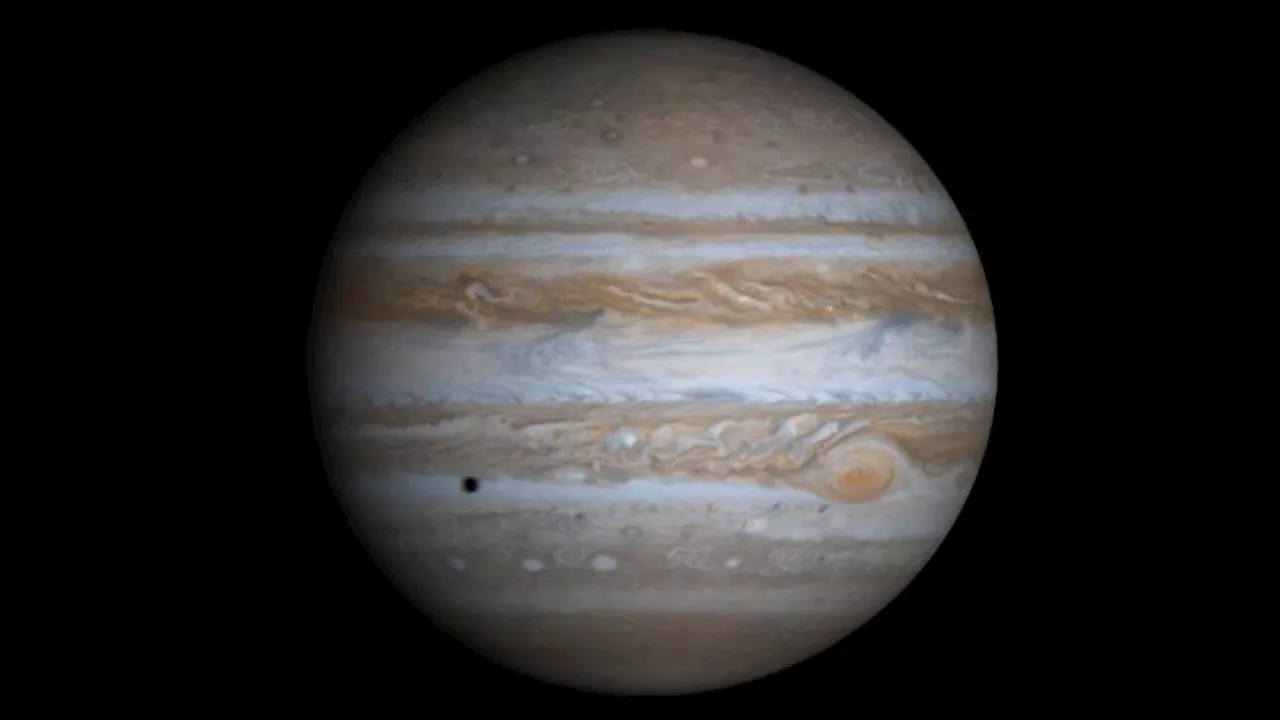
The latest findings from NASA’s Juno mission indicate that Jupiter, the largest planet in the solar system, is actually smaller and flatter than previously estimated. New measurements suggest that Jupiter’s radius at the equator is approximately 5 miles less than earlier calculations, while its polar radius is about 15 miles smaller. This significant refinement alters our understanding of the gas giant’s dimensions and shape.
New Measurements from Juno
The breakthrough in understanding Jupiter’s size comes from the advanced techniques employed by the Juno spacecraft, which has been orbiting the planet since 2016. One of the key methods used is called radio occultation. This technique involves measuring how radio signals change as they traverse Jupiter’s dense atmosphere. During several flybys, Juno transmitted radio waves back to Earth while moving behind Jupiter, allowing scientists to analyze variations in the signals that reveal details about temperature, pressure, and atmospheric structure.
These observations have led to a more accurate estimation of Jupiter’s dimensions. The equatorial radius is now calculated to be about 5 miles smaller than previously thought, while the polar radius is 15 miles less. The updated data confirms that Jupiter is more noticeably flattened than earlier models indicated, a result attributed to the planet’s rapid rotation, which completes a full spin in less than 10 hours.
Implications Beyond Jupiter
Accurately defining Jupiter’s shape is crucial for scientists as it enhances their understanding of its massive gravitational field, the movement of energy within its atmosphere, and the characteristics of the planet’s interior. According to NASA, these insights are not limited to Jupiter alone. Given that the planet is often used as a reference point for studying other gas giants and distant exoplanets, even minor adjustments in its known dimensions can have significant implications for interpreting observations of planets orbiting distant stars.
The Juno mission has provided a wealth of information beyond the new measurements of Jupiter. Since its arrival, the spacecraft has revealed critical insights into the planet’s magnetic field, atmospheric jets, and complex interior structure. The updated findings serve as a reminder that while Jupiter’s fundamental nature remains unchanged, our understanding of this massive gas giant continues to evolve.
“Jupiter itself hasn’t changed, but our understanding of it has,” said Skyler Ware, a freelance science journalist covering developments in planetary science.
As the scientific community digests these revelations, it is clear that textbooks will need to be updated to reflect the new understanding of Jupiter’s dimensions. This ongoing research not only reshapes our knowledge of the solar system’s largest planet but also enhances our ability to study other celestial bodies, making the Juno mission a pivotal part of contemporary planetary science.