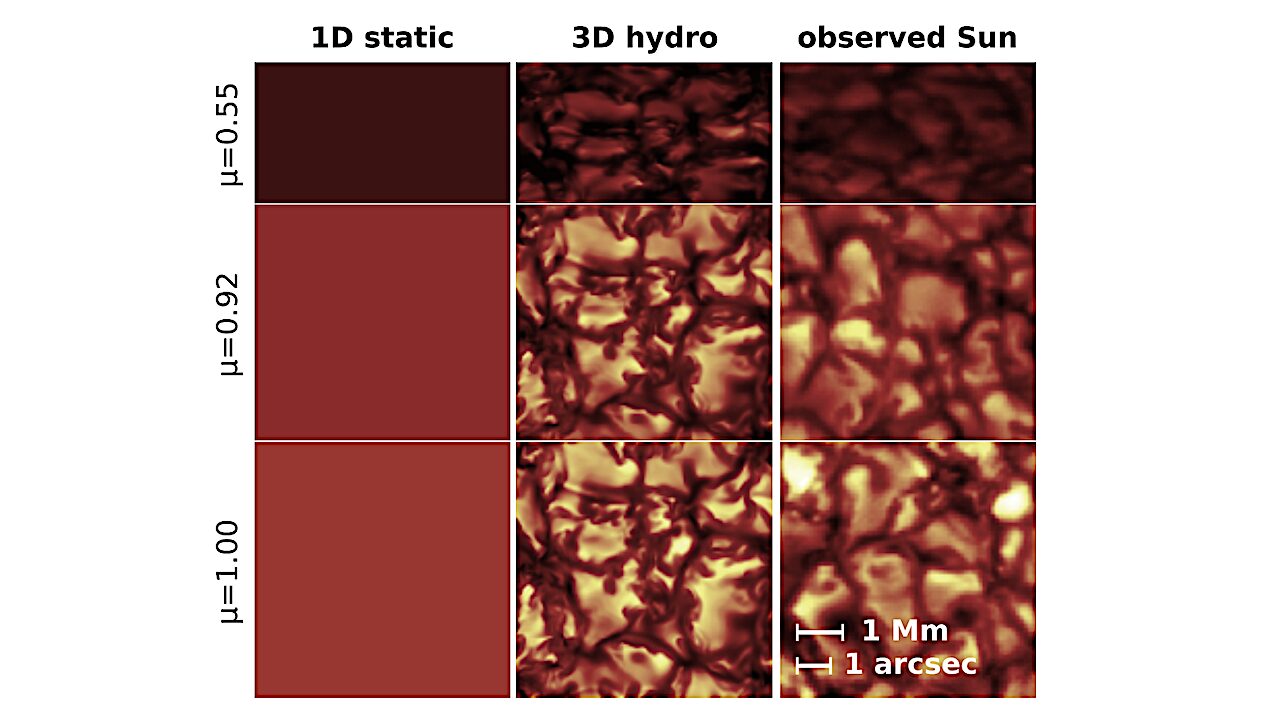
Research has unveiled significant findings regarding solar carbon abundance through advanced modeling techniques. A team of scientists, including Richard Hoppe and Maria Bergemann, has conducted a study using 3D Non-LTE (NLTE) models to analyze the spectral lines of the CH molecule in the solar spectrum. This marks a notable advancement in the diagnostics of carbon abundance in FGKM-type stars, which include a wide range of stellar classifications.
The CH molecule’s spectral lines serve as a critical diagnostic tool for understanding carbon levels, particularly in both metal-rich and metal-poor late-type stars. Previous analyses primarily relied on 1D LTE models, which have proven inadequate for accurately assessing the center-to-limb variation (CLV) of these lines. The new 3D NLTE modeling approach offers a more nuanced understanding of carbon abundance, addressing the limitations of earlier methodologies.
Methodological Advances in Carbon Abundance Analysis
The researchers employed updated NLTE models from a previous study by Popa et al. (2023) alongside various solar 3D radiation-hydrodynamics model atmospheres. By contrasting these models with new spatially-resolved optical solar spectra, they investigated the CLV of CH lines across the optical (4218 – 4356 Å) and infrared (33025 – 37944 Å) ranges.
Their findings indicate that both 1D LTE and 1D NLTE models fall short in accurately describing the line CLV, resulting in underestimations of solar carbon abundance. In contrast, the 3D NLTE modeling produced a carbon abundance estimate of A(C)=8.52±0.07 dex. This estimate aligns with recent measurements of neutrino fluxes collected by the Borexino experiment, indicating a robust methodology.
Implications for Astrophysical Research
The research underscores the importance of 3D NLTE modeling in deriving reliable solar abundances. While the analysis primarily focuses on the CH molecule, the authors anticipate that similar phenomena will apply to other molecules of astrophysical interest. The study has been accepted for publication in the MNRAS journal, contributing to the ongoing discourse in solar and stellar astrophysics.
This comprehensive approach not only enhances understanding of solar carbon levels but also exemplifies the potential of advanced modeling techniques in astrophysical research. The implications of these findings extend beyond solar studies, potentially informing future research on exoplanets and heliophysics.
The research, submitted on November 18, 2025, represents a significant step forward in the field, promising to refine our grasp of stellar chemical compositions and their evolutionary processes. As scientists continue to explore the cosmos, insights like these pave the way for deeper understanding of the universe’s fundamental elements.