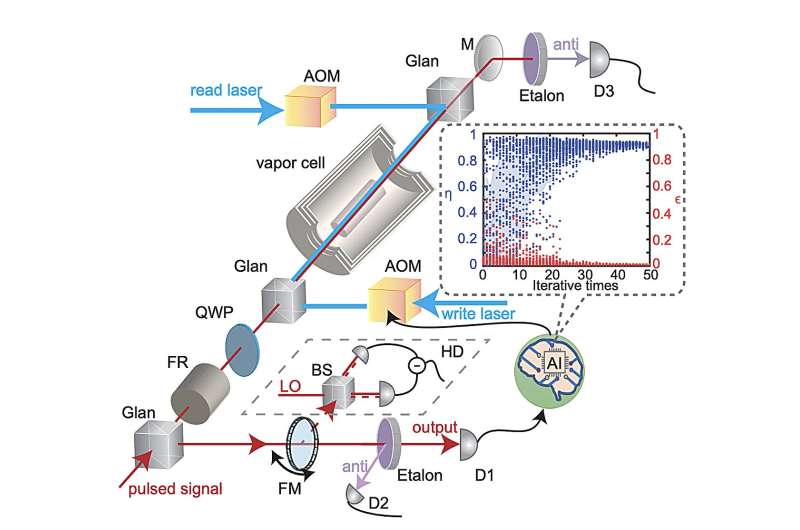
Recent advancements in quantum memory technology have achieved a significant milestone in efficiency and fidelity. A research team led by Professor Weiping Zhang from Shanghai Jiao Tong University and Professor Liqing Chen from East China Normal University successfully demonstrated a Raman quantum memory that operates with an efficiency of 94.6% and a fidelity of 98.91%. This breakthrough addresses long-standing challenges in the field of quantum information processing.
Quantum memories are essential for storing and retrieving quantum information, particularly in applications involving light and other physical carriers. For effective real-world usage, these devices must not only exhibit high efficiency but also maintain a high level of fidelity. Historically, many proposed quantum memory solutions produced unwanted noise, which compromised their performance and reliability.
The team’s innovative approach focuses on controlling atom-light interactions during the storage of quantum information. Their findings, published in the journal Physical Review Letters on November 15, 2025, reveal that the new technique produces minimal noise and allows for efficient quantum storage capabilities.
Innovative Techniques Enhance Quantum Memory
The researchers utilized a method known as a far-off resonant Raman scheme, which enhances the storage of optical signals at a rapid pace compared to other techniques. This method not only facilitates quantum storage but also provides a broad bandwidth advantage. The researchers introduced a precise technique for adaptively controlling quantum memory’s performance, guided by the mathematical principle of atom-light spatiotemporal mapping, also known as the Hankel transform.
According to Professor Zhang, “Quantum memory with near-unity efficiency and fidelity is indispensable for quantum information processing. Achieving such performance has long been a central challenge in the field.” This research not only uncovers the underlying physics of atom-light mapping in quantum memory but also paves the way for practical implementations that could achieve near-perfect quantum memory.
Breaking the Efficiency-Fidelity Trade-Off
The team’s application of this mathematical approach to a Raman quantum memory using warm rubidium-87 (87Rb) vapor marks a significant advancement in overcoming the “efficiency–fidelity trade-off” that has hindered the development of ideal quantum memories. This progress positions the research as a potential catalyst for the improvement of various quantum technologies, including long-distance quantum communication, quantum computing, and distributed quantum sensing systems.
Looking ahead, Zhang and his colleagues plan to explore new physics-driven principles and seek to integrate their memory technology into quantum repeaters for fault-tolerant quantum computing architectures and quantum networks.
This research represents a crucial step toward realizing more efficient quantum memories, which could significantly impact the future of quantum technologies. The team’s work underscores the importance of innovative techniques in pushing the boundaries of quantum information science and enhancing the practical applications of quantum memory systems.