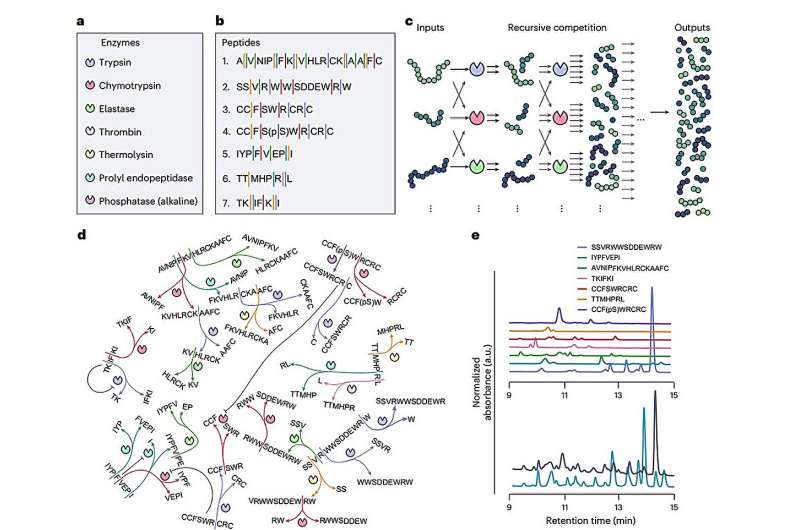
A team of researchers from the Netherlands and Australia has developed a groundbreaking chemical network that mimics decision-making capabilities based on external environmental factors. This innovative structure, known as a recursive enzymatic competition network (ERN), effectively allows peptides to compete for enzymes, creating a dynamic system capable of responding to changes in its surroundings.
The research, published in the journal Nature Chemistry on November 12, 2025, highlights how the ERN can classify both chemical and physical signals. It demonstrates an impressive ability to accurately sense temperature within a range of 25–55°C at approximately 1.3°C precision. This level of adaptability enables the network to make choices and adjust its responses, functioning similarly to biological neural systems.
Emulating Biological Decision-Making
Living organisms have long been recognized for their ability to process information from their environment. They effectively detect changes such as nutrient availability, temperature, acidity, and light levels. Traditionally, replicating this behavior within chemical systems was deemed a significant challenge, as it was assumed that the complexity of life could not be reduced to a few chemicals in a laboratory setting.
Researchers have identified that many natural chemical networks operate using repeatable patterns called network motifs. These motifs have been utilized in several studies to create synthetic reaction networks that aim to replicate biological information processing. However, previous attempts often fell short of capturing the full intricacies of living systems.
The latest research leverages the concept of recursive interactions, where the products of a chemical reaction are fed back into the system for further processing. This approach allows the ERN to produce a wide variety of chemical outcomes from a limited number of initial inputs.
Innovative Chemical Architecture
The team constructed the ERN using seven enzymes and seven peptides, each with multiple cleavage sites that contribute to a competitive reaction network. This configuration enables the peptides to continuously compete for the enzymes, leading to a dynamic and ever-changing mixture of chemical fragments.
As these fragments are produced, they are analyzed in real-time using a mass spectrometer. The resulting data is processed by a simple algorithm, referred to as a linear readout layer. This component decodes the patterns of fragments to arrive at a final decision or prediction, such as sensing temperature or detecting changes in periodicity related to light pulses.
The implications of this research are significant. The abilities demonstrated by the ERN suggest potential applications in developing advanced biosensors and materials that can adapt to various conditions. Such innovations hold promise for sectors like health care and technology, where dynamic sensing and data processing are essential.
In conclusion, the development of this recursive enzymatic competition network marks a notable advancement in the field of synthetic biology. By emulating the decision-making processes found in living organisms, researchers are opening new pathways for understanding and harnessing the capabilities of chemical systems. As this research progresses, it could lead to transformative applications that enhance our interaction with technology and the environment.