Researchers at the Helmholtz-Zentrum Dresden-Rossendorf (HZDR) have identified new oscillation states, termed Floquet states, within tiny magnetic vortices. Unlike previous experiments that relied on energy-intensive laser pulses for such discoveries, this research reveals that a modest excitation using magnetic waves is sufficient. This breakthrough could pave the way for innovative connections across electronics, spintronics, and quantum devices. The findings are detailed in the journal Science.
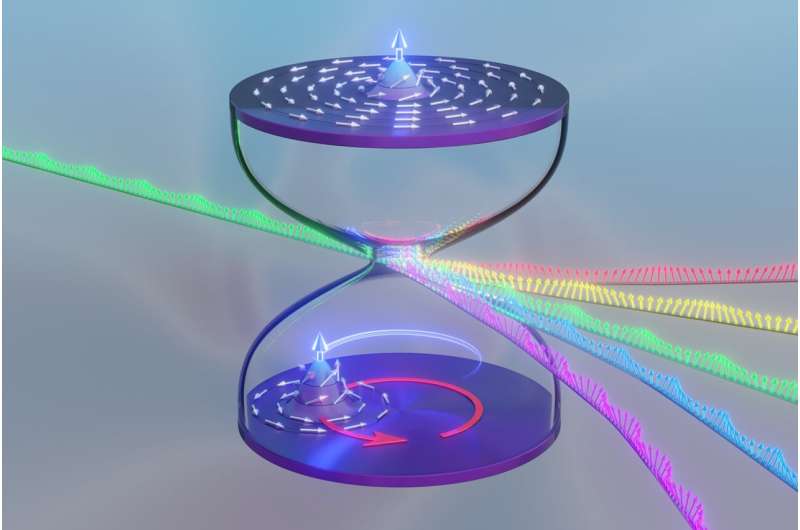
Magnetic vortices emerge in ultrathin disks made of magnetic materials, such as nickel–iron. Within these vortices, elementary magnetic moments arrange in circular formations. When disturbed, waves propagate through the system, creating a collective motion similar to a wave rippling through a stadium. These wave excitations are known as magnons. According to project leader Dr. Helmut Schultheiß from HZDR, “These magnons can transmit information through a magnet without the need for charge transport.” This characteristic makes them particularly appealing for advancements in next-generation computing technologies.
The research team initially focused on evaluating smaller magnetic disks, reducing their diameters from several micrometers to a few hundred nanometers. Their intent was to explore how varying sizes could be utilized in neuromorphic computing, a cutting-edge computational approach. However, during their analysis, they discovered that certain disks generated not just a single resonance line but an entire series of finely split lines, akin to a frequency comb.
Initially, the researchers considered this phenomenon a potential measurement artifact. “At first we assumed it was a measurement artifact or some kind of interference,” Schultheiß noted. “But when we repeated the experiment, the effect reappeared. That is when it became clear we were looking at something genuinely new.”
Understanding the Mechanism
The breakthrough can be attributed to the mathematical principles established by the French mathematician Gaston Floquet, who demonstrated in the late 19th century that systems subjected to periodic driving can develop new states. Traditionally, creating such Floquet states required strong laser pulses. However, the Dresden team’s research indicates that in magnetic vortices, Floquet states can emerge spontaneously if magnons are sufficiently excited. In this case, they transfer energy to the vortex core, causing it to execute a slight circular motion around its center. This subtle movement results in a rhythmic modulation of the magnetic state, evidenced by the appearance of a frequency comb.
“We were stunned that such a minute core motion was enough to transform the familiar magnon spectrum into a whole array of new states,” Schultheiß explained.
Implications for Future Technology
The efficiency of this discovery is striking. The process requires minimal energy input, with only microwatt-level inputs needed—significantly less than the power consumed by a smartphone in standby mode. This efficiency opens up exciting possibilities for synchronizing disparate systems, potentially linking ultrafast terahertz phenomena with conventional electronics or quantum components.
“We call it the universal adapter,” Schultheiß elaborated. “Just as a USB adapter allows devices with different connectors to work together, Floquet magnons could bridge frequencies that would otherwise remain incompatible.”
The research team intends to investigate whether this principle applies to other magnetic structures. The effect may also be instrumental in developing new computing architectures, facilitating connections between magnonic signals, electronic circuits, and quantum systems.
“On the one hand, our discovery opens new avenues for addressing fundamental questions in magnetism,” Schultheiß emphasized. “On the other hand, it could eventually serve as a valuable tool to interconnect the realms of electronics, spintronics, and quantum information technology.”
The measurements of the magnetic vortices were conducted using the Labmule program developed at HZDR, which aids in lab automation and data evaluation across various measuring devices. This research not only expands the understanding of magnetic phenomena but also suggests pathways for future technological advancements.