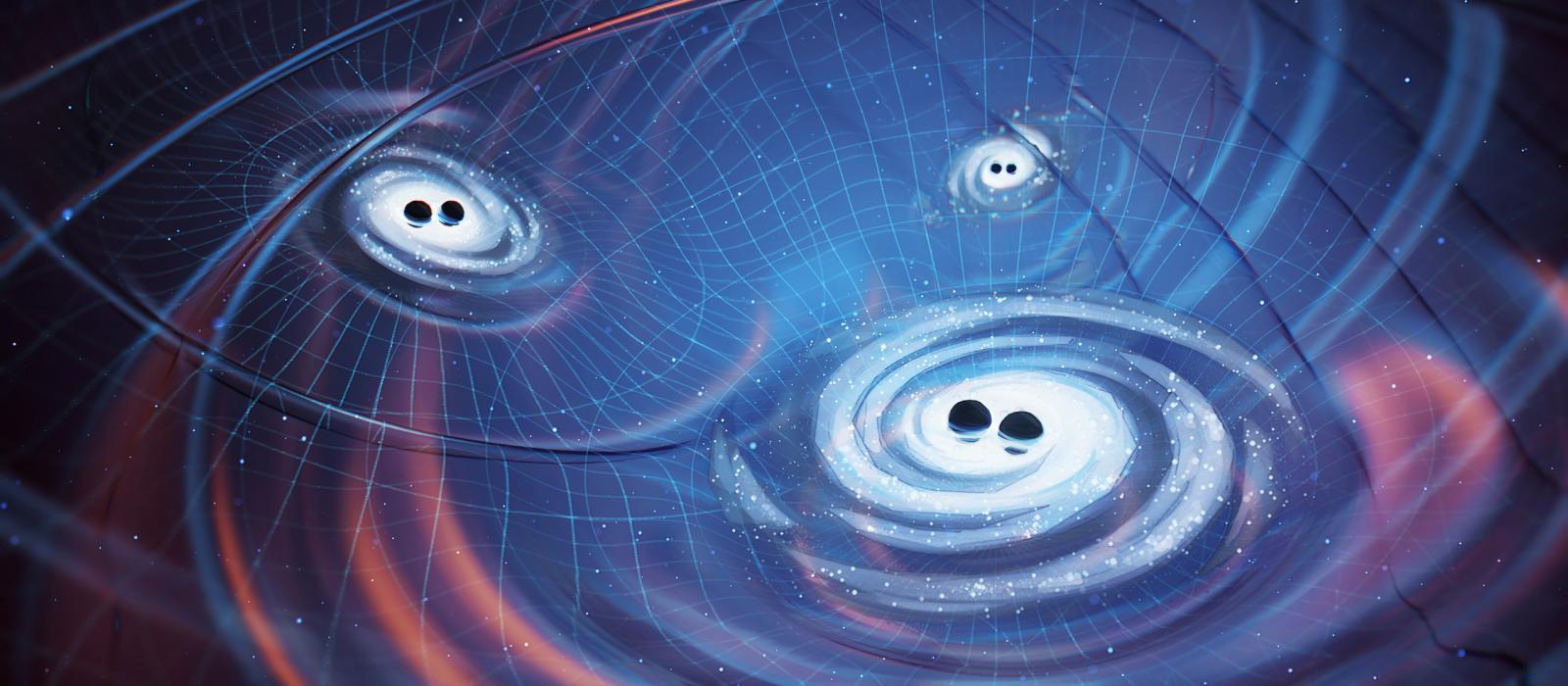
The University of Amsterdam has unveiled groundbreaking research suggesting that gravitational waves (GWs) could be used to explore the elusive nature of dark matter. This study, published in the journal Physical Review Letters, builds on the discovery of GWs in 2015, which confirmed a prediction of Einstein’s Theory of General Relativity. These waves arise from the merging of massive objects like black holes and neutron stars, producing detectable ripples in spacetime across vast distances.
Led by researchers Rodrigo Vicente, Theophanes K. Karydas, and Gianfranco Bertone at the university’s Institute of Physics and the Gravitation & Astroparticle Physics Amsterdam (GRAPPA), the study proposes a sophisticated model to investigate how dark matter interacts with gravitational waves generated by black hole mergers. Their findings suggest that, with the deployment of next-generation instruments, scientists may discern the presence of dark matter, which is believed to constitute about 65% of the Universe’s mass.
Advancements in Understanding Gravitational Waves
The research focuses on Extreme Mass-Ratio Inspirals (EMRIs), where black hole binaries or other compact objects spiral inward, eventually forming more massive black holes. Previous studies primarily used simplified models to describe how a black hole’s environment influences EMRIs. In contrast, the new research employs a fully relativistic framework, utilizing General Relativity for a more comprehensive understanding of these interactions.
One of the key aspects of this study is its examination of dense concentrations of dark matter that may develop around massive black holes. The team demonstrated that these dark matter “spikes” would leave distinct imprints on gravitational wave signals, potentially allowing astronomers to map the distribution of dark matter throughout the Universe.
Future Implications and Observational Advances
Looking ahead, the European Space Agency (ESA) plans to launch the Laser Interferometer Space Antenna (LISA) within the next decade. This pioneering space-based observatory will be dedicated to studying gravitational waves and is expected to detect over 10,000 gravitational wave signals during its mission. The insights gained from this research not only hint at what scientists may discover through LISA but also through other detectors like the Laser Interferometer Gravitational Wave Observatory (LIGO), the Virgo Collaboration, and the Kamioka Gravitational-wave Detector (KAGRA).
This work is part of a larger initiative to enhance our understanding of the Universe’s composition. The potential to use gravitational waves as a tool for mapping dark matter could ultimately lead to new revelations about its nature and composition. As researchers continue to explore this field, they are paving the way for significant advancements in cosmology and astrophysics, unraveling the mysteries that lie within the cosmos.