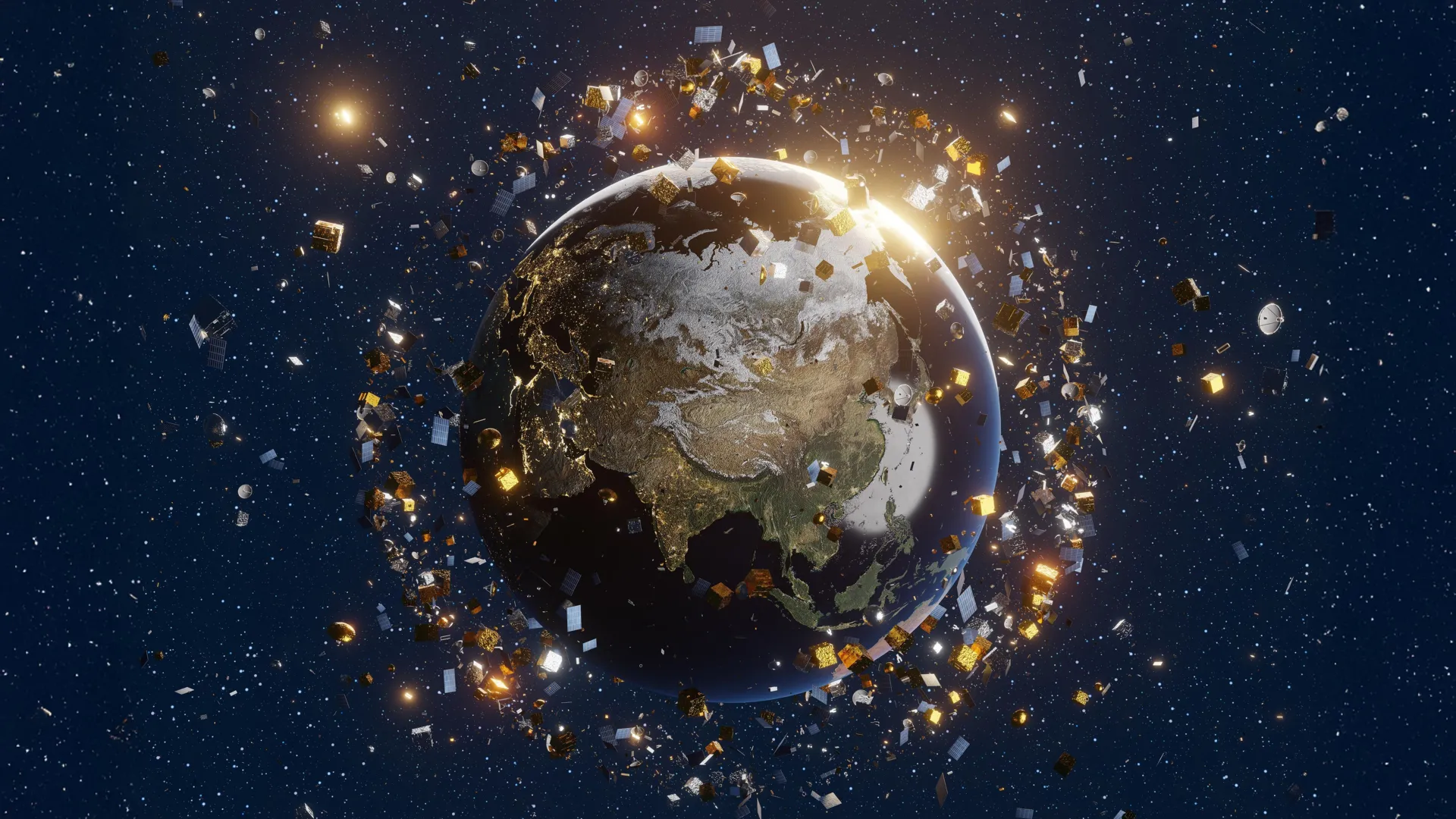
Low-Earth orbit (LEO) is on the brink of a potentially catastrophic crisis. According to recent research, a significant solar storm could lead to a disastrous chain reaction among satellites in LEO, resulting in a severe loss of humanity’s access to space. This alarming finding suggests that it may take as little as 2.8 days for a complete breakdown of satellite navigation and communication systems, following a major solar event.
The study, led by Sarah Thiele, a researcher at Princeton University and former PhD student at the University of British Columbia, emphasizes the precarious nature of today’s satellite networks. In a paper released on arXiv, Thiele and her colleagues illustrate that the increasing density of satellite constellations makes them vulnerable to a range of risks, particularly when faced with extreme solar activity.
Understanding the Risks of Solar Storms
Satellites in LEO are already engaged in a constant dance to avoid collisions; they come within 1 kilometer of each other every 22 seconds, with the Starlink network experiencing close approaches approximately every 11 minutes. To mitigate these risks, each Starlink satellite must execute an average of 41 course corrections annually. While this maneuvering may suggest that systems are functioning effectively, engineers warn that the real dangers often arise from rare and unpredictable events, known as “edge cases.”
Solar storms pose two primary threats to satellites. First, they cause atmospheric heating, which expands the upper atmosphere and increases drag on satellites. This added resistance forces satellites to expend more fuel to maintain their orbits, exacerbating the risk of collision. The Gannon Storm in May 2024 exemplified this threat, as over half of the satellites in LEO had to adjust their trajectories to avoid potential collisions.
The second, more severe, impact of solar storms is the disruption of navigation and communication systems. When satellites lose these capabilities, they cannot respond effectively to collision threats, leading to a heightened risk of accidents.
The CRASH Clock: A New Measure of Catastrophe
The researchers introduced a new metric called the Collision Realization and Significant Harm (CRASH) Clock, which calculates how quickly a catastrophic collision could occur under specific circumstances. Their findings indicate that by June 2025, a total loss of command over satellite avoidance maneuvers could lead to a significant collision within just 2.8 days. For context, similar conditions prior to the rise of mega constellations would have provided approximately 121 days before a collision might occur.
The situation becomes even more urgent when considering that a loss of control for merely 24 hours could result in a 30% chance of a major collision, potentially triggering a cascade of events leading to Kessler syndrome, where debris from collisions renders space inaccessible.
The unpredictability of solar storms adds another layer of complexity. Warning times can be as short as one to two days, leaving operators with limited options to protect their satellites. Once control is lost, the window for recovery may be only a few days before the entire satellite network collapses.
The Gannon Storm of 2024 was notable for its intensity, yet it was not the most powerful solar storm recorded. That title belongs to the Carrington Event of 1859, which could cause far more extensive disruption to satellite control if a similar event were to occur today.
The implications of this research highlight a pressing need for vigilance. As satellite mega constellations continue to grow, the risks they introduce to global communications and navigation cannot be overlooked. A future where humanity is cut off from space due to a single extreme solar storm is a scenario that demands serious consideration.
In conclusion, understanding the vulnerabilities of our interconnected satellite networks is crucial. While these systems provide significant technological advancements, they also present serious long-term risks that must be addressed. As the research indicates, a more informed approach to managing these dangers is now essential for safeguarding future access to space.