A team of scientists from the University of Chicago successfully launched the PUEO experiment on December 20, 2024, embarking on a 23-day mission to detect ultra high energy neutrinos from the edge of space. The experiment utilized a sophisticated instrument designed to monitor for these elusive particles, believed to originate from some of the universe’s most extreme events.
Neutrinos, which are subatomic particles, constantly bombard Earth from outer space. They interact so weakly with matter that they can pass through entire planets without detection. Among these, a unique subset of ultra high energy neutrinos carries more energy than particles generated in accelerators like the Large Hadron Collider. Detecting these neutrinos could provide insights into cosmic phenomena such as supermassive black holes and neutron star collisions.
To catch these elusive particles, the PUEO team devised an innovative strategy that leverages Antarctica’s vast ice sheet as a natural detector. When ultra high energy neutrinos collide with atoms in the ice, they produce radio waves that can be captured. PUEO was strategically placed at an altitude of 120,000 feet, allowing it to monitor the signals generated from these interactions.
The instrument itself is equipped with 96 highly sensitive radio antennas arranged in concentric circles, surrounding a central processing unit that filters incoming signals for potential neutrino detections. Powered by solar panels, PUEO boasts enhanced sensitivity compared to its predecessor, ANITA, due to advancements in electronic design.
Constructing PUEO involved a global collaboration over five years, with components sourced from various laboratories worldwide. Following extensive testing, including trials in Texas to simulate near-vacuum conditions, the instrument was disassembled for transport. It traveled by road to California, by ship to Christchurch, New Zealand, and finally by air to NASA’s balloon station in Antarctica.
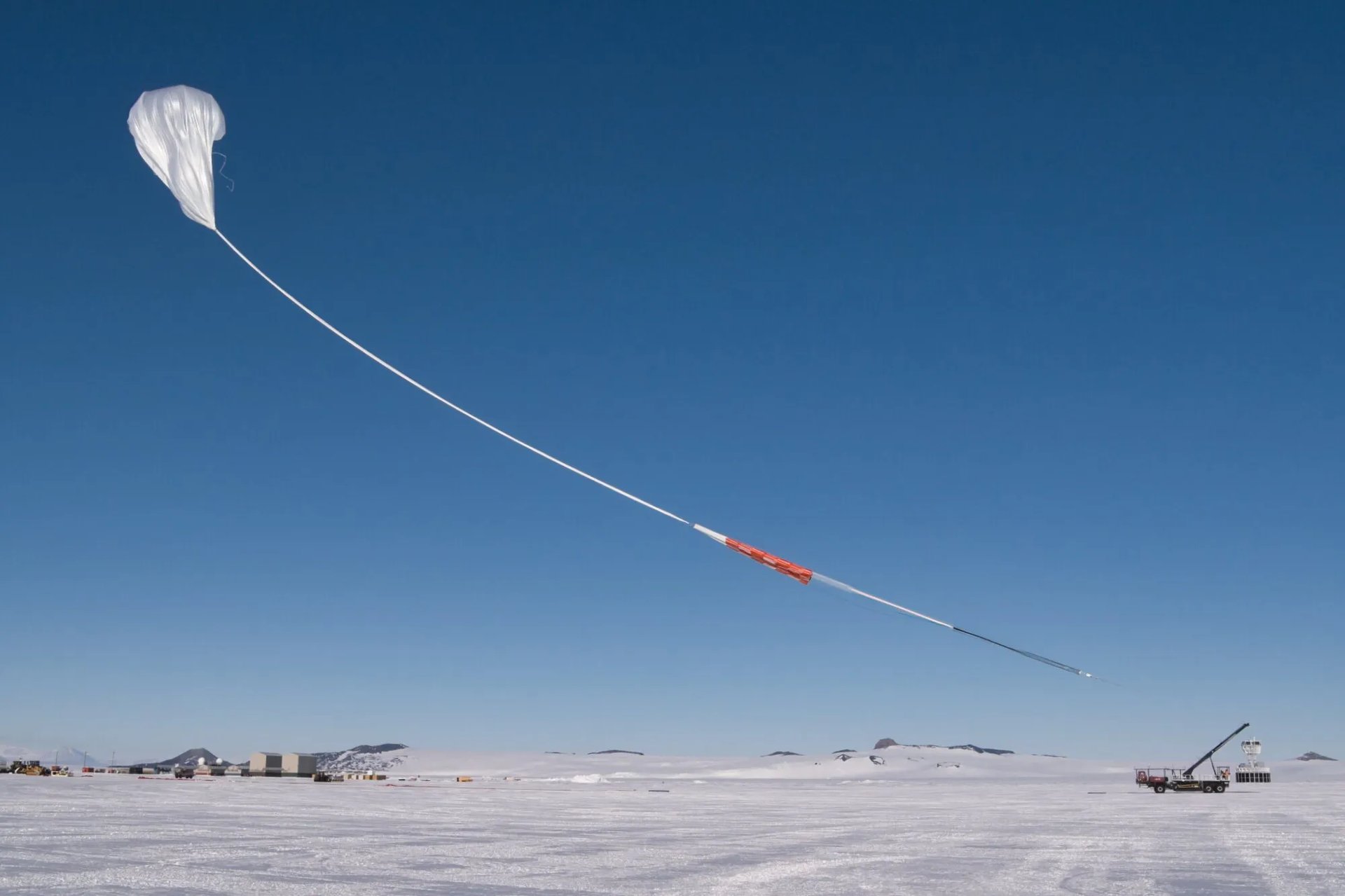
Upon arrival, scientists quickly reassembled PUEO in anticipation of a suitable launch window. Conditions needed to be clear and stable throughout the atmosphere for a successful launch. Fortunately, the team was able to launch PUEO on its first attempt early in the morning of December 20, 2024. The balloon ascended, lifting the 700-foot assembly into the stratosphere, where solar panels extended and antennas deployed to enhance sensitivity.
During its 23-day flight, the team monitored PUEO continuously, adjusting its operations as necessary. At one point, the payload began to rotate more slowly than expected, leading to overheating on one side. The scientists managed to maintain the instrument’s functionality despite these challenges.
As the mission concluded, the team decided to descend the payload due to changing weather conditions. NASA cut the balloon’s tether, deploying a parachute that allowed PUEO to drift gently back to Earth, landing approximately 200 miles north of the South Pole.
A retrieval crew was dispatched to recover the instrument, which contained a “black box” holding between 50 to 60 terabytes of data collected during the mission. Once transported back to Chicago, the analysis phase will begin, requiring about a month to process the data. First results are expected to emerge within a year, potentially revealing groundbreaking discoveries about the universe’s most energetic particles.
Whether the team will detect the highest energy particles ever recorded remains uncertain, but the mission promises valuable insights into the extreme environments of our universe.