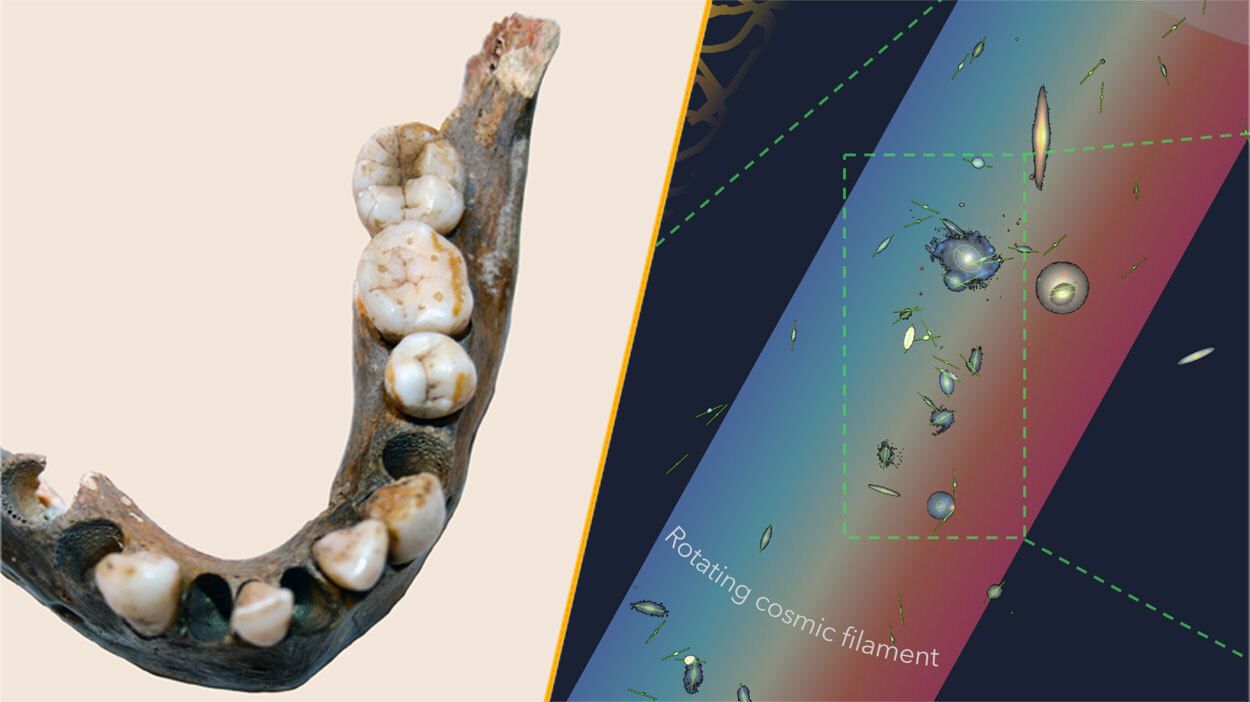
This week, significant discoveries in the fields of archaeology and astronomy have captivated researchers and the public alike. Among the highlights is the identification of a human population that remained genetically isolated for approximately 100,000 years, as well as the detection of the largest spinning structure in the universe, located 140 million light-years from Earth.
Ancient Human Isolation Revealed in Southern Africa
In southern Africa, a study has identified a human population whose genetic makeup diverged significantly from modern humans. Researchers analyzed skeletons dating back as far as 10,000 years found south of the Limpopo River. All remains from individuals who lived more than 1,400 years ago exhibited a unique genetic variation, suggesting they represent an “extreme end of human genetic variation,” according to the study published in a peer-reviewed journal.
The implications of this research may reshape our understanding of human history, particularly how different populations adapted and evolved in isolation. This investigation sheds light on the complexities of human genetics and population dynamics over millennia.
Cosmic Discoveries and Their Mysteries
On the cosmic front, astronomers have discovered the largest spinning structure in the known universe, a colossal filament associated with a chain of 14 galaxies. This massive structure, which is wider than the Milky Way, is rotating at an astonishing speed of 68 miles per second (approximately 110 kilometers per second). The discovery, made possible through advanced observational techniques, underscores the vastness and complexity of the universe.
In a related cosmic event, researchers are closely monitoring the interstellar comet 3I/ATLAS, which has recently shown signs of activity resembling ice volcanoes. Observations from the Joan Oró Telescope in northeastern Spain revealed that the comet heated up rapidly as it approached the sun, suggesting that ice on its surface is sublimating. This phenomenon places 3I/ATLAS in a category similar to other solar system objects, highlighting the dynamic nature of celestial bodies.
Archaeological Finds and Environmental Concerns
In a separate archaeological discovery, a pit filled with human skulls was unearthed near a 4,000-year-old city in China. What surprised researchers was the predominance of male skulls, diverging from the typical sacrificial patterns observed in similar archaeological contexts. This finding opens new avenues for understanding ancient cultural practices and societal structures.
Meanwhile, environmental scientists are assessing the unintended consequences of China’s ambitious Great Green Wall project, initiated decades ago to combat desertification. Although the tree-planting initiative has shown some success, a recent analysis indicates that it has altered rainfall and evaporation patterns, resulting in lower water levels in densely populated areas. These findings highlight the complexities of large-scale ecological interventions.
In a disconcerting note regarding climate records, a recent study suggests that the world’s hottest temperature, recorded in Death Valley in 1913, may have been influenced by human error. This finding raises questions about historical climate data and its accuracy.
As the week progresses, the scientific community continues to unveil new insights into both ancient history and the cosmos, revealing the intricate connections between past events and present-day phenomena. The discoveries not only advance our understanding of human evolution and celestial mechanics but also remind us of the ongoing challenges in environmental stewardship and historical analysis.
For those eager to stay updated on the latest scientific developments, engaging discussions and further findings on these topics are readily available across various platforms and publications.