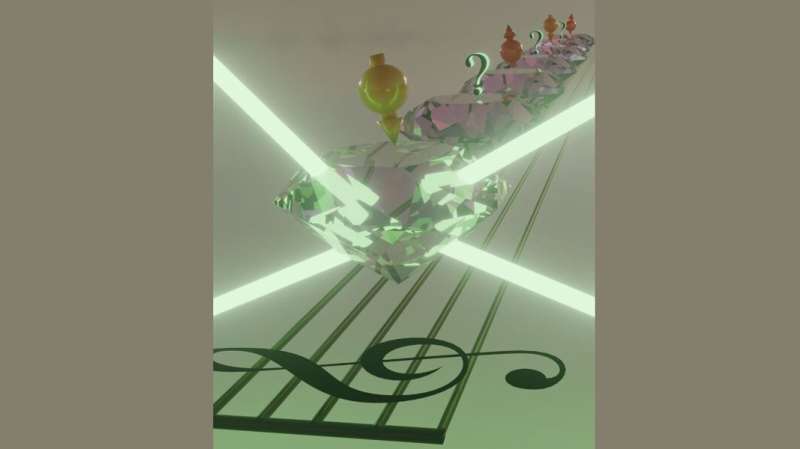
Researchers have achieved a groundbreaking milestone with the experimental observation of a time rondeau crystal, as detailed in a study published in Nature Physics on November 10, 2025. This new phase of matter demonstrates a unique combination of long-range temporal order and short-term disorder. The crystal’s name draws inspiration from the classical musical form known for its alternating themes, similar to how this crystal exhibits predictable behavior at specific intervals while also allowing for random fluctuations in between.
Leo Moon, a Ph.D. student in Applied Science and Technology at UC Berkeley and co-author of the study, explained the motivation behind the research. He noted that the coexistence of order and variation is common in both art and nature, with early artistic expressions often featuring repetitive patterns enhanced by intricate variations. This concept extends to natural examples, such as ice, where the ordered arrangement of oxygen atoms contrasts with the random positioning of hydrogen nuclei.
The time rondeau crystal represents a significant advancement in the study of temporal order. Previous research focused on deterministic patterns, like quasicrystals. This new discovery combines elements of stroboscopic order and controllable randomness, creating an innovative phase of matter that researchers are eager to explore further.
Creating the Rondeau Crystal
To create the time rondeau crystal, scientists utilized carbon-13 nuclear spins in diamond as a quantum simulator. The setup involved randomly positioned nuclear spins at room temperature, which interacted through long-range dipole-dipole couplings. The researchers employed a hyperpolarization technique that utilizes nitrogen-vacancy (NV) centers—defects in diamonds where nitrogen atoms are adjacent to empty lattice sites. By illuminating these NV centers with a laser, the team was able to polarize the spins significantly, boosting their signal nearly 1,000-fold above the thermal equilibrium value.
Following this initial step, the researchers applied complex microwave pulse sequences. These included protective “spin-locking” pulses combined with polarization-flipping pulses, generating the structured yet partially random driving pattern necessary for the rondeau order. The team developed a new control system that enabled the execution of over 720 different pulses in a single run, crucial for achieving the desired non-periodic drives that produce rondeau order.
Moon emphasized the advantages of using carbon-13 nuclear spins within the diamond lattice, noting its stability, strong interactions, and effective noise shielding. This combination makes diamond an ideal material for investigating exotic temporal phases.
The researchers named their structured sequences “random multipolar drives” or RMD. This approach allowed for systematic control over randomness, with periodic polarization flips occurring at regular intervals, showcasing the characteristic periodic behavior of time crystals. In contrast, between these intervals, the spins exhibited random fluctuations, creating a unique blend of order and disorder.
Observations and Future Implications
The team successfully maintained the rondeau order for more than 170 periods, lasting over four seconds. The dynamics were analyzed using the discrete Fourier transform, revealing a distinctive frequency spectrum. Unlike traditional time crystals, which display a sharp peak in their spectrum, the time rondeau crystal presented a smooth, continuous distribution, affirming the coexistence of temporal order and disorder.
“This discovery shows that order and disorder can coexist in a stable quantum system,” stated Moon. The researchers gained control over the system’s dynamics, allowing them to construct a comprehensive phase diagram of rondeau order stability. They found that adjusting the drive parameters could tune the lifetime of the order, and predicted heating rates followed expected quadratic and linear scaling laws.
Additionally, the team explored the capacity to encode information within the temporal disorder. By engineering specific drive pulse sequences, they successfully encoded more than 190 characters, including the paper’s title, into the dynamics of the nuclear spins. This innovative method illustrates how information can be stored in time rather than space by manipulating the direction of the spins at designated moments.
While immediate applications of this research are not yet apparent, Moon noted the potential implications of harnessing tunable disorder. This could lead to advancements in quantum sensors that are selectively sensitive to various frequency ranges. The work expands the understanding of non-equilibrium temporal order, paving the way for further investigations into time aperiodic crystals and time quasicrystals.
Looking ahead, the research team plans to explore alternative materials beyond diamond, such as pentacene-doped molecular crystals. These materials could enhance sensitivity due to the presence of hydrogen-1 nuclear spins. Moon expressed optimism about the potential for applying these findings in practical quantum sensors or memory devices that leverage stability in the temporal domain.
This research not only broadens the horizon of quantum physics but also emphasizes the intricate connections between order and disorder, echoing themes found in both art and nature. The ongoing exploration of these exotic states may yield significant breakthroughs in quantum technology and our understanding of time itself.