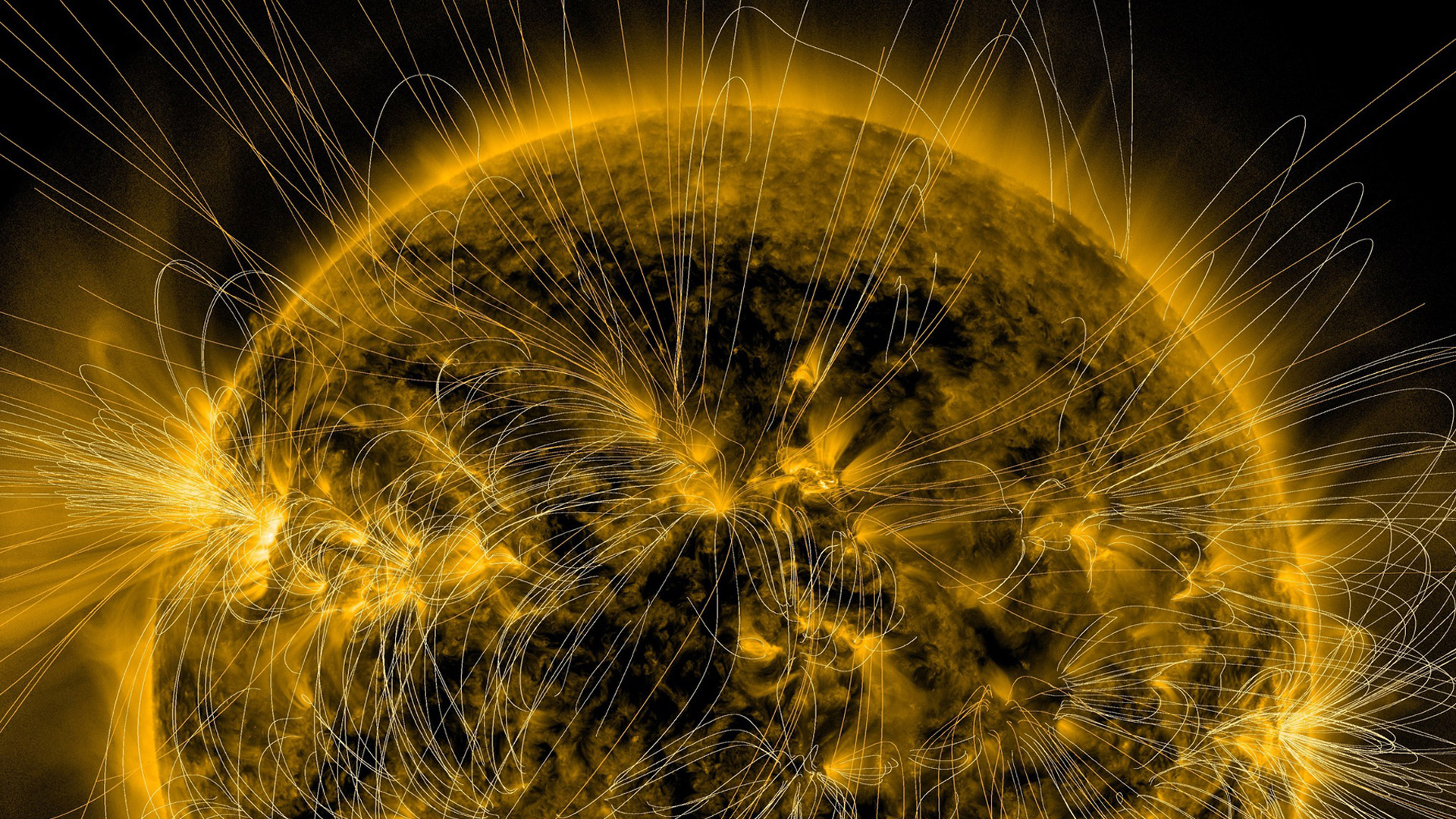
A groundbreaking study has revealed a three-dimensional map of the sun’s internal magnetic field for the first time, utilizing nearly three decades of satellite data. Researchers have reconstructed this magnetic interior, providing insights into the sun’s complex behavior, which influences conditions on Earth.
The sun exhibits a cyclical pattern of activity, characterized by the appearance of dark spots and massive energy bursts. These phenomena are linked to the sun’s magnetic field, generated by the movement of electrically charged gas deep within. Until now, scientists have been unable to directly measure these magnetic fields, relying instead on surface observations and theoretical models.
To tackle this challenge, researchers leveraged data from the Solar Dynamics Observatory, gathering daily magnetic field maps from 1996 to 2025. By integrating this information into a sophisticated three-dimensional computer model, they simulated the sun’s internal magnetic dynamics. As new surface data was introduced, the model adapted itself, allowing scientists to infer the hidden magnetic structures responsible for observable patterns.
The study authors highlighted the significance of their approach: “Observationally, none of the techniques—including helioseismology—are able to provide an estimation of the interior magnetic field. We reconstruct, for the first time, the dynamics of the interior large-scale magnetic fields.”
To validate their model, researchers tested its ability to reconstruct past solar cycles, which last approximately 11 years. The model successfully mirrored key features of these cycles, including the familiar shift of sunspots from higher latitudes towards the solar equator, a crucial indicator of solar activity progression. The authors stated, “Our data-driven model successfully reproduces key observational features, such as the surface butterfly diagram, accurate polar field evolution, and axial dipole moment.”
The researchers further assessed the model’s predictive capabilities. By ceasing the addition of new data at certain intervals, they allowed the model to project future solar activity independently. Remarkably, it accurately forecasted major solar features up to three or four years ahead of time.
They noted, “A strong correlation between the simulated toroidal field and sunspot number establishes our 3D magnetogram-driven model as a robust predictive model of the solar cycle.” This advancement shifts the paradigm in solar research, enabling scientists to monitor the sun’s interior indirectly and continuously.
Improved forecasts of solar activity could significantly benefit various sectors, including satellite operations and power grid management, by providing early warnings of geomagnetic disturbances. However, the model’s effectiveness relies on the continuation of long-term satellite missions, which are essential for ongoing data collection.
Looking ahead, the team aims to refine their techniques, aspiring to not only predict the timing of heightened solar activity but also to identify specific locations on the sun’s surface where active regions are likely to form. The study has been published in The Astrophysical Journal Letters, marking a pivotal moment in solar science and enhancing our understanding of this vital celestial body.