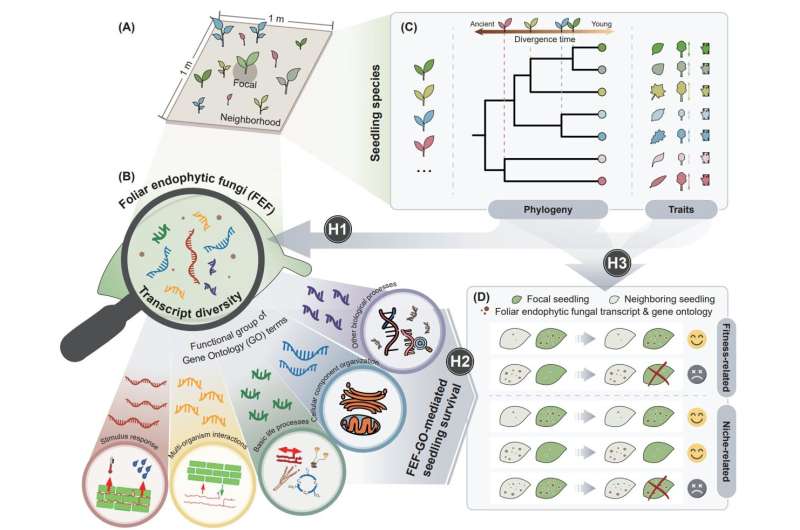
A recent study published in Ecology Letters has shed light on the significant yet often overlooked role of plant-associated microorganisms, specifically foliar endophytic fungi (FEF), in the survival of seedlings in subtropical forests. Conducted by a team led by Prof. Liang Yu from the Chinese Academy of Sciences, the research highlights the complex interactions between these fungi and woody plant species.
The study utilized transcriptomic data from seedlings of 103 woody species, along with species-level functional traits and extensive long-term monitoring data from the Gutianshan forest plot. By examining the molecular functions of FEF and their impact on host plants, the researchers established a direct connection between microbial genomics and the modern coexistence theory.
The findings revealed that the diversity of FEF transcripts is influenced by both the phylogenetic divergence time of the host and the maximum height of trees in the ecosystem. The researchers discovered that FEF significantly enhances seedling survival through processes related to fitness and niche differentiation. In total, the study identified 118 Gene Ontology (GO) terms that are crucial for seedling survival.
Understanding Fungal Contributions to Ecosystem Health
Further analysis uncovered a dual regulatory mechanism that underpins these relationships. GO terms with a strong dependence on host phylogeny contribute to seedling survival by promoting fitness differences among various organisms. Conversely, GO terms that rely on host traits support survival through niche differentiation linked to fundamental life processes.
These results carry profound implications for forest biodiversity conservation and management. Historically, ecological theories have concentrated on plant-to-plant interactions. This research, however, emphasizes the essential role of microbial symbionts, such as FEF, in maintaining species coexistence and the overall functioning of ecosystems.
The study posits that overlooking the contributions of microorganisms in ecological restoration and conservation strategies could jeopardize long-term biodiversity outcomes. As the global community faces increasing challenges related to biodiversity loss, understanding these intricate relationships becomes vital for effective environmental management.
For more detailed insights, refer to the work of Baocai Han et al in the article titled “Molecular Functional Diversity of Foliar Endophytic Fungi and Their Contributions to Seedling Survival in a Subtropical Forest,” published in Ecology Letters in 2025. The DOI for the study is 10.1111/ele.70290.