A new satellite, named CarbSAR, is set to launch on March 10, 2024, from the United Kingdom, marking a significant step in monitoring Earth’s surface with advanced radar technology. Developed by Oxford Space Systems (OSS) in collaboration with Surrey Satellite Technology Limited (SSTL), CarbSAR showcases an innovative mesh radar antenna produced using a technique traditionally associated with textiles manufacturing.
The unique antenna, crafted on a standard knitting machine, incorporates ultra-fine tungsten wire coated in gold, allowing it to capture high-resolution images of the Earth. According to Amool Raina, production lead at OSS, “It’s a very standard, off-the-shelf industrial machine used for knitting jumpers. All we’ve done is add some bells and whistles to let it stitch our special yarns.”
Innovative Design for Efficient Launch
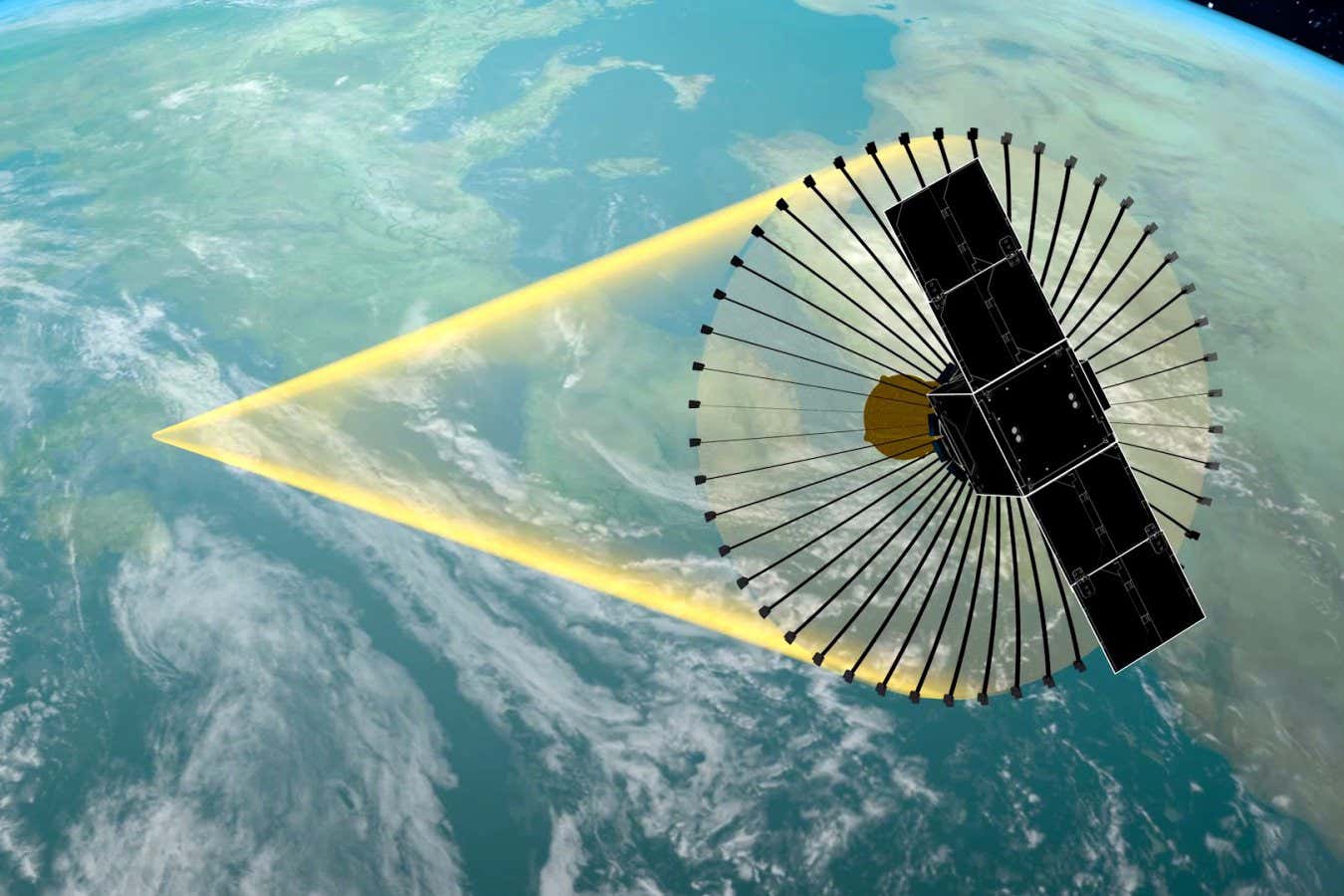
CarbSAR features a design that facilitates efficient deployment and operation. The antenna is made from mesh sheets that can be cut into specific shapes and sewn together, forming a parabolic dish when deployed. This structure is supported by 48 carbon-fibre ribs that collapse to a compact diameter of just 75 cm for launch. Once in orbit, the ribs will extend and the mesh will unfurl into its operational configuration.
“This wrapped-rib design dramatically reduces the volume the 140-kilogram CarbSAR satellite would otherwise occupy at the top of its rocket,” explains Sean Sutcliffe, OSS’s chief executive. The satellite is expected to achieve an imaging resolution sufficient to distinguish objects as small as 50 cm, which is adequate for military applications, including identifying tanks and aircraft.
The launch of CarbSAR is part of a broader initiative to bolster the UK’s capabilities in space radar technology. Despite having pioneered advancements in this area during the 1990s, the UK has faced stiff competition from international players in recent years. The satellite will serve as a prototype for a future network of radar satellites intended for the UK Ministry of Defence under the constellation named Oberon, part of the ISTARI programme.
Strategic Importance and Future Prospects
The launch of CarbSAR is expected to draw significant interest from various stakeholders, including foreign governments keen on leveraging radar technology. Andrew Cawthorne, SSTL’s managing director, stated, “We’re getting a lot of interest from foreign governments about the possibility of providing a radar concept for them. Obviously, the first thing we need to do is deploy this antenna and prove we can take an image.”
The satellite’s operational capabilities will also be closely monitored by the UK Space Command, which is overseen by the Royal Air Force. Major General Paul Tedman, commander of UK Space Command, emphasized the significance of this launch, stating, “CarbSAR is a testament to the innovation and collaboration of one of the UK’s most forward-thinking space companies.” He expressed excitement about the potential integration of CarbSAR’s advanced instruments into the Oberon constellation and the wider ISTARI satellite programme.
As the launch date approaches, the anticipation surrounding CarbSAR reflects a renewed commitment to advancing the UK’s position in the global space radar market, potentially reshaping the landscape of Earth observation technologies.